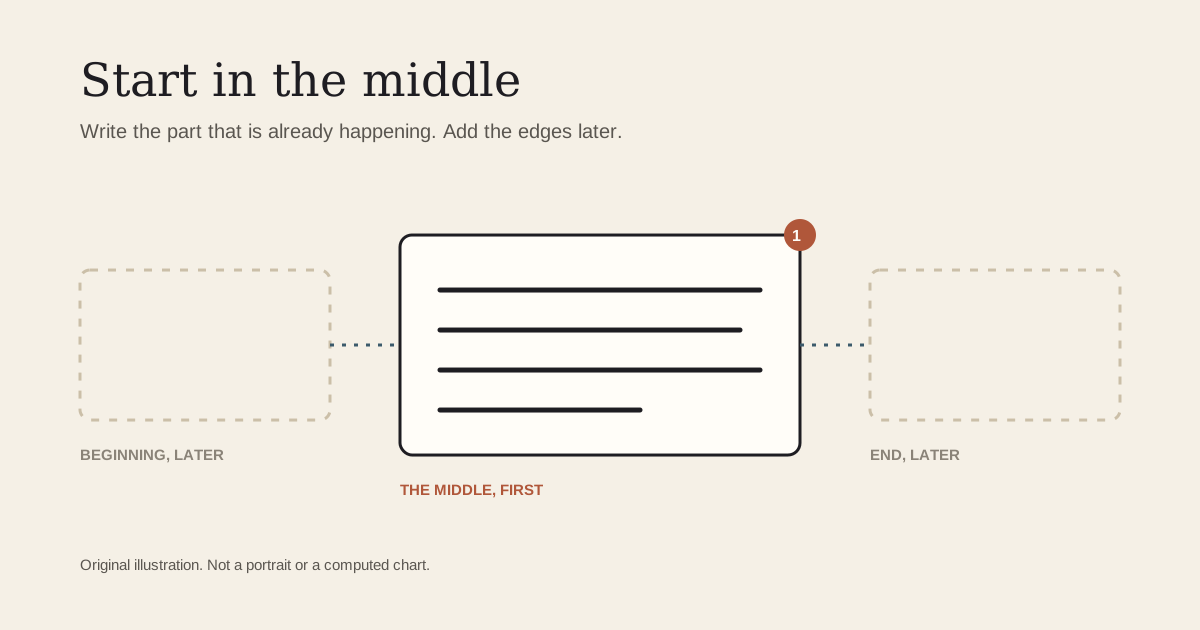
Most unfinished things stay unfinished at the beginning. The blank first line, the opening paragraph rewritten six times, the email that never gets past "Hi". Anne Carson has a different suggestion, and she gave it three times in one short phone call.
The news, and the advice
On October 8, 2026, the Swedish Academy announced that Anne Carson had won the Nobel Prize in Literature. The citation praises "her bold and inventive oeuvre that, in playful dialogue with the classical tradition, has created new forms for contemporary literature".
Shortly after the announcement, she spoke by phone with Jenny Rydén of the Nobel Prize in a first-reactions interview. In our paraphrase:
- The morning was ordinary. She was at home in Reykjavík with tea and the London Review of Books, and she said she usually turns the phone off when it rings.
- She called her work "inadvertent", always trying to do something else, and named Homer as her source of inspiration.
- Where should a new reader begin? She mentioned that many people start with Autobiography of Red, then said: start in the middle.
- How does she start a book? The same answer. She called it the only rule she has, and declined to define it: whatever you take that to mean.
- Advice for aspiring writers? The same again.
That's the whole instruction. It's short enough to try today, which is what the exercise below does. The interpretation of it in that exercise is ours, not hers.
What her chart can and can't show
The Nobel Prize gives her birth as 21 June 1950, in Toronto. We don't have a verified birth time, so we calculated her chart at 25 times across that local day and kept only what held throughout. That rules out the Rising sign, the houses and anything that depends on the clock.
Her Sun sign is genuinely uncertain. She was born on the day of the June solstice. The Sun sat in the last degree of Gemini for most of the day and crossed into Cancer at about 7:35 in the evening, Toronto time. Without a birth time, we can't say which side of that line she was born on, so we don't give her a Sun sign. Charts drawn with a default time before the crossing, such as noon, show late Gemini; that's a convention for a missing time, not knowledge of when she was born.
The Moon stayed in Virgo all day, but moved about 13°, so we don't use its degree. What follows is a symbolic lens beside her own words. It doesn't explain her writing, her prize or her choices.
Mercury in Gemini, square Saturn in Virgo
Mercury sits at about 9° to 11° Gemini all day and squares Saturn at about 14° Virgo, within about 3° to 5°.
Mercury in Gemini is traditionally read as quick, playful, curious about words and their double meanings. Saturn in Virgo is read as exacting craft: precision, revision, patience with detail. A square is a working tension rather than a harmony. Together they make an image of play held to a strict standard. That's a reasonable echo of a citation that pairs "playful" with "the classical tradition", not evidence for it.
Mercury trine Neptune
Mercury also trines Neptune at about 14.5° Libra, within about 4° to 5.5° all day. Neptune is read as imagination and blurred edges; a trine as an easy channel. As a symbol, it suits writing that lets forms bleed into each other.
Mars in Libra, square Uranus
Mars at about 4° Libra squares Uranus at about 5° Cancer, within about 1° all day, one of the closest contacts in the day's chart. Mars is action; Uranus is the sudden and unconventional. Astrologers often read this square as a restless urge to break a pattern instead of following it. Starting in the middle is, among other things, a small refusal of the usual order.
Our exercise: write the middle first
This is a Lunara exercise, not Anne Carson's method, and it isn't a writing course. It takes ten minutes.
- Pick something unfinished. A story, a hard email, a speech, a letter you keep putting off.
- Find the middle. Not the opening, not the conclusion: the moment where something is already happening. In a story, the scene where two people are already arguing. In an email, the one sentence you actually need to say.
- Write only that part. Set a timer for ten minutes. Don't explain how you got there.
- Stop, and leave the edges for later. When you come back, ask two questions: what does a reader need to know before this? What happens after?
Example. Unfinished: a message to a friend you've drifted from. The middle: "I miss the Thursday walks." Write that first. The beginning ("It's been a while") and the end ("Are you free next week?") are easy once the middle exists.
Afterwards, notice which was easier: writing the middle, or deciding what goes around it.
Explore further
To look at your own placements, calculate your free birth chart. Add a birth time and city only if you know them. Her profile is at Anne Carson's natal chart.
If you'd like a written interpretation of your own chart afterwards, an automated personal birth chart reading is optional and paid. It's a fixed written report, not a conversation with an astrologer. You can read the sample reading first, and the current price for your country is shown before you decide.
Text written with AI assistance. Prize details are from NobelPrize.org's facts page; interview remarks are paraphrased, with a few short quoted phrases, from the Nobel Prize's first-reactions interview by Jenny Rydén, October 2026. Lunara is not affiliated with Anne Carson or the Nobel Prize. Chart positions come from a date-only calculation Lunara saved for this article. The illustration is original.