The face of Dracula was a Libra.
Bela Lugosi was born on October 20, 1882, in Lugos, then in Hungary and now Lugoj in Romania. Four decades later he became the Count, first on Broadway and then in Universal's 1931 film, and the image stuck: for most people, this is still what a vampire looks and sounds like.
So it's tempting to look for a "Dracula chart". There isn't one. Dracula is a character, written by Bram Stoker and reshaped by many hands. This piece reads the chart of the actor, and it ends somewhere more useful than a zodiac verdict on a villain.
What we can read
Wikidata gives October 20, 1882, in Lugos, and Wikipedia gives the same date. We haven't verified a birth time, so there's no rising sign and no houses. The 1882 local clock is uncertain too, so we checked a window wide enough to cover any local time from one to two hours ahead of Greenwich, hour by hour. Everything below held across that whole window. The Moon didn't: it moved from Capricorn into Aquarius, so we leave it out.
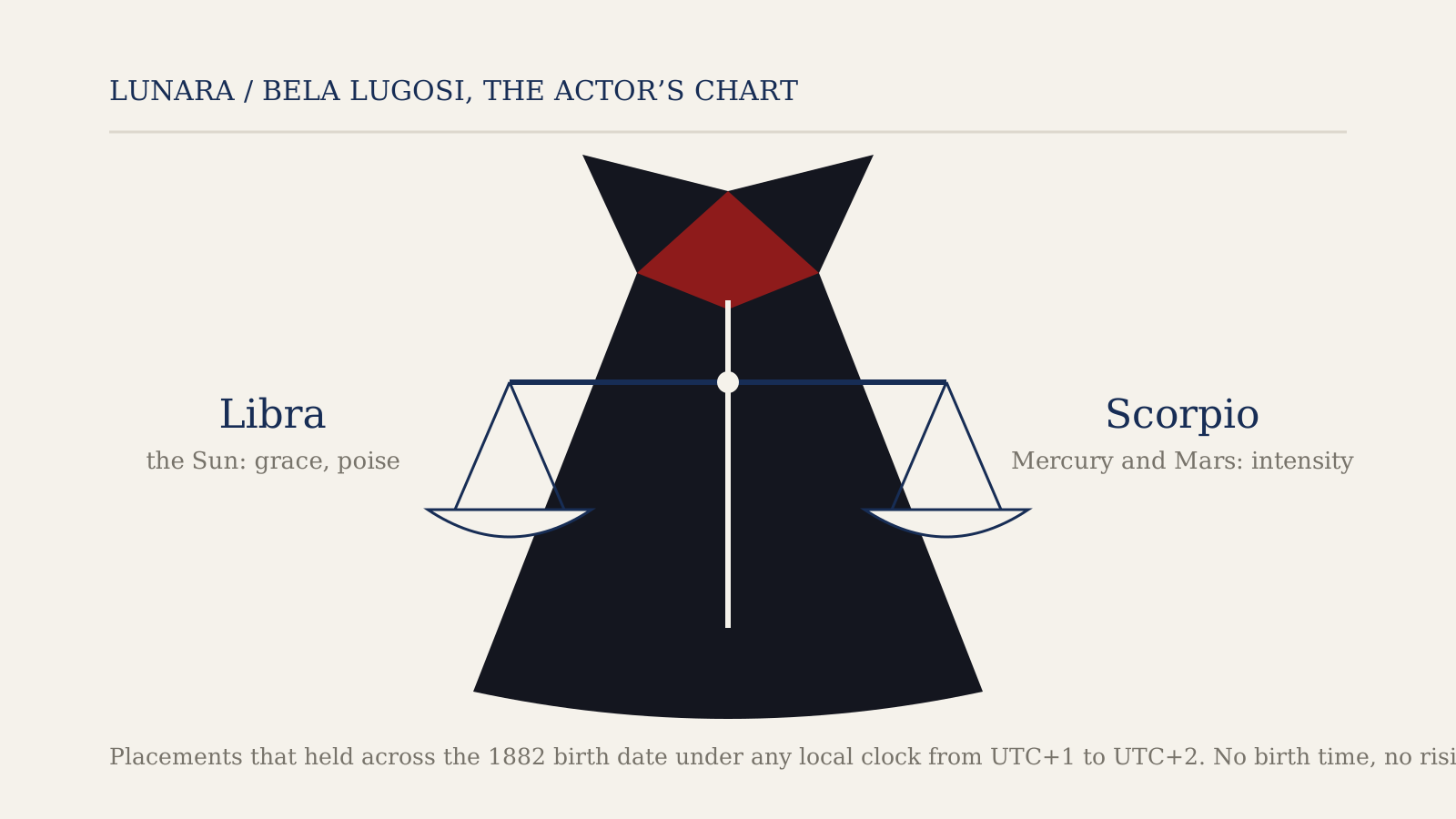
A Libra Sun: the charm in the role
Lugosi's Sun is in late Libra, about three days short of Scorpio. Libra is traditionally read as grace, manners and a feel for how a gesture lands with other people: the sign of the host and the diplomat.
That's the surprising part of the hook. The BFI's appreciation of the 1931 film credits Lugosi's old-world charm with turning the Count into a courtly, seductive figure, rather than simply a monster. Read symbolically, a Libra Sun is a fitting lens for that: menace delivered through poise. It's a lens, not an explanation; plenty of Libras never charm anyone in a cape.
Mercury and Mars in Scorpio: the darker register
The Scorpio side of the chart is in Mercury and Mars, both in the sign that follows Libra. Scorpio is read as intensity and focus, an interest in what lies under the surface. Mercury was retrograde across the whole date, read as a mind that turns things over before it speaks, and it makes a trine to Jupiter in Cancer, read as words that carry feeling and weight.
So the chart holds two registers side by side: Libra's courtesy at the core, Scorpio's intensity in how it speaks and acts. That pairing reads well beside a performance built on a polite surface and something watchful underneath.
Venus in Sagittarius, and a generation in Taurus
Venus is in Sagittarius, read as a taste for distance, travel and stories from elsewhere: the chart's most outward-looking note.
Saturn, Neptune and Pluto were all in Taurus. Those are slow planets, shared by everyone born in the same months, so they describe a generation rather than a person. It's worth saying because it's easy to read too much into them.
The craft behind the Count
What the chart can't do is account for the work. The public record is clearer:
- The stage first. Lugosi began acting on the Hungarian stage in 1902 and appeared in more than 170 productions there, according to Wikipedia.
- Hundreds of rehearsals in public. The BFI notes that he refined his Dracula over more than 350 Broadway performances before the film.
- A team, not a sign. The film's look came from director Tod Browning, cinematographer Karl Freund's dramatic light and shadow, and Charles D. Hall's gothic sets, according to the BFI.
That's the useful lesson for Halloween: a villain is built, line by line and night by night, by an actor and a crew. Playing a monster says nothing about an actor's character, and no zodiac sign makes anyone sinister. The chart offers symbols to read beside the work; the work came from practice.
Compare your chart with Lugosi's
The most direct way to use this chart is to set yours beside it. Bela Lugosi's profile shows the same placements and compares them with your own chart: if you have a planet in Libra or Scorpio, you'll see how it meets his Sun, Mercury or Mars.
If you'd rather start with your own chart, you can calculate it for free; leave the time blank if you don't know it. To see what a full written interpretation looks like, read the complete fictional sample reading. If you want one for your own chart, there's an optional, paid personal birth chart reading. It's an automated symbolic interpretation, not a consultation or a prediction, and the price for your country is shown before you decide.
Sources: birth date and place from Wikidata, the actor's entry, and the date also from Wikipedia, which is also the source for his Hungarian stage career. Film and stage context from the BFI's “Why I love… Bela Lugosi's Dracula”, John Oliver, October 25, 2013, paraphrased. No stills, posters or likenesses are used. Positions were calculated with Lunara's central Swiss Ephemeris path, sampled hourly across a window covering the 1882 birth date under any local clock from UTC+1 to UTC+2. Written with AI assistance and edited by Lunara; the illustration is original.