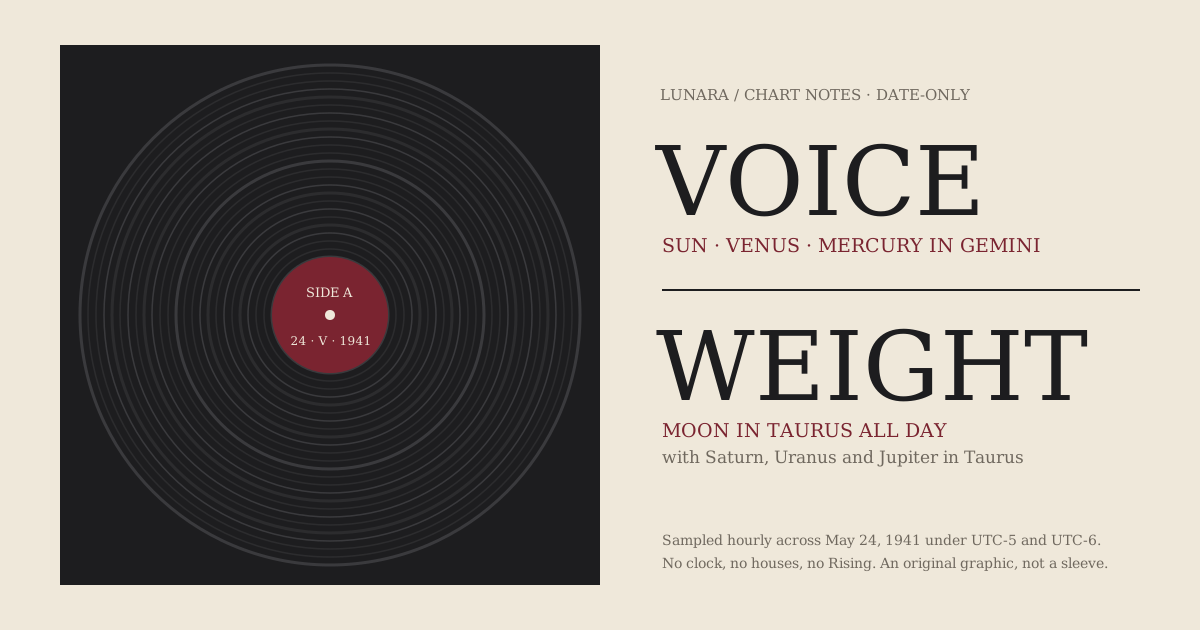
On October 13, 2016, the Swedish Academy announced the Nobel Prize in Literature for Bob Dylan, "for having created new poetic expressions within the great American song tradition" (Nobel Prize press release). Nobel announcements are running again this week, October 5–12, and October 13, 2026 marks ten years since that one. This article makes no guess about this year's prizes.
What it does is look at the birth chart behind the date the Nobel records give: May 24, 1941, in Duluth, Minnesota (Nobel facts page). The recognised work is public record; the chart is a symbolic lens, not an explanation of it.
How the chart was calculated
No birth time is used, so this is a date-only chart: no Rising sign, no houses and no Moon aspects. There's one extra wrinkle. Time-zone records give Duluth daylight time (UTC-5) for that date, but the city may have kept standard time (UTC-6). So we sampled the civil day every hour, plus 23:59, under both offsets with Lunara's central Swiss Ephemeris engine, and used only what holds across all 50 samples. These are sampled ranges, not a continuous proof, but the result is clean: no personal planet changes sign under either offset.
Three anchors
- Gemini, three times: the Sun at about 2–4° Gemini, Venus at about 12–13° Gemini, Mercury at about 21–23° Gemini.
- Taurus underneath: the Moon in Taurus for the entire day (roughly 10–23°), sharing the sign with Saturn at about 20°, Uranus at about 27° and Jupiter in Taurus's last degree.
- A Pisces pulse: Mars at about 5–6° Pisces, square the Sun within about 2½°.
That's a chart with an airy, verbal top layer and an earthy, slow-moving base. Astrologers would call it voice and weight.
Voice: the Gemini emphasis
Gemini is the sign astrologers most often tie to words, curiosity and changing the angle on a subject. Having the Sun, Venus and Mercury all there gives it real emphasis. Identity, taste and the planet of language share one vocabulary.
Mercury sits in the sign it traditionally rules, and the strongest contact it makes is a square to Neptune at about 25° Virgo (orb roughly 2–3½°). Mercury–Neptune contacts are read as language that reaches for imagery and suggestion rather than plain statement, with the square adding friction between precision and mist. Venus in Gemini is read as a taste for variety and wit.
None of this says how any song was made. It describes what the placements are traditionally associated with.
Weight: a Taurus Moon in a crowded sign
The Moon moves fast, but on this date it stays in Taurus from first sample to last, so the sign is firm even without a clock. Its degree isn't, which is why no Moon aspect is claimed here.
Taurus is read as steadiness, physical presence and a slow, sure pace. A Taurus Moon is associated with feeling settled through what's tangible and lasting. In this chart the Moon shares the sign with three slow planets: Saturn, Uranus and Jupiter. That cluster is generational, shared by everyone born in spring 1941, so on its own it isn't personal. What's specific is a Gemini Sun sitting directly on top of a Taurus base, with Jupiter in the last degree of Taurus about 3–4° from the Sun across the sign line.
Symbolically, the contrast is between quick, shifting expression and an unhurried ground it rests on. Astrologers would say the voice moves while the floor stays put.
Rhythm: Mars in Pisces against the Sun
Mars is read as drive and the pulse of action. Here it's in Pisces, a water sign associated with flow, absorption and dissolving edges, and it squares the Sun within about 2½° across the whole day.
A Sun–Mars square is traditionally read as energy that comes with friction, a push against the grain of the self-image. With Mars in Pisces, the push is fluid rather than blunt. In the voice-and-weight picture, this is the third element: a restless, tidal rhythm working against the Gemini surface.
Try the same lens on yourself
You don't need a famous chart to use this. Two questions to bring to your own:
- Where does your voice live? Find your Mercury sign. Is it in the same element as your Sun, or pulling against it?
- What's your weight? If your Moon sign holds all day, which element is it, and does it steady the rest of the chart or argue with it?
Bob Dylan's profile, with the same date-only limits, is at Bob Dylan's natal chart. To answer those questions for yourself, start with the free natal chart calculator. You can leave the time unknown and it'll tell you whether your Moon sign is firm. If you'd like the whole chart interpreted in writing, there's an optional paid personal birth chart reading. What's included and the price are shown before you buy.
Positions are tropical and geocentric, sampled hourly plus 23:59 on May 24, 1941 under UTC-5 and UTC-6 (union of both). Birth date and place come from the Nobel Prize facts page and Wikidata. The interpretation is symbolic and doesn't explain the work the Nobel recognised.
Text written with AI assistance. The positions are calculated, not estimated.