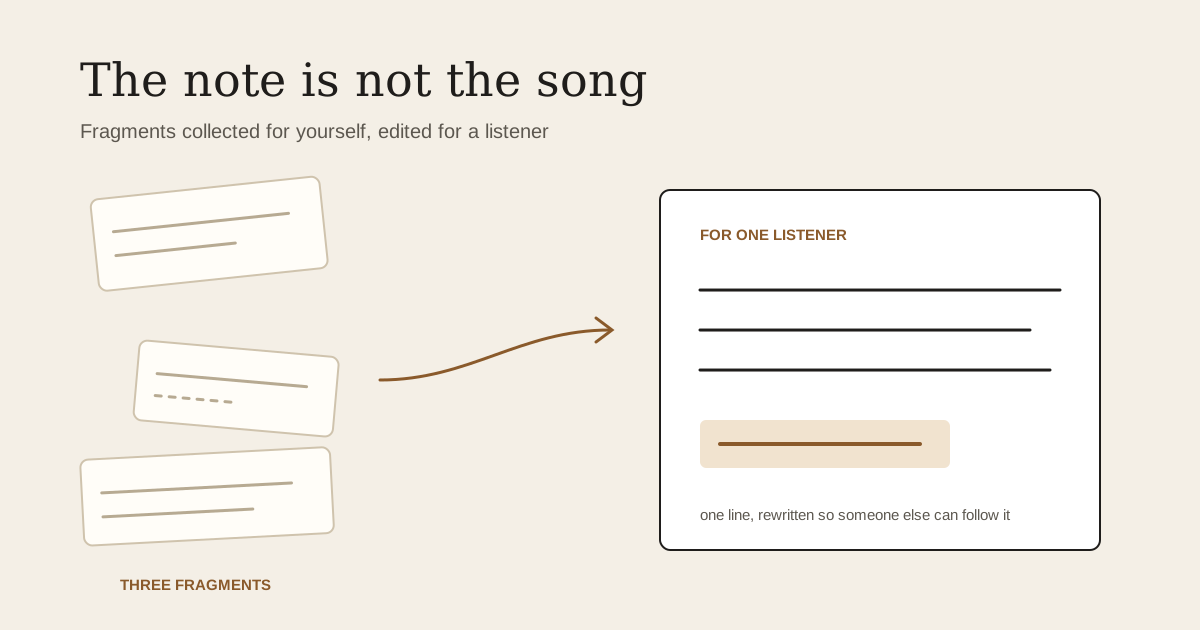
Most of us have a notes app full of half-thoughts: a line from the bus, a phrase that sounded good at midnight, a feeling with no sentence attached yet. Those notes matter. But a note isn't a song, and it isn't a message anyone else can follow. Turning one into the other is a separate job.
Drake turns 40 on October 24, 2026. A profile from 2013 is a useful way into that difference.
Fragments by day, songs at night
In June 2013, GQ published Michael Paterniti's profile "Drake on Money, Rap, and his Musical Legacy." We read the article itself; we didn't play any music or video. It describes how he worked more than a decade ago, not how he works now, and this piece says nothing about new releases or his private life.
Two kinds of detail are worth keeping apart.
What the writer observed. Paterniti describes Drake typing lyric fragments into a BlackBerry during the day and assembling them into songs at night. He also describes Drake and his longtime collaborator Noah "40" Shebib paying close attention to small details in the recordings and mixes.
What Drake said. In his own explanation, he thought about how a song would work on stage while he was writing it, and he'd been moving towards shorter verses and hooks that a crowd could join in on.
Put together, the profile describes two different modes. Capturing is private and fast: get the line down before it goes. Editing is for someone else: what will this sound like to a person hearing it once, in a crowd? The fragment is raw material. The song is the version that has been shaped for a listener.
What his chart can and can't show
Drake was born on October 24, 1986, in Toronto. Lunara's catalogue stores a birth time for him with a good source rating, and his profile page uses it. This article doesn't, because we couldn't independently confirm that time for this piece. That doesn't make the stored time wrong; it just isn't what we're relying on here. Instead we calculated his chart at 25 times across the Toronto birth day and kept only what held from start to finish. That leaves out the Rising sign, the houses and the Moon's exact degree. The degrees below are sampled ranges.
What follows is a symbolic lens placed beside a reported working method. It doesn't explain his career or his talent.
Mercury and a retrograde Venus in Scorpio
Mercury sat at about 25° Scorpio and Venus at about 19° Scorpio all day, with Venus retrograde. The Sun was there too, just over the sign's threshold at about 0° to 1°.
Mercury is how we think and phrase things; in Scorpio it's read as private, probing and drawn to what's left unsaid. Venus retrograde is traditionally read as feeling that gets revisited rather than simply released. As an image, that suits a writer who keeps a private store of material and returns to it, but the image says nothing about which lines are ready to share.
Sun sextile Neptune
The Sun sextiles Neptune at about 3° Capricorn, within about 2° to 3° all day.
Neptune is read as mood, atmosphere and imagination. The sextile is an opening rather than a guarantee. It's a fair symbol for the hazy, late-night fragment: full of feeling, not yet clear to anyone else.
Mars sextile Saturn
Mars at about 9° Aquarius sextiles Saturn at about 8° Sagittarius, within about 1.5° all day.
Mars is effort; Saturn is structure and time. Together they make a symbol for the night shift of assembly: sitting down with the pile of notes and building something with a shape.
Venus trine Jupiter
Venus in Scorpio trines Jupiter at about 13° Pisces, within about 5.5° all day.
Jupiter is read as expansion and generosity. Next to his remark about hooks a crowd can join, the trine makes an image of private feeling opened outward for other people, which is what editing for an audience does.
Our exercise: three fragments, one rewrite
This is a Lunara exercise, not a routine Drake recommends.
- Capture three fragments today. Lines, ideas, observations: anything that catches you. Don't fix them. Keep them private.
- Tomorrow, pick one. The one you'd most like someone else to understand.
- Rewrite it for one specific person. A friend, a colleague, a stranger at a show. Add what they'd need to follow it; cut what only makes sense to you. Then read both versions side by side.
The difference between the two is the editing. The first version was for you. The second is for them.
Explore further
To look at your own placements, calculate your free birth chart. Add a birth time and city only if you know them. His full profile is at Drake's natal chart.
If you'd like a written interpretation of your own chart afterwards, an automated personal birth chart reading is optional and paid. It isn't songwriting advice or a forecast, and the sample and current price are shown on that page before you decide.
Text written with AI assistance. Working-method details are paraphrased from GQ (Michael Paterniti, June 18, 2013); no lyrics are quoted. Chart positions come from a date-only calculation Lunara saved for this article; the stored birth time was not used. Illustration is original.