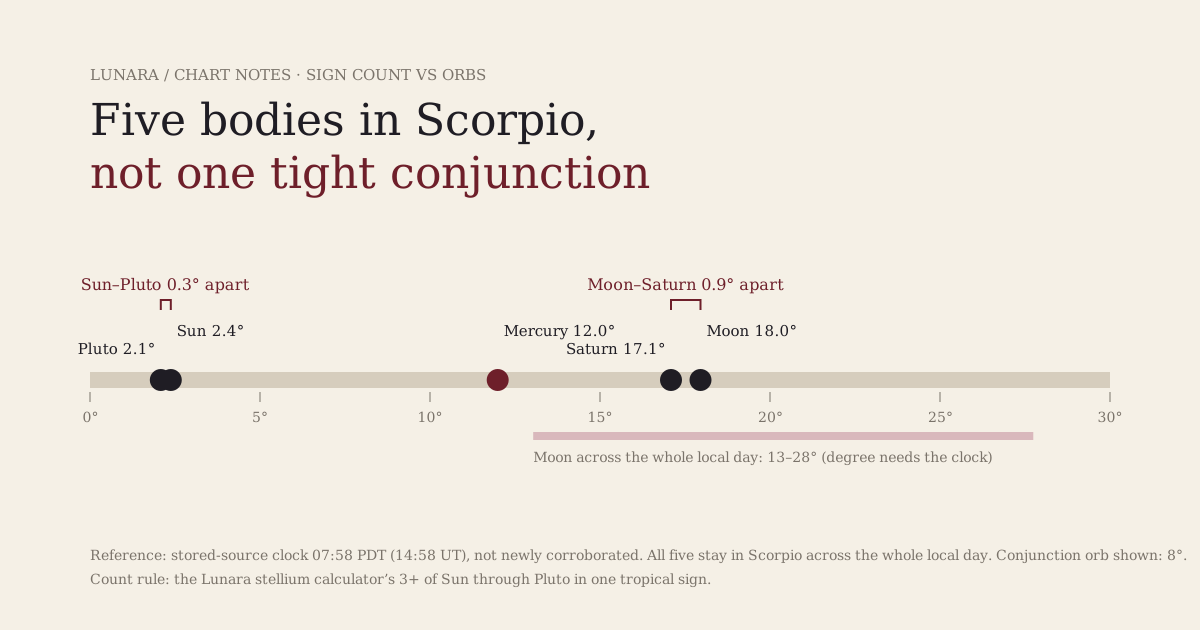
A sign can hold several planets without all of them touching. Katy Perry's birth chart is a clear example: five bodies in Scorpio, which counts as a stellium, but they sit in two tight pairs with Mercury between them. They are not one tight conjunction.
What counts here
We use the same rule as Lunara's stellium calculator: three or more of the ten bodies from the Sun to Pluto in one tropical sign. The Sun and Moon count. The lunar nodes, Lilith, Chiron and the angles don't. Four or more is flagged as a strict stellium. Other astrologers use other rules, so this is a convention, not a law.
Separately, to talk about which planets actually touch, this article uses an 8° orb for conjunctions.
The five Scorpio bodies
Positions are tropical, at the catalogue's reference instant of 07:58 PDT on October 25, 1984 in Santa Barbara (14:58 UT):
- Pluto: 212.08°, or 2.1° Scorpio
- Sun: 212.38°, or 2.4° Scorpio
- Mercury: 221.99°, or 12.0° Scorpio
- Saturn: 227.09°, or 17.1° Scorpio
- Moon: 227.96°, or 18.0° Scorpio
Venus (6.5° Sagittarius), Mars and Jupiter (Capricorn), Uranus and Neptune (Sagittarius) are elsewhere. That's five of ten, so it meets the strict four-body rule too.
Sign concentration versus pairwise orbs
Here's what the five actually do with each other, against the 8° conjunction orb:
- Sun–Pluto: 0.3° apart, a tight conjunction.
- Moon–Saturn: 0.9° apart, a tight conjunction.
- Mercury–Saturn: 5.1° apart, within orb.
- Mercury–Moon: 6.0° apart, within orb.
- Sun–Mercury: 9.6°, Mercury–Pluto 9.9°, outside orb.
- Sun–Saturn: 14.7°, Saturn–Pluto 15.0°, Sun–Moon 15.6° and Moon–Pluto 15.9°, all well outside.
So there are two clusters about 15° apart: Sun–Pluto at the start of Scorpio and Moon–Saturn in the middle, with Mercury leaning toward the second. "Five planets in Scorpio" is true. "Five planets conjunct" isn't.
How much depends on the clock
The 07:58 time is a stored-source clock. The catalogue rates it A, from its imported source, but it hasn't been newly corroborated. So here's what holds without it.
Sampling every hour of the local day, plus 23:59:
- All five bodies stay in Scorpio all day. The count of five doesn't depend on the clock.
- Sun–Pluto stays within about 1° all day.
- Mercury–Saturn stays within about 4–6° all day.
- The Moon runs from about 13° to 28° Scorpio over the day. Its sign is firm, but its exact degree, and so the tight Moon–Saturn pairing, depends on the 07:58 clock.
The stellium calculator handles this the same way. Leave the time blank and it checks your whole birth day for sign changes; houses are only shown when you give a time.
Two different kinds of Scorpio
Astrologers read Scorpio as depth, intensity and transformation. The two pairs carry those themes in different directions.
Sun–Pluto fuses identity with Pluto, the planet of power and regeneration. It's read as a self that gets remade rather than simply expressed, creative reworking, the urge to tear down a version and build the next.
Moon–Saturn joins feeling with Saturn, the planet of structure and responsibility. It's read as emotional steadiness that's been built: feelings handled with care, commitments kept, a sense of being the reliable one.
Same sign, two different instincts. That's a reading of symbols, not of anyone's private life.
Two questions for your own chart
If you have several planets in one sign, check the orbs, then ask:
- Where do you remake yourself? If a Sun–Pluto-style pair stands out in your chart, what are you reworking right now, and is it a choice or a habit?
- Where are you the steady one? If a Moon–Saturn-style pair stands out, which responsibilities do you hold by choice, and which could you set down without losing your footing?
Check your own stellium
Run your date through the stellium calculator. It counts with the same three-body rule and tells you whether a time-sensitive body could change the result. The full profile, with houses from the stored clock, is at Katy Perry's natal chart. If you'd like your whole chart interpreted in writing, there's an optional paid personal birth chart reading. What's included and the price are shown before you buy.
On the music side, her official site links 143 and Teenage Dream (katyperry.com). The chart doesn't explain any of it.
Method
Lunara's central Swiss Ephemeris engine, tropical and geocentric. Reference instant: 1984-10-25 07:58 PDT (14:58 UT), a stored-source clock rated A and not newly corroborated. Whole-day check: hourly samples plus 23:59, America/Los_Angeles; these are sampled values, not continuous bounds. Birth date and place come from Wikipedia.
Text written with AI assistance. The positions are calculated, not estimated.