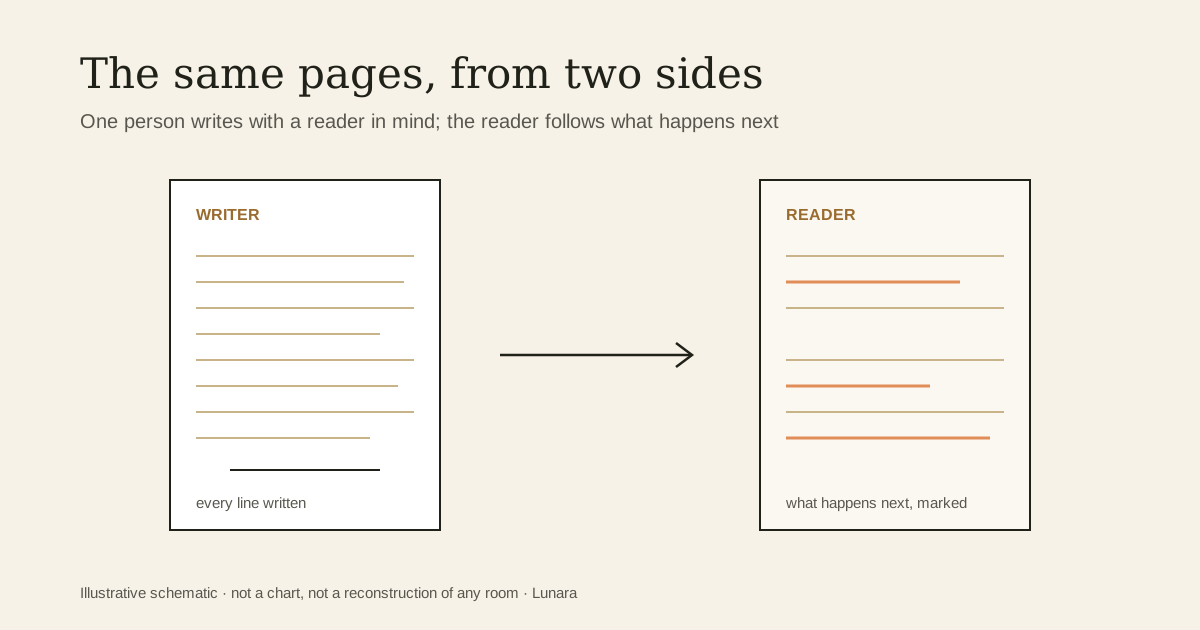
Anyone who has handed a draft to someone else knows the gap. You wrote it one way. They read it another. Neither of you is wrong.
Sigourney Weaver and James Cameron described that gap, with some affection, four decades after making Aliens together.
What they told Empire
On April 30, 2026, Empire published a preview of a reunion interview by Ben Travis, marking 40 years since Aliens. Cameron, Weaver, Michael Biehn and Jenette Goldstein sat down together. The full interview ran in Empire's print magazine; what follows draws only on the public online excerpt.
In it, Weaver recalled reading the script for the first time, from a writer she didn't know. She remembered it as unusually well structured and full of thematic weight, and described the story's central conflict, between Ripley and the alien queen, almost as a piece of music.
Cameron's memory of the same period was different. He said he had been writing for months with a picture of Weaver on the wall in front of his desk, trying to carry forward what she and Ridley Scott had built in the first film. When they finally met, he said, he was frightened of what she would think.
Then came the joke at the heart of it. Cameron said it turned out she hadn't even read the long action passages he'd written between the dialogue. Weaver agreed: "I just had to find out what happened next!"
A day later, on May 1, 2026, a second Empire excerpt focused on Weaver looking back on Ripley, including her appreciation of the seriousness Cameron brought to the character.
What the excerpts show is two people remembering the same pages from different sides. Cameron remembers writing them, with a particular reader in mind and anxious about her reaction. Weaver remembers reading them as a performer, pulled forward by what happens next and less interested in the prose that wasn't hers to speak.
That is their own light-hearted account, told decades later. It isn't a record of how the script developed, and this article doesn't treat it as one.
One contact between their charts
Neither has a reliable recorded birth time, so this comparison uses only what holds across each whole birth day. That means no Rising signs, no houses and no Moon degrees.
The birth details come from indexed Britannica descriptions: Sigourney Weaver, October 8, 1949, New York City; James Cameron, August 16, 1954, Kapuskasing, Ontario. Lunara sampled each person's local birth day at 25 times and compared every pairing.
One contact holds across all of them:
- Weaver's Mars at about 19.0–19.6° Leo
- Cameron's Mercury at about 16.8–18.8° Leo
- a conjunction, with the gap between them ranging from about 0.2° to 2.9° across every sampled pairing, inside the 8° limit we use for conjunctions.
In astrological tradition, Mercury is the planet of language, ideas and writing. Mars is the planet of drive, action and how effort gets spent. In Leo, both are associated with expression and wanting to make something vivid.
Symbolically, then, one person's planet of words sits on the other's planet of action. That's a neat image for a writer and a performer. It is only an image. It doesn't explain why they worked well together, why the film succeeded, or how either of them thinks. Many pairs of people share contacts like this without ever meeting.
Each chart also has plenty of its own. Weaver's Sun sits almost exactly on Neptune in Libra, and her Moon was in Aries or Taurus, depending on the unknown hour. Cameron's Sun is in Leo beside Pluto, and his Moon was in Pisces all day.
Their full date-only profiles are at Sigourney Weaver's natal chart and James Cameron's natal chart.
Before feedback: a two-person practice
This exercise is Lunara's own. It isn't something Weaver or Cameron described.
Try it the next time you hand someone a draft, a plan or a piece of work, or when you're the one receiving it.
1. Each of you writes one note, privately. Before any reading or listening happens:
- The person sharing the work writes: "The thing I most want you to notice is…"
- The person receiving it writes: "The thing I'll probably notice first is…"
Keep the notes to a sentence each. Don't show them yet.
2. Read or listen. The receiver goes through the work in whatever way is natural to them, skipping and all.
3. Swap the notes. Compare what each of you expected with what actually happened.
4. Talk about the gap, not about who's right. If the receiver skipped something the writer cared about, that's information about the draft or about the reader, not a failure.
One rule: don't decide in advance how the other person should react, whether from your experience of them or from their birth chart. A Mars placement doesn't oblige anyone to read the action scenes, and a Mercury placement doesn't make anyone a better writer. The point is to hear the response you actually get.
Explore further
You can calculate your free birth chart to find your own Mercury and Mars signs. Add a birth time and city only if you know them.
To see how a written natal reading handles placements, read the sample natal reading, which uses fictional birth details. If you want one for yourself, there's an optional paid personal birth chart reading. It's an automated, written reading of one person's chart. It doesn't compare two people, can't fix an unknown birth time and isn't written by a human astrologer. What's included and the price are shown before you buy.
Text written with AI assistance. Interview material is paraphrased from Empire's public online excerpts (April 30 and May 1, 2026), with one short quotation. The positions are calculated, not estimated.