Taylor Swift's The Life of a Showgirl: The Encore has been out since Friday, September 25. This piece doesn't review it or guess what any song is about. It uses the release as an occasion to look at one placement in her calculated birth chart, the one astrologers usually connect with writing, and to turn it into an exercise you can try on your own work.
What's public
According to Variety's report by Chris Willman (September 23, 2026), the Encore adds four tracks: "Patient Zero", "Cleveland!", "Pink Clouding" and "Babylon". Variety also reports that after the original album, Swift went back to Sweden with Max Martin and Shellback and wrote more songs. Separately, her official site lists Patient Zero among her projects with direction credited to Taylor Swift. That corroborates the project and the credit, and nothing more.
That's all the context this article uses. It quotes no lyrics, assigns no meanings and makes no claim about how anything was written.
What's calculated
Swift was born on December 13, 1989, in West Reading, Pennsylvania, per Wikipedia. A birth time of 08:36 circulates, but our catalogue rates it D, meaning conflicting sources, so it isn't used. That makes this a date-only chart: no Rising sign and no houses.
We sampled her birth day every hour from 00:00 to 23:00, plus 23:59, Eastern time, with Lunara's central Swiss Ephemeris engine. These are sampled values, not a continuous proof, but the planets below move slowly enough that the ranges are tight:
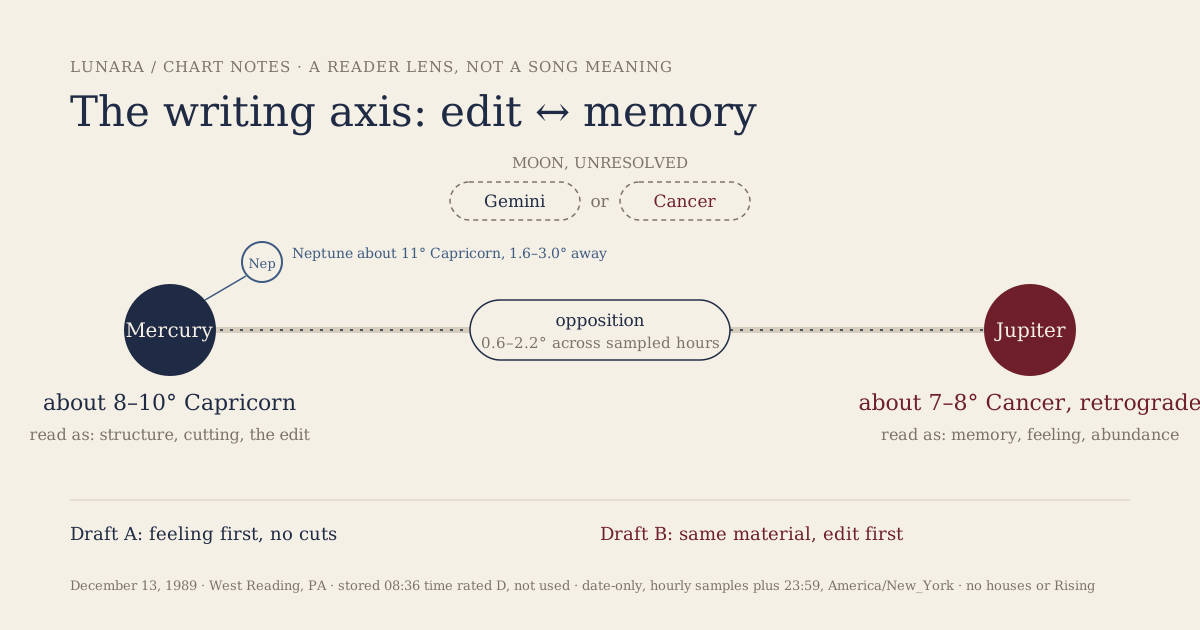
- Mercury: about 8–10° Capricorn.
- Jupiter: about 7–8° Cancer, retrograde.
- Mercury opposite Jupiter: orb 0.6–2.2° across every sample.
- Neptune: about 11° Capricorn, 1.6–3.0° from Mercury.
- Sun: about 21–22° Sagittarius. Mars: about 26–27° Scorpio.
- Moon: Gemini until about 02:49 EST, then Cancer. Without a reliable time, it's Gemini or Cancer. We don't pick one.
Her full natal profile has the complete reading and the same clock caveats.
How the axis is read
Here we switch from measurement to symbolism.
Mercury is the planet astrologers tie to language, sorting and craft. In Capricorn it's read as structured and deliberate: the draft that gets built, tested and cut until it holds. Jupiter is the planet of expansion. In Cancer, its classical exaltation, it's read as abundance found in memory, family and feeling.
An opposition puts them on one line, facing each other. The usual reading is a pull between two instincts. One wants to engineer something exact. The other wants to let it overflow with what's remembered. Neither side is meant to win. Many astrologers read an opposition as a working tension, something you keep balancing, rather than a flaw to fix.
Neptune near Mercury adds a softer note: imagery, atmosphere and blur woven into otherwise precise language. The open Moon matters too. A Gemini Moon is read as processing feeling by naming it quickly. A Cancer Moon is read as holding feeling close until it has deepened. The chart can't say which, and that uncertainty is part of the honest picture.
None of this describes how Swift writes. It's a lens a reader can pick up, not a window into a working process.
Try it: two drafts of the same thing
The Mercury–Jupiter opposition makes a useful exercise whatever your chart says. Pick one real memory with some feeling in it: a kitchen, a drive, a goodbye. Then write it twice.
- Draft A, emotion first (the Jupiter side). Set a timer for ten minutes. Write everything you remember and everything you felt, in the order it arrives. Don't cut, don't fix grammar, don't look for a shape. Let it run long.
- Draft B, edit first (the Mercury side). On a fresh page, before writing a word, decide the structure: three short parts, no more than 120 words, and one concrete image in each. Now write the same memory inside that frame.
Put them side by side and ask three questions. Which lines appear in both? Which detail survived only because the structure forced you to choose it? Which feeling appears only in Draft A, and does Draft B lose something without it?
Most people find their strongest material where the two overlap. If you keep reaching for one side, that's worth noticing. It isn't a verdict.
Your own Mercury
To see where your own Mercury sits, and whether your Moon sign holds all day without a birth time, start with the free natal chart calculator. If you'd like more than positions, there's an optional paid personal birth chart reading. It's a broader written reflection on your whole chart, not a songwriting method or a forecast. You can read a fictional sample report first, and the price and contents are shown before you buy.
Calculation notes
Positions are tropical and geocentric, from Lunara's central Swiss Ephemeris path. December 13, 1989 was sampled hourly plus 23:59 in America/New_York; these are sampled ranges, not continuous bounds. Birth date and place come from Wikipedia (accessed October 5, 2026), consistent with the source behind our profile. That source lists the 08:36 time with a conflicting-sources rating, which is why it isn't used. We haven't seen a birth record. Nothing here implies that Swift or her collaborators endorse this analysis.
Text written with AI assistance. The positions are calculated, not estimated.