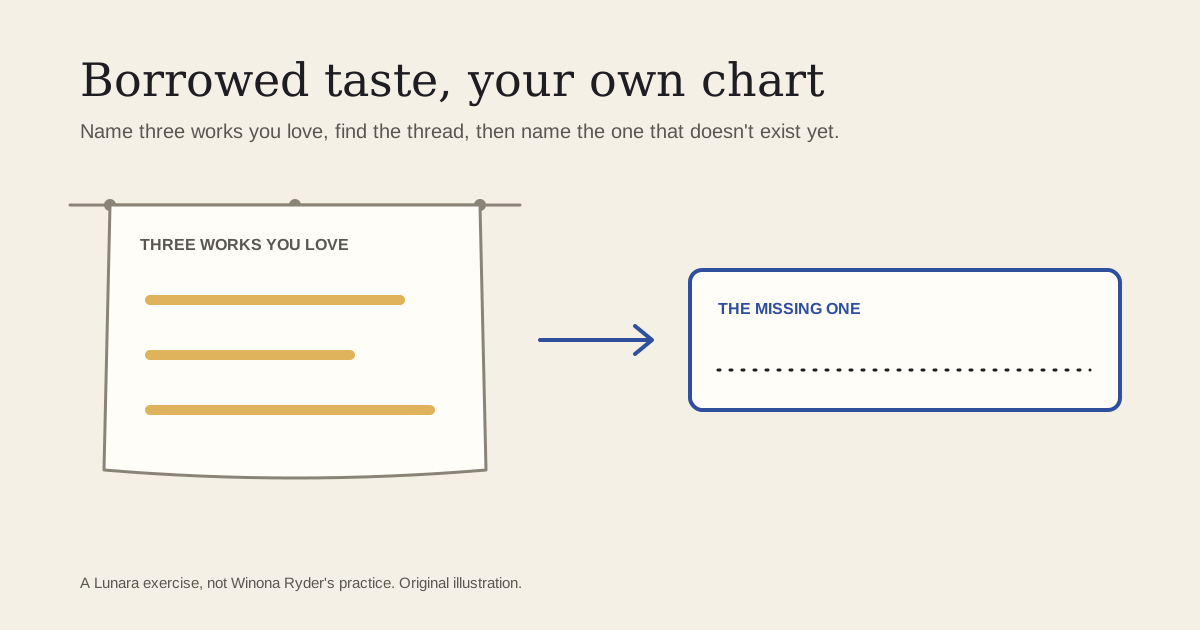
Most people can name what they admire faster than what they'd make. A shelf of favourite films, a playlist, a folder of saved pictures: taste builds up quietly. Turning it into something of your own is a different step, and it usually starts with noticing what's missing from the shelf.
Winona Ryder, who turns 55 on October 29, 2026, described both halves of that in a long AnOther Magazine interview by Hannah Lack, published in September 2024. This piece uses it as a starting point for a small exercise. The exercise is ours, not hers.
A sheet in a barn
During the years her family lived on a commune in northern California, without electricity or television, Ryder says her mother, who "had been a projectionist in college", would get hold of films and show them "on a big sheet in an old barn".
The writer lists what she took in on those evenings: Greer Garson, Sarah Miles, Gena Rowlands in everything. Of the Rowlands films with John Cassavetes, Ryder says that "even though I didn't understand the grown-up stuff, I felt like I was in the room with these people."
Then comes the line this article is built around: "I loved films, but I don't think I ever saw myself being in films." Admiration came first, by years.
From admirer to maker
The interview traces how that changed. In our paraphrase, keeping the voices apart:
- What Ryder said. She loved character actors more than leads. After Harold and Maude, she remembers thinking, "surely someone must need a young Ruth Gordon?" Later, she says a big reason she wanted to make films like Heathers and Little Women was "because we didn't have a lot of that adolescent time, in film or literature."
- What the writer observed. Lack describes Ryder pushing Little Women forward and backing its casting, and recounts her handing Francis Ford Coppola the Dracula script at the end of a meeting about something else. Ryder's own description of that was "a total shot in the dark."
That's the arc we're interested in. Her taste started with other people's work. What she pushed for later was work she saw was missing. We don't claim to know how she thinks, and nothing here is about her private life.
What her chart can and can't show
Winona Ryder was born on October 29, 1971, near Winona, Minnesota, the town she's named after. Lunara's celebrity catalogue stores a birth time of 11:00 in the morning in Winona. A published astrology database is reported to give the same time with a high reliability rating but places the birth in nearby Rochester. We couldn't open that record, so we haven't checked it.
So this piece uses only what holds across her whole local birth day. That rules out the Rising sign, the houses and the Moon's exact degree.
Her Sun is in Scorpio all day, at about 5° to 6°. Mercury and Venus are in Scorpio too. The Moon stays in Pisces from midnight to midnight, so its sign is safe even though its degree isn't.
The three readings below are symbolic lenses with more than one fair interpretation. They don't explain her career.
Mercury conjunct Venus in Scorpio
Mercury sits at about 18° to 19.5° Scorpio and Venus at about 21.5° to 23° Scorpio. That keeps them in a conjunction, about 3.2° to 3.5° apart, all day.
Mercury is read as attention and the way we take things in. Venus is read as what we value and find beautiful. Scorpio is read as depth, privacy and staying with something rather than skimming it. Together they make a fitting image for taste that goes deep: one actress watched closely, one book read again and again. The writer notes she spent early earnings on Salinger first editions.
The same pairing can be read another way. It can describe a narrow, guarded taste that's slow to let new things in. A chart doesn't settle which reading fits.
Moon in Pisces all day
Pisces is read as absorbing, porous and image-led. A Moon there is a traditional symbol for feeling you're inside a story rather than watching it. That echoes her "in the room with these people," but an echo isn't proof.
A cooler reading is just as available: a tendency to drift into other people's worlds instead of building one's own. Because the Moon moves quickly, we're using only its sign here, and no Moon aspects.
Venus in Scorpio, square Mars in Aquarius
Mars sits at about 26° Aquarius, in a square to Venus about 3.5° to 4.3° from exact all day.
Venus is what you love; Mars is what you act on. Aquarius is read as the group, the outsider and what isn't being offered yet. A square is read as friction that asks for a move. It's a fitting picture for the shift from loving films to pushing for the ones that didn't exist yet.
It can equally describe a tug-of-war between private taste and public causes, or impatience with what's already on offer. Her own reason for those films came from what she saw missing on screen, and we take that at her word.
Our exercise: find the missing one
This is a Lunara exercise. It isn't Winona Ryder's practice, it isn't taken from any film, and she hasn't endorsed it. It takes about ten minutes.
- List three works you love. Films, books, albums, buildings, anything. Write one line on each about the exact moment that gets you.
- Find the thread. Read your three lines together. What do they share? A kind of character, a mood, a way of telling a story?
- Name the missing one. Write one sentence describing a fourth work in that thread that doesn't exist yet: the film with the character you never got to see, or the book written from the side nobody chose. Don't plan it. Just name it.
Example. Three works: an old detective series, a novel told by a minor character, a song about a small town. The thread: the person standing at the edge of the main story. The missing one: a mystery solved by the person who serves the coffee.
Keep the sentence somewhere you'll see it. It may not turn into anything, and that's fine. It tells you which way your taste leans when you're making rather than collecting.
Explore further
Her full profile is on Lunara's Winona Ryder natal chart page, where you can compare your own placements with hers.
To see your own chart, calculate your free birth chart. If you don't know your birth time, leave it blank rather than guessing; the calculator will leave out anything that depends on the clock.
If you'd like a written interpretation of your own chart afterwards, an automated personal birth chart reading with reflection questions is optional and paid. It's a fixed written report, not a conversation with an astrologer, therapy or a forecast. You can read the complete fictional sample reading first, and the current price for your country is shown before you decide.
Text written with AI assistance. Quotes and details come from Hannah Lack's interview in AnOther Magazine's Autumn/Winter 2024 issue, published online on September 5, 2024. Ryder's words and the writer's observations are kept separate. Birth date and place are from Wikipedia and the same interview. The birth time and its rating were reported from a published database we couldn't open, so they weren't verified, and the chart readings don't depend on them. Chart positions come from a whole-day calculation Lunara saved for this article. Lunara is not affiliated with Winona Ryder or AnOther Magazine. The illustration is original.