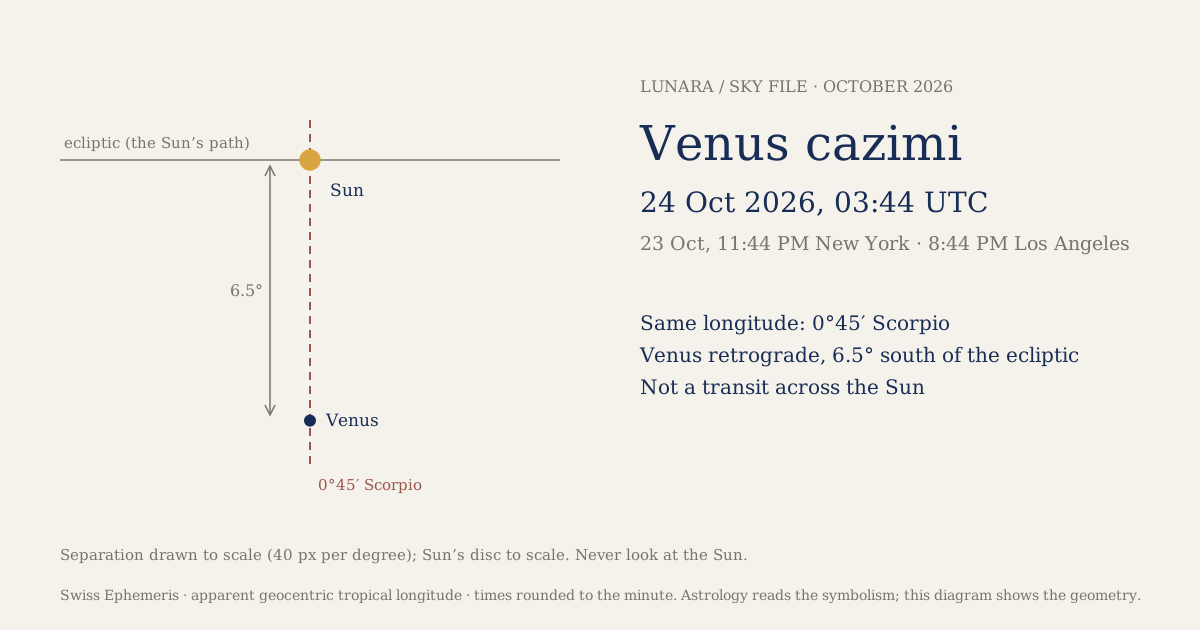
Retrograde Venus reaches the same tropical longitude as the Sun on October 24, 2026 at 03:44 UTC. Both are at 0°45′ Scorpio. That moment falls on the evening of October 23 in the Americas:
- New York: October 23, 11:44 PM (EDT, UTC−4)
- Los Angeles: October 23, 8:44 PM (PDT, UTC−7)
- London: October 24, 4:44 AM (BST, UTC+1)
- Sydney: October 24, 2:44 PM (AEDT, UTC+11)
Astronomers call this Venus's inferior conjunction. Astrologers call the moment cazimi.
What actually happens
Venus has been retrograde since early October. Seen from Earth, it appears to slide backwards against the zodiac. Halfway through that retrograde, Venus passes roughly between Earth and the Sun. That is the inferior conjunction.
Measured along the ecliptic, the Sun's apparent yearly path, the two share the same longitude for an instant. In Lunara's Swiss Ephemeris calculation, the gap between them changes sign between 03:44 and 03:45 UTC. Interpolated, that's about 03:44:07 UTC. At 03:44, the read-back separation is half an arcsecond.
Sharing a longitude doesn't mean sharing a spot in the sky. At this conjunction, Venus sits about 6.5° south of the ecliptic. The Sun's disc is only about half a degree wide, so Venus doesn't cross it. It is not a transit of Venus. Those events are rare, and the next one is not until December 2117.
Any claim that Venus "passes through the exact centre of the Sun" this October mixes up a longitude measurement with a picture. Venus is lost in the Sun's glare either way. Never look at the Sun to check, with or without optics.
Why some calendars say October 23 and others October 24
Three things explain most of the disagreement you'll see:
- Time zones. 03:44 UTC on the 24th is still the 23rd anywhere at UTC−4 or further west. A calendar written in New York or Los Angeles will say October 23 and be correct for its readers. A calendar in UTC, London or Sydney will say October 24.
- Rounding and settings. Ephemeris settings vary, and some sites round to five or ten minutes, so published times can differ by a few minutes.
- Day labels. A date without a time may just label the day, not the exact instant.
If you see 11:44 PM Eastern, that matches our result. If you see 8:50 PM Pacific, it's a few minutes from ours, and we can't reconstruct how it was calculated. Either way, there's a single instant; the dates differ because it's read on different clocks.
Cazimi: the tradition, not a promise
Cazimi comes from medieval astrology. A planet within about 17 arcminutes of the Sun's longitude was said to be "in the heart of the Sun." Traditional authors treated that state as strengthening rather than weakening the planet. Venus and the Sun close that 17′ gap at about 1.6° per day, so by the common convention the cazimi window lasts roughly four hours either side of the exact time.
That is how the tradition reads it. It isn't a measurable effect, and it doesn't promise clarity, money or love. Some astrologers use the moment as a quiet point to set an intention. Others barely mention it. Nothing about the conjunction makes a particular outcome more likely.
The Scorpio symbolism, kept separate
The conjunction falls at 0°45′ Scorpio in the tropical zodiac, which is anchored to the equinoxes. (Sidereal systems are anchored to the stars and place it in a different sign.) Scorpio is traditionally associated with depth, privacy, intensity and what is shared or held in trust. Venus is associated with what you value and what draws you in.
Read together, astrologers describe this as a moment to look beneath first impressions at what you actually value. The sign and the meaning are interpretation. The timing above is the astronomy.
The Sun itself entered Scorpio about eighteen hours before the conjunction; our Scorpio season 2026 article has the exact dates. Venus also crosses back into Libra during its retrograde, and the full timeline is in the Venus retrograde 2026 guide. Mercury stations retrograde a few hours after the conjunction, also in Scorpio; see Mercury retrograde in Scorpio 2026.
One concrete use: what attracts you, and what sustains you
If you want something practical from the date, try this short review. It's the same exercise whether or not you follow astrology:
- Attracts. List three things you were drawn to this year: a purchase, a project, a habit, a way of spending evenings.
- Sustains. Next to each, note whether it still gives you something a month later. Write it plainly: "still use it", "glad I did it", "mostly the idea of it".
- One adjustment. Choose one item where attraction and staying power differ, and decide one small change. You might cancel it, keep it with a limit, or give it more time on purpose.
The review is about your own choices. It says nothing about whether someone will return, or whether any relationship will begin or end.
Finding Venus and early Scorpio in your own chart
A natal chart shows where Venus was when you were born, and whether you have planets near early Scorpio. Contacts close to 0°–1° Scorpio are traditionally the ones astrologers would watch around this date. So are contacts at the same degrees of Taurus, Leo and Aquarius.
- From a birth date alone, the planets' signs and approximate degrees are usually available. The Moon can be uncertain, because it moves about 13° a day.
- Houses and the Ascendant need a reliable birth time and place. If you don't know your time, it's better to leave houses out than to guess. A noon placeholder is not your birth time.
Calculate your free natal chart to see your Venus sign and degree and any placements in early Scorpio. If you want it explained in writing, there is an optional paid written interpretation of your personal natal chart. It reads the chart you were born with and is not a prediction about this transit. The chart page shows what it covers and the price before you buy.
Quick answers
Why October 23 or October 24? Time zones: 03:44 UTC on October 24 is the evening of October 23 in the Americas.
What does cazimi mean? A traditional term for a planet within about 17′ of the Sun's longitude. It's interpretation, not a guaranteed result.
Is this a transit of Venus across the Sun? No. Venus is about 6.5° south of the ecliptic; the next transit is in December 2117.
What can my natal chart tell me? Where Venus and any early-Scorpio placements sit, and with a reliable birth time, which house. Not what will happen.
Calculation notes
Positions are apparent geocentric tropical longitudes from Lunara's central Swiss Ephemeris helper, in Universal Time. The sign change of Venus minus Sun was bisected to a one-minute bracket (03:44–03:45 UTC) and is published to the nearest minute. Local times use the IANA time-zone rules in force on October 23–24, 2026.
Text written with AI assistance. The times and positions are calculated, not copied.