Sky file · November 2026 · calculated
New Moon November 2026: November 8 or 9? One instant, local dates
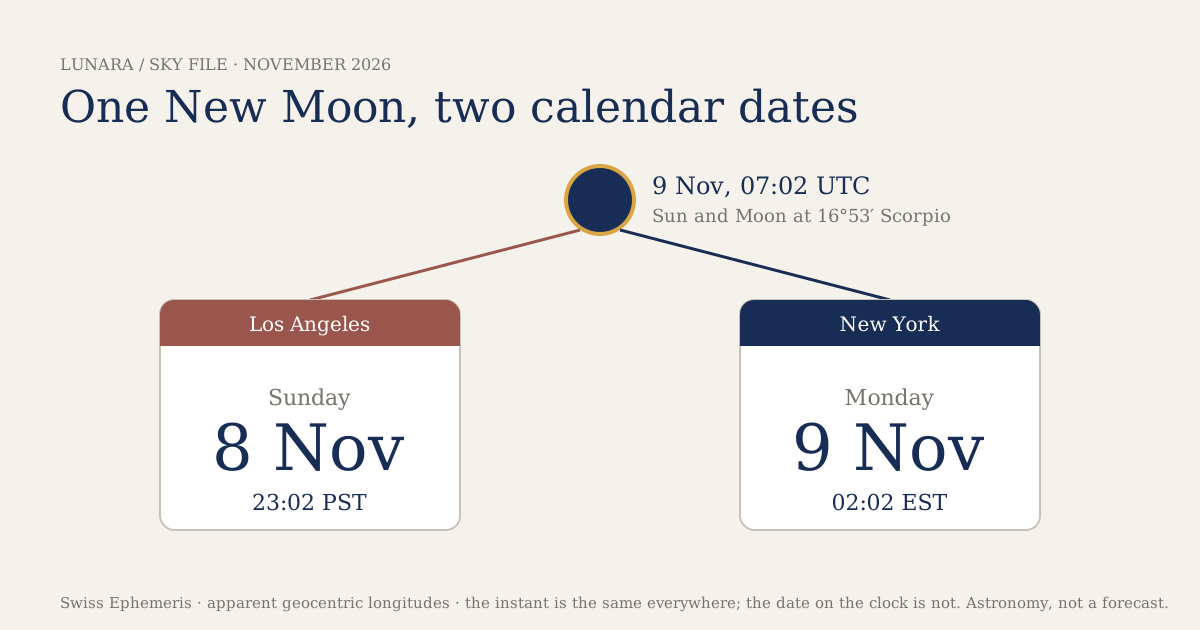
The November 2026 New Moon is exact on , when the Sun and the Moon stand at the same longitude, 16°53′ Scorpio in the tropical zodiac. In Los Angeles the clocks still read Sunday 8 Nov (23:02); in New York it is already 9 Nov (02:02). The Moon itself is invisible at that moment; the first thin crescent comes later.
Exact New Moon
9 Nov 2026, 07:02 UTC
Sun and Moon
16°53′ Scorpio
Next New Moon
9 Dec 2026, 00:52 UTC
Which date goes in your calendar?
Use the date on your own clock at 07:02 UTC. The New Moon happens once, at the same instant for everyone; what changes is the local date and time that instant falls on.
This month the split falls across North America. New York is on EST (UTC−05:00), so the New Moon lands at 02:02 on Monday 9 Nov, in the small hours. Los Angeles is on PST (UTC−08:00), three hours behind, so it lands at 23:02 on Sunday 8 Nov, an hour before midnight. A calendar built for one coast and read on the other will be a day out. That is usually why two websites give two different dates: both are right for the time zone they used.
US clocks went back an hour on 1 November, so these are standard-time offsets, not the summer offsets used for October’s phases.
New Moon time by city
One instant, different clocks. Offsets are those in force on the day; a highlighted date is earlier than the UTC date.
| Place | Local date | Local time | Offset |
|---|---|---|---|
| UTC | Mon 9 Nov 2026 | 07:02 | UTC+00:00 |
| Los Angeles | Sun 8 Nov 2026 (previous day) | 23:02 | UTC−08:00 |
| New York | Mon 9 Nov 2026 | 02:02 | UTC−05:00 |
| London | Mon 9 Nov 2026 | 07:02 | UTC+00:00 |
| Madrid | Mon 9 Nov 2026 | 08:02 | UTC+01:00 |
| Cairo | Mon 9 Nov 2026 | 09:02 | UTC+02:00 |
| Dubai | Mon 9 Nov 2026 | 11:02 | UTC+04:00 |
| Mumbai | Mon 9 Nov 2026 | 12:32 | UTC+05:30 |
| Sydney | Mon 9 Nov 2026 | 18:02 | UTC+11:00 |
The New Moon is not the first crescent
The astronomical New Moon is a single instant: the moment the Moon’s longitude equals the Sun’s. Nobody sees it. As NASA explains, the lit side faces the Sun and the night side faces us, and the Moon is close to the Sun in the sky, rising and setting with it. It usually passes a little above or below the Sun because its orbit is tilted; this time it is 4.93° south of the Sun’s path, so there is no eclipse.
The first visible crescent is an observation, not an instant. It depends on how far the Moon has moved from the Sun, your latitude, the evening horizon, haze and eyesight, so calendars that start the month with a sighted crescent can begin a day or more later. How far the Moon has moved after the instant:
| After the New Moon | UTC | Moon − Sun longitude | Disc lit |
|---|---|---|---|
| 24 hours | 10 Nov 2026, 07:02 | 11.3° | 1.2% |
| 48 hours | 11 Nov 2026, 07:02 | 22.5° | 4% |
| 72 hours | 12 Nov 2026, 07:02 | 33.4° | 8.4% |
These numbers describe geometry, not whether you will see the crescent from your window. This page does not predict crescent visibility.
This lunar cycle, phase by phase
Exact instants in UTC, to the minute. Your local date can be one day different.
| Phase | Exact (UTC) |
|---|---|
| New Moon (this New Moon) | |
| First Quarter | |
| Full Moon | |
| Last Quarter (third quarter) | |
| New Moon |
The US Naval Observatory’s published table, in Universal Time, lists the Full Moon at 14:53 and the Last Quarter at 06:08; Lunara’s calculation rounds both to the next minute. The other instants match to the minute. Any month’s phases are in the Moon phase calendar.
A small plan for the cycle
A lunar cycle is a short, fixed container: 9 Nov 2026, 07:02 UTC to 9 Dec 2026, 00:52 UTC, about 29½ days. The dates come from the sky. Everything else in this plan is your choice; the Moon doesn’t make it work.
- Pick one unfinished thing and decide what stays private while it’s unfinished: a draft, a plan, an application you haven’t sent.
- Take one concrete step by First Quarter (17 Nov 2026, 11:48 UTC). One action, small enough to finish.
- Review it at the Full Moon (24 Nov 2026, 14:54 UTC): keep going, change course, or decide it’s ready to share.
An optional Scorpio lens (astrology)
Everything above is astronomy or ordinary planning. This section is astrology, offered as a reflective lens only.
The Sun and Moon meet at 16°53′ Scorpio. Astrologers traditionally associate Scorpio with depth, privacy and what happens below the surface before anything shows. Read as a lens, that fits the plan above: what deserves more time out of view before you show it to anyone? If the question isn’t useful to you, the plan works without it.
Nothing here says this New Moon will cause, reveal or change anything. A Sun sign or birthday alone also can’t place the New Moon in one of your houses: houses need a reliable birth time and place.
Where is Scorpio in your own chart?
With a recorded birth time and place, the free natal chart shows which of your houses holds 16°53′ Scorpio, alongside every planet you were born with. Without a time it still gives your planets’ signs, but not houses or a rising sign, and it won’t guess a time for you. You can read a fictional sample reading to see what a written chart looks like. If you want your own explained, there is an optional, paid, automated reading of your natal chart; the price for your country is shown before you buy. It reads your birth chart and is not a forecast for this New Moon.
Quick answers
Is the November 2026 New Moon on November 8 or November 9?
Both, depending on your clock. The New Moon is one instant, 07:02 UTC on 9 November 2026. In Los Angeles (PST) that is 23:02 on Sunday 8 Nov; in New York (EST) it is 02:02 on Monday 9 Nov. Anywhere on the US Pacific coast, or further west in the Americas, the local date is 8 Nov.
What sign is the November 2026 New Moon in?
Scorpio, in the tropical zodiac used by most Western astrologers: the Sun and Moon are both at 16°53′ Scorpio. Sidereal (Vedic) systems use a different zero point and give a different sign.
Can I see the New Moon?
No. At the New Moon the lit side faces away from Earth and the Moon sits close to the Sun in the sky. The first thin crescent comes a day or more later, depending on where you are, the sky and the horizon. At the New Moon the Moon is 4.93° south of the ecliptic, so this is not a solar eclipse.
When are the next Moon phases?
First Quarter is 17 Nov 2026, 11:48 UTC, the Full Moon 24 Nov 2026, 14:54 UTC, and the next New Moon 9 Dec 2026, 00:52 UTC. Your local date can differ by one day.
Does my birthday tell me where this New Moon falls in my chart?
No. A birth date gives your Sun sign, but houses need a reliable birth time and place, so this page does not assign the New Moon to a house for any sign.
Method and limits
Swiss Ephemeris (production ephemeris files) through Lunara’s central lunar-phase helpers: geocentric apparent ecliptic longitudes, tropical zodiac, UT. The New Moon instant is where Moon − Sun longitude equals 0°, refined to under a second and shown to the nearest minute. Illumination is the Swiss Ephemeris illuminated fraction of the disc. Local times use the IANA time-zone rules in force on 9 November 2026.
Lunara’s times are in UT and shown to the minute; they are compared with, not copied from, the US Naval Observatory’s 2026 phase table (Universal Time, to the minute). That is a minute-level match, not agreement to the second. The New Moon explanation paraphrases NASA’s Moon phases page; the diagram is Lunara’s own.
Lunara uses the tropical zodiac, which is anchored to the equinoxes; sidereal systems place the same New Moon in a different sign. No Ascendant or houses are calculated for this page, and crescent visibility is not predicted.
Text written with AI assistance; every date, position and percentage is computed, not written.