Sky file · October 2026 · calculated
Full Moon October 2026: the Hunter’s Moon, and what the Moon is doing on Halloween
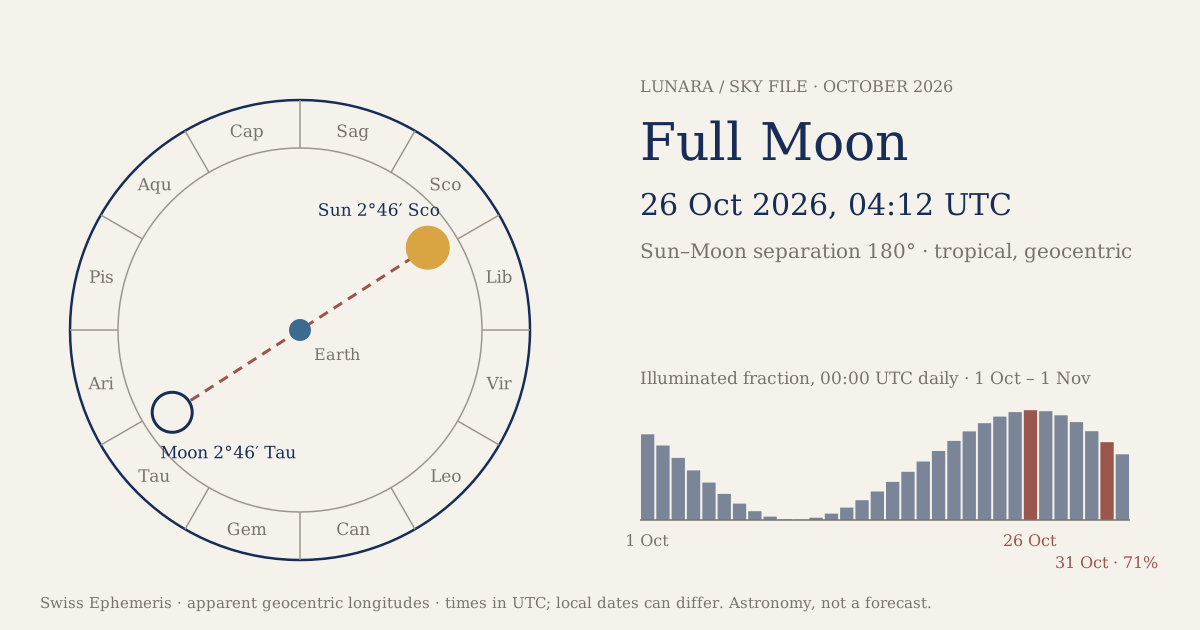
The October 2026 Full Moon is exact on , when the Moon sits 180° from the Sun: Sun at 2°46′ Scorpio, Moon at 2°46′ Taurus. It is the Hunter’s Moon in the traditional English, Northern Hemisphere naming. Halloween is not a Full Moon: on 31 October the Moon is a waning gibbous, about 71% lit at the start of the UTC day and 60% at the end.
Exact Full Moon
26 Oct 2026, 04:12 UTC
Disc lit at that instant
99.84%
31 Oct, 00:00 UTC
70.7% · waning
The same moment on your clock
Pick a time zone. Nothing is sent or stored; your browser converts the instant with its own time-zone rules.
Full Moon in UTC (UTC+00:00)
Same calendar date as in UTC.
31 October in UTC, local midnight to 23:59: waning gibbous,70.7% lit at the start of the day and 59.7% at the end. Not a Full Moon at any moment of that local day.
October 2026 Full Moon time by city
One instant, different clocks. Europe has already left summer time (25 October); the United States has not (1 November). Offsets are those in force at the Full Moon.
| Place | Local date | Local time | Offset |
|---|---|---|---|
| UTC | 26 Oct 2026 | 04:12 | UTC+00:00 |
| Madrid | 26 Oct 2026 | 05:12 | UTC+01:00 |
| Mexico City | 25 Oct 2026 | 22:12 | UTC−06:00 |
| New York | 26 Oct 2026 | 00:12 | UTC−04:00 |
| Cairo | 26 Oct 2026 | 07:12 | UTC+03:00 |
| Riyadh | 26 Oct 2026 | 07:12 | UTC+03:00 |
| Buenos Aires | 26 Oct 2026 | 01:12 | UTC−03:00 |
Why it is called the Hunter’s Moon
In the traditional English calendar of Moon names, the Harvest Moon is the Full Moon closest to the September equinox and the Hunter’s Moon is the one after it. In 2026 the equinox falls on 23 Sep 2026, 00:05 UTC and the nearest Full Moon on 26 Sep 2026, 16:49 UTC, so the Hunter’s Moon is this one, on 26 October 2026.
It is a folk name from the Northern Hemisphere’s autumn, not an astronomical class and not part of any astrological system. South of the equator October is spring, and other cultures use other names for this Moon.
How close is it? At the Full Moon the Earth–Moon distance (centre to centre) is about 368,900 km, roughly 15,500 km less than the Moon’s average of about 384,400 km. Some outlets call Full Moons like this a “supermoon”; that is a popular label with no single agreed threshold, and the difference in apparent size is hard to see without a side-by-side photo.
Why only 99.84% lit? “Full” is defined by longitude along the ecliptic. At this Full Moon the Moon sits 4.58° above the ecliptic, so the Sun lights it very slightly from the side — enough to keep it out of Earth’s shadow (no eclipse this time) and to leave a sliver unlit that no eye can see.
Is there a Full Moon on Halloween 2026?
No. The Full Moon comes five days earlier, and the Moon reaches Last Quarter on 1 Nov 2026, 20:28 UTC. Throughout 31 October, wherever you are, it is a waning gibbous: more than half lit and shrinking. Reference values at fixed UTC instants:
| Instant (UTC) | Phase | Disc lit | Days since New Moon | Moon (tropical) |
|---|---|---|---|---|
| 31 Oct, 00:00 | Waning Gibbous | 70.7% | 20.3 | 13°13′ Cancer |
| 31 Oct, 12:00 | Waning Gibbous | 65.3% | 20.8 | 20°22′ Cancer |
| 31 Oct, 23:59 | Waning Gibbous | 59.7% | 21.3 | 27°28′ Cancer |
A phase is a single moment for the whole planet; a “Halloween night” is not. Local 31 October starts and ends at different UTC instants (Riyadh’s day begins at 21:00 UTC on the 30th, Mexico City’s ends at 05:59 UTC on 1 November), so the percentage on your evening sits somewhere between the values above. Pick your zone in the converter above to see the start and end of your local day. Whether and when you can see the Moon depends on your location, horizon and weather; a phase alone does not tell you that, so this page does not give rising times.
Full Moons near Halloween, 1990–2060
Every Full Moon that falls on 31 October on at least one civil clock, with the clocks for which that is true.
| Year | Exact Full Moon (UTC) | 31 October on |
|---|---|---|
| 1993 | 30 Oct 1993, 12:38 | clocks at UTC+11:22 or ahead |
| 2001 | 1 Nov 2001, 05:41 | clocks behind UTC−05:41 |
| 2020 | 31 Oct 2020, 14:49 | clocks behind UTC+09:11 |
| 2039 | 31 Oct 2039, 22:36 | clocks behind UTC+01:24 |
| 2058 | 31 Oct 2058, 12:55 | clocks behind UTC+11:05 |
Moon phases around October 2026
Exact instants in UTC (Moon − Sun longitude at 0°, 90°, 180°, 270°). Your local date can be one day different. The cycle began with the New Moon in Libra on 10 October.
| Phase | Exact (UTC) |
|---|---|
| Full Moon — Harvest Moon | |
| Last Quarter (third quarter) | |
| New Moon | |
| First Quarter | |
| Full Moon — Hunter’s Moon | |
| Last Quarter (third quarter) | |
| New Moon | |
| First Quarter | |
| Full Moon |
A short Full Moon reflection (astrology)
Everything above is astronomy. This section is astrology: a symbolic reading of the calculated positions, offered for reflection, not as a prediction or a remedy.
In the tropical zodiac this Full Moon falls across the Taurus–Scorpio axis: the Moon at 2°46′ Taurus, the Sun at 2°46′ Scorpio. Astrologers traditionally read Taurus as what is steady, owned and kept, and Scorpio as what is shared, hidden or ready to change. A Full Moon is read as a point of maximum contrast between the two ends of an axis.
The Sun enters Scorpio on 23 October at 09:38 UTC and leaves on 22 November: Scorpio season 2026, exact start and end dates.
- Taurus end. Name one thing — a habit, an object, a routine — that genuinely steadies you this month.
- Scorpio end. Name one thing you are holding on to mostly out of habit.
- Between them. Write one sentence on what would change if you kept the first and loosened your grip on the second. Leave it there; there is nothing to do by a deadline.
The prompts are a writing exercise. They promise no outcome, and are no basis for health, money or relationship decisions.
What was the Moon doing when you were born?
October’s Full Moon is in Taurus; your own Moon could be anywhere. If you know only your birth date, check whether the Moon stayed in one sign all day or changed signs. If you know the time and place, the free natal chart gives your Moon’s exact degree alongside your Sun, rising sign and every planet. A paid natal report, if you then want one, interprets that whole birth chart; it is not a Full Moon forecast.
Know your birth time already? The Moon sign calculator answers just the Moon question.
Quick answers
When is the Full Moon in October 2026?
The Full Moon is exact on 26 October 2026 at 04:12 UTC, when the Moon is 180° from the Sun in ecliptic longitude. On local clocks that is 05:12 on 26 October in Madrid, 22:12 on 25 October in Mexico City, 00:12 on 26 October in New York, 07:12 on 26 October in Cairo, 07:12 on 26 October in Riyadh, 01:12 on 26 October in Buenos Aires.
Is the October 2026 Full Moon the Hunter’s Moon?
Yes, in the traditional English naming. The Harvest Moon is the Full Moon nearest the September equinox (equinox 23 Sep 2026, 00:05 UTC; Full Moon 26 Sep 2026, 16:49 UTC), and the Hunter’s Moon is the next one: 26 October 2026. It is a Northern Hemisphere folk name, not an astronomical or astrological category; in the Southern Hemisphere October is spring.
Is there a Full Moon on Halloween 2026?
No. The Full Moon is on 26 October 2026 (UTC) and the next one on 24 November 2026. On 31 October the Moon is a waning gibbous: 70.7% of the disc lit at 00:00 UTC and 59.7% at 23:59 UTC, about 20–21 days after New Moon. It reaches Last Quarter on 1 Nov 2026, 20:28 UTC.
When is the next Full Moon on Halloween?
The next Full Moon dated 31 October in UTC is 31 Oct 2039, 22:36 UTC (2039). The last one was 31 Oct 2020, 14:49 UTC (2020). Whether a Full Moon falls on 31 October depends on your time zone; the table on this page shows which clocks count each case.
What zodiac sign is the October 2026 Full Moon in?
In the tropical zodiac used by most Western astrologers, the Moon is at 2°46′ Taurus and the Sun at 2°46′ Scorpio: a Full Moon in Taurus. Sidereal (Vedic) systems use a different zero point and place it in a different sign. The sign is a symbolic label; the opposition itself is astronomy.
Method, sources and limits
Swiss Ephemeris (production ephemeris files) through Lunara’s central lunar-phase helpers: geocentric apparent ecliptic longitudes, tropical zodiac, UT. Phase instants are where Moon − Sun longitude equals 0°, 90°, 180° or 270°, refined to under a second and shown to the nearest minute. Illumination is the Swiss Ephemeris illuminated fraction of the disc. Days since New Moon count from 10 Oct 2026, 15:50 UTC. Local times use the IANA time-zone rules in your browser (the table uses the server’s copy of the same rules).
Context checked on 4 October 2026: NASA’s Moon Phases page describes a Full Moon as the Moon opposite the Sun as viewed from Earth, and its What’s Up: October 2026 list gives the Full Moon as 25 October — a United States listing; our instant falls on 25 October on clocks west of US Eastern time (21:12 Pacific Daylight Time) and on 26 October from Eastern time eastward. Neither page lists the minute; the instants here are Lunara’s own calculation.
Text written with AI assistance; every date, position and percentage is computed, not written.