2027 sky file · Leo · calculated
Total solar eclipse of 2 August 2027: times by city, totality and the Leo degree
The total solar eclipse of 2 August 2027 peaks at near Luxor, Egypt, where the Moon covers the Sun for 6m 23s. Totality crosses southern Spain (Cádiz 2m 53s, Málaga 1m 49s), northern Morocco, Libya, Egypt and Saudi Arabia (Jeddah 5m 58s, Mecca 5m 04s). The Sun and Moon meet at 9°55′ Leo.
Every time, percentage and degree on this page is calculated from the Swiss Ephemeris that powers Lunara’s charts. The astrology section is symbolic: it describes what the tradition associates with eclipses, not what will happen to you.
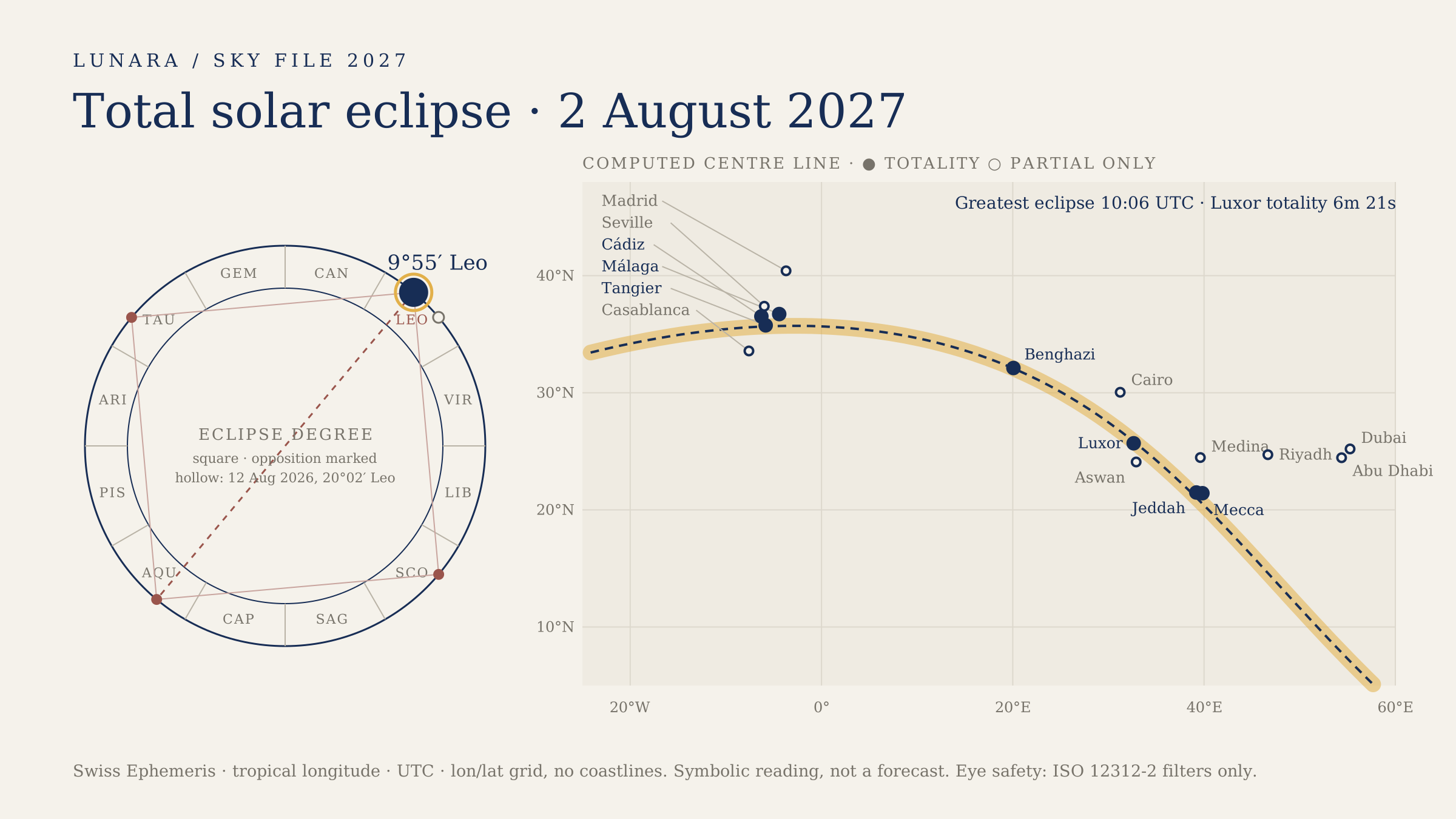
The eclipse at a glance
| Greatest eclipse | · 25.49°N 33.17°E · Sun 82° high |
|---|---|
| Longest totality | 6m 23s (Luxor itself: 6m 21s) |
| Partial phases anywhere on Earth | 07:30 UTC – 12:43 UTC |
| Totality anywhere on Earth | 08:23 UTC – 11:49 UTC |
| Eclipse degree | 9°55′ Leo (tropical) · Lunar node 11°29′ Aquarius |
| Saros series | 136, member 38 |
| Previous total solar eclipse | , 20°02′ Leo |
Inside the path of totality
Spain sees totality for the second August running: the 12 August 2026 eclipse crossed the north of the country; this one clips the far south. Cádiz and Málaga lie near the northern edge of the path, in the mid-morning; Luxor, Jeddah and Mecca lie close to the centre line with the Sun almost overhead, which is why totality there lasts about twice as long.
| City | Starts | Totality | Maximum | Ends | Sun covered | Sun height |
|---|---|---|---|---|---|---|
| CádizSpain · UTC+2 | 09:40 | 2m 53s10:45:26–10:48:20 | 10:46 | 11:59 | Total | 37° |
| MálagaSpain · UTC+2 | 09:42 | 1m 49s10:48:11–10:50:01 | 10:49 | 12:02 | Total | 39° |
| TangierMorocco · UTC+1 | 08:40 | 4m 51s09:44:42–09:49:33 | 09:47 | 11:00 | Total | 38° |
| BenghaziLibya · UTC+2 | 10:10 | 6m 09s11:27:53–11:34:02 | 11:30 | 12:53 | Total | 68° |
| LuxorEgypt · UTC+3 | 11:40 | 6m 21s13:02:08–13:08:29 | 13:05 | 14:26 | Total | 82° |
| AswanEgypt · UTC+3 | 11:42 | edge of path | 13:08 | 14:29 | 99.9% | 83° |
| JeddahSaudi Arabia · UTC+3 | 12:00 | 5m 58s13:22:25–13:28:23 | 13:25 | 14:43 | Total | 76° |
| MeccaSaudi Arabia · UTC+3 | 12:02 | 5m 04s13:24:09–13:29:13 | 13:26 | 14:44 | Total | 75° |
Local clock times (24 h) use each city’s current time-zone rules for that date. “Sun covered” is the share of the solar disc hidden at maximum. Results are for the city centre: a few kilometres can decide totality near the edge of the path.
Nearby, but only partial
Seville (98.4%) and Aswan (99.9%) sit just outside totality in this city-centre calculation; drive towards the centre line to be sure. Cairo (maximum 12:55), Medina, Riyadh (13:32), Dubai (14:43) and Abu Dhabi see a deep partial eclipse, all times local. Mexico City and Buenos Aires see nothing.
| City | Starts | Totality | Maximum | Ends | Sun covered | Sun height |
|---|---|---|---|---|---|---|
| SevilleSpain · UTC+2 | 09:41 | edge of path | 10:47 | 12:00 | 98.4% | 38° |
| MadridSpain · UTC+2 | 09:45 | — | 10:51 | 12:02 | 86.4% | 40° |
| CasablancaMorocco · UTC+1 | 08:38 | — | 09:44 | 10:57 | 97.1% | 36° |
| CairoEgypt · UTC+3 | 11:33 | — | 12:55 | 14:16 | 94.8% | 78° |
| MedinaSaudi Arabia · UTC+3 | 11:57 | — | 13:20 | 14:38 | 94.5% | 76° |
| RiyadhSaudi Arabia · UTC+3 | 12:13 | — | 13:32 | 14:44 | 75.9% | 67° |
| DubaiUAE · UTC+4 | 13:33 | — | 14:43 | 15:48 | 53.3% | 57° |
| Abu DhabiUAE · UTC+4 | 13:32 | — | 14:44 | 15:49 | 57.4% | 58° |
| LondonUK · UTC+1 | 09:03 | — | 10:00 | 10:59 | 41.9% | 40° |
| Mexico CityMexico | Not visible | |||||
| Buenos AiresArgentina | Not visible | |||||
Local clock times (24 h) use each city’s current time-zone rules for that date. “Sun covered” is the share of the solar disc hidden at maximum. Results are for the city centre: a few kilometres can decide totality near the edge of the path.
Eye safety (this part is not astrology)
- Looking at the partly covered Sun without protection can permanently damage your eyes. Use eclipse glasses or a handheld viewer that meets ISO 12312-2, or project the Sun through a pinhole.
- Ordinary sunglasses, smoked glass and phone screens are not safe filters.
- Only inside the path, and only during the minutes of totality, is it safe to look without a filter. Put the glasses back on the moment the first bright bead of Sun returns.
- Cameras, binoculars and telescopes concentrate sunlight: they need a certified solar filter on the front, never just glasses behind them.
- In Luxor, Jeddah and Mecca the eclipse happens around midday in August heat. Plan for shade and water.
Sources: NASA eclipse safety · American Astronomical Society on ISO 12312-2
Your degree, not your Sun sign
Does the 2027 eclipse degree touch your chart?
Copy one position from a tropical birth chart: sign, degree and minute. We measure how far it sits from the eclipse degree and from the three points that square or oppose it.
Method, limits and privacy
The eclipse degree is the Sun–Moon position at greatest eclipse, 10:06 UTC on 2 August 2027, from the Swiss Ephemeris. The bands (1°, 3°, 5°) are common conventions, not rules; astrologers use different orbs.
A contact is a calendar marker for reflection. It does not predict an event, a health change, money, or the outcome of any decision.
Everything runs in your browser. We do not store or send the position you type. A generic “checked” event may be recorded without the sign, degree or any birth data.
A symbolic reading of the Leo eclipse
A new moon at 9°55′ Leo, beside the lunar nodes. A solar eclipse is a new moon close enough to the Moon’s nodes for the Moon to block the Sun. On 2 August 2027 the Moon’s north node sits at 11°29′ Aquarius, so the eclipse falls at the opposite, south-node end of the axis. Astrologers traditionally read south-node eclipses as endings and releases rather than beginnings: what has run its course?
Leo, one year on. The 12 August 2026 total eclipse fell at 20°02′ Leo; this one is about ten degrees earlier, at 9°55′ Leo. Leo is traditionally linked with self-expression, creativity, children and visibility. If both eclipse degrees sit near points in your chart, you can read the pair as one chapter on the same theme.
Who it touches, by degree. A Sun sign alone tells you little. The useful question is whether a natal planet or angle sits near 9°55′ Leo, or near 9°55′ Taurus, 9°55′ Scorpio or 9°55′ Aquarius. That is what the checker above measures. A Moon from a chart without a birth time is uncertain by about ±7°, so treat any contact there as open.
None of this says an event will happen. It is a calendar for noticing, not a forecast, and it is no basis for health, money or relationship decisions.
Method and limits
Swiss Ephemeris (production ephemeris files): swe_sol_eclipse_when_glob for global circumstances, swe_sol_eclipse_when_loc for each city at sea level, tropical geocentric apparent longitudes, Universal Time to the second. Times are computed for each city centre at sea level; local terrain and your exact position change contact times by seconds and, near the edge of the path, can decide whether you see totality at all. Local clock times assume each country keeps its current daylight-saving rules in 2027.
Cross-check: NASA lists the greatest duration of this eclipse as 6m23.2s (NASA interactive path map). For all eclipses through 2026 see our eclipse calendar.
Quick answers
When and where is the total solar eclipse of 2 August 2027?
Greatest eclipse is at 10:06:41 UTC on 2 August 2027, in southern Egypt near Luxor (25.49°N, 33.17°E), where totality lasts 6m 23s. The path of totality runs from the Atlantic across the Strait of Gibraltar (southern Spain and northern Morocco), Algeria, Tunisia, Libya, Egypt, Saudi Arabia and Yemen to Somalia.
How long is totality in Luxor, Jeddah, Mecca and Cádiz?
Calculated for each city centre: Luxor 6m 21s, Benghazi 6m 09s, Jeddah 5m 58s, Mecca 5m 04s, Tangier 4m 51s, Cádiz 2m 53s and Málaga 1m 49s.
Will Madrid, Seville, Cairo, Riyadh or Dubai see totality?
No. They see a partial eclipse: Seville 98.4% of the Sun’s disc covered, Cairo 94.8%, Madrid 86.4%, Riyadh 75.9% and Dubai 53.3%. Even 98% is not totality: the sky stays bright and eye protection is needed the whole time.
Can it be seen from Mexico or Argentina?
No. The eclipse happens while it is still night in Mexico City, and Buenos Aires lies outside the Moon’s shadow altogether; neither city sees any part of it.
What zodiac sign is the August 2027 eclipse in?
The Sun and Moon meet at 9°55′ Leo in the tropical zodiac used by Lunara. Its squares fall at 9°55′ Taurus and 9°55′ Scorpio, its opposition at 9°55′ Aquarius. Sidereal (Vedic) calendars place the same eclipse in mid-Cancer.
How do I watch it safely?
Never look at the Sun, even when it is mostly covered, without eclipse glasses or a viewer that meets ISO 12312-2. Ordinary sunglasses are not safe. Only inside the path, and only while the Sun is completely covered, can you look without them. Cameras, binoculars and telescopes need their own certified solar filters.
Find your degrees to check
The free chart lists every natal planet to the minute. Copy any position into the checker above. If you then choose a paid natal report, it interprets your birth chart as a whole. It is not an eclipse forecast.
Calculate my natal positions