Reference · printable sheet
Birth chart symbols: a legend you can keep beside your chart
A birth chart is written in shorthand. Each symbol is a name: a planet, a zodiac sign, a calculated angle or an aspect between two planets. This page pairs every symbol with its English name. The positions come from a calculator; what they mean is a symbolic tradition, which is a separate step.
Download the reference sheet
One page with everything below: the ten planets, the twelve signs, the Ascendant and Midheaven, the five major aspects and one worked example. It’s an SVG file sized to fit both A4 and US Letter paper.
Download the sheet (SVG)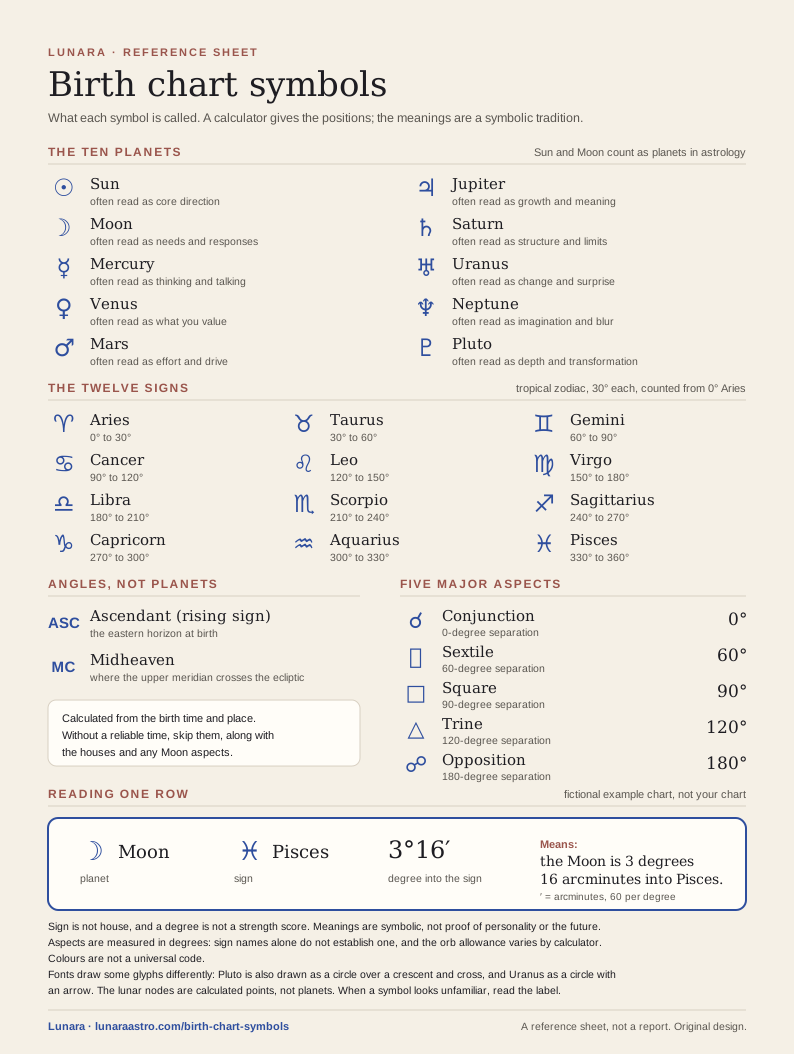
To print it, open the file in any web browser and use Print. Choose your paper size and leave scaling at “fit to page”. It’s a reference sheet, not a report; it holds no personal details.
The ten planets
Astrology calls the Sun and Moon “planets” by convention. The short notes are traditional themes, not measurements.
- Sunoften read as core direction
- Moonoften read as needs and responses
- Mercuryoften read as thinking and talking
- Venusoften read as what you value
- Marsoften read as effort and drive
- Jupiteroften read as growth and meaning
- Saturnoften read as structure and limits
- Uranusoften read as change and surprise
- Neptuneoften read as imagination and blur
- Plutooften read as depth and transformation
The twelve zodiac signs
In the tropical zodiac, each sign is a 30° stretch of the ecliptic, counted in order from 0° Aries. A planet’s sign tells you where it is, not how strong it is.
- Aries0° to 30°
- Taurus30° to 60°
- Gemini60° to 90°
- Cancer90° to 120°
- Leo120° to 150°
- Virgo150° to 180°
- Libra180° to 210°
- Scorpio210° to 240°
- Sagittarius240° to 270°
- Capricorn270° to 300°
- Aquarius300° to 330°
- Pisces330° to 360°
ASC and MC: angles, not planets
These two are points calculated from the birth time and place, usually written as letters. They need a reliable birth time. Without one, leave them out, along with the houses and any Moon aspects.
- Ascendant (rising sign)the eastern horizon at birth
- Midheavenwhere the upper meridian crosses the ecliptic
The five major aspects
An aspect is the angle between two planets, measured in degrees. The angles below are exact geometry. Sign names alone don’t establish an aspect: two planets in signs that are usually three apart can still miss a square, and planets near sign edges can form one across an unexpected pair of signs. How close two planets must be to count (the orb allowance) varies by calculator, and the line colours some charts use are not a universal code.
- Conjunction0-degree separation0°
- Sextile60-degree separation60°
- Square90-degree separation90°
- Trine120-degree separation120°
- Opposition180-degree separation180°
Reading one row
This example comes from the fictional chart in our guide to reading a birth chart. It isn’t your chart or anyone else’s.
Moon Pisces3°16′
Read it as: the Moon is 3 degrees 16 arcminutes into Pisces. The ′ mark means arcminutes, 60 to a degree, not clock minutes.
- The sign isn’t the house. Houses are a separate division that needs a reliable birth time.
- The degree isn’t a strength score. 3° Pisces is no less Pisces than 25°; the degree matters for boundaries and for measuring aspects.
- Symbols describe positions. Interpretations are a symbolic tradition, useful for reflection. They don’t prove anything about personality or the future.
When a symbol looks different
Fonts and chart programs draw some glyphs differently. Pluto is also drawn as a circle over a crescent and cross, and Uranus as a circle with an arrow. Some charts also show the lunar nodes, which are calculated points rather than planets. If a symbol looks unfamiliar, read its label or the program’s own key.
Put the symbols to work
Calculate your free birth chart and read it with the sheet beside you. If you don’t know your birth time, leave it blank; the calculator leaves out anything that depends on the clock.
For a step-by-step method, follow the six-step guide to reading a birth chart. If you’d like your own chart written out afterwards, an automated personal birth chart reading is optional and paid. It’s a fixed written report, not a consultation. The complete fictional sample shows the format first, and the price for your country is shown before you decide.
Original Lunara reference. Glyphs are standard Unicode astrological symbols shown with your device’s fonts; nothing on this page is calculated from your data.