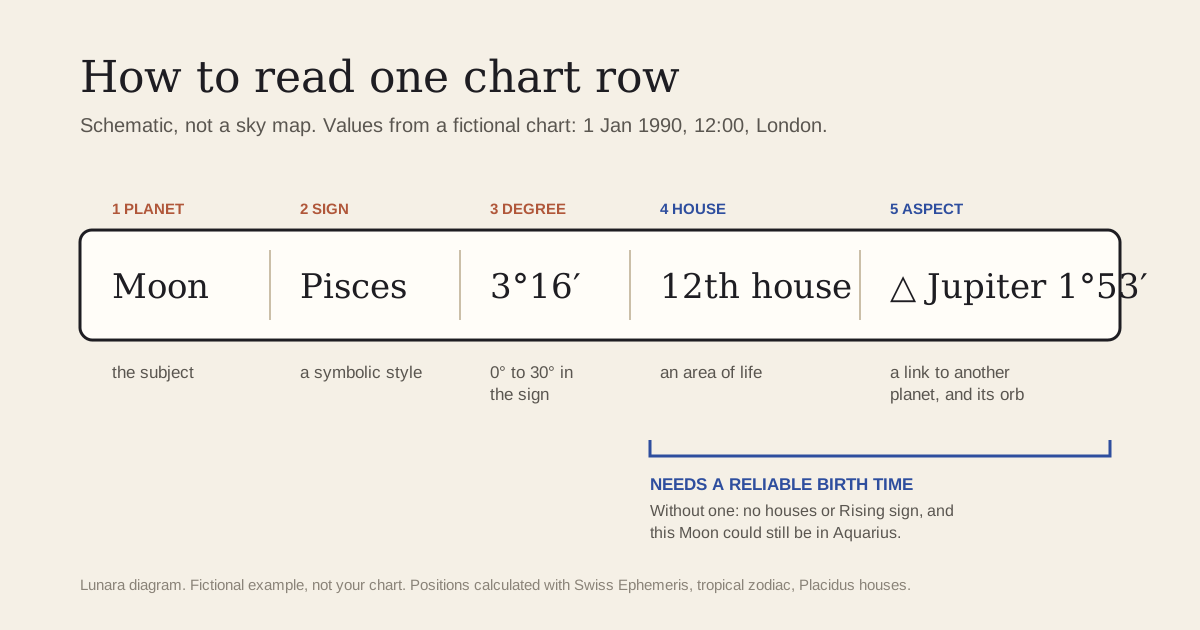
A birth chart looks like a dense wheel of symbols, but you only ever read it one row at a time. Each row says which planet, which sign, how far into that sign, which house and which other planets it connects with. Learn to read one row properly and the rest of the wheel is repetition.
This guide uses one example chart throughout. It is fictional: 1 January 1990, 12:00 noon, London. It is the same invented chart as Lunara's sample reading, calculated with Swiss Ephemeris, the tropical zodiac and Placidus houses. It is not your chart and not a real person's.
One ground rule before the steps. The positions are calculated. What they mean is a symbolic tradition, useful for reflection, not a diagnosis of your personality or a forecast.
Step 1: Check whether the time is reliable
Before reading anything, ask where the birth time came from. A time from a birth certificate or hospital record is reliable. "Around lunchtime" or "Mum thinks morning" is not.
The time matters more than most people expect. In the example chart, the Sun sits 0°56′ past the Midheaven, the line that starts the 10th house. If the same person had been born five minutes later, at 12:05, the Sun would fall in the 9th house instead. The Sun's sign and degree would barely change; its house would.
So the rule is simple: signs and degrees of most planets survive a small time error, houses and the Rising sign often don't. If your time is unknown or rounded, read signs first and treat houses as provisional or leave them out. We come back to this at the end.
Step 2: Read one row: planet, sign, degree
Pick the Moon. In the example, the row reads Moon, Pisces, 3°16′.
If the chart shows symbols instead of names, keep our birth chart symbols reference sheet open beside it.
- The planet is the subject. The Moon is traditionally about habitual responses and what helps you settle after a difficult day.
- The sign is the style. Pisces is read as quiet, imaginative and absorbent, taking in the mood around it.
- The degree is the position inside the sign. Every sign spans 30°. 3°16′ means 3 degrees and 16 arcminutes into Pisces, early in the sign. The ′ mark is arcminutes (60 to a degree), not clock minutes.
The degree is not a strength score. A Moon at 3° Pisces is not "less Pisces" than one at 25°. You need the degree for two practical jobs: checking whether a planet is near a sign or house boundary, and measuring aspects.
Step 3: Tell the house apart from the sign
Signs and houses are easy to confuse because there are twelve of each. They answer different questions:
- The sign comes from where the planet is along the zodiac. It changes slowly.
- The house comes from the birth time and place: the sky is divided into twelve sections from the local horizon. It turns all the way round in a day.
In the example, the Moon is in Pisces and in the 12th house. The 12th house starts at 28°08′ Aquarius, so the Moon sits about 5° inside it. Traditionally, the 12th house is read as privacy, retreat and what happens out of view. For a short meaning of each of the twelve, see what the houses in astrology mean. If some of your houses have no planets at all, the empty house calculator shows which ones and where to read them instead. If another site puts some of your planets in different houses, the Whole Sign vs Placidus comparison shows whether a different house system explains it.
So the full row reads: the Moon (responses), in Pisces style (quiet, absorbent), in a 12th-house area (privacy). Notice that the sign and the house point in a similar direction here. That's a reason to look at the theme, not proof of anything.
Step 4: Choose one aspect by its actual degree
Aspects are the lines across the middle of the wheel. They're angles between planets: 0° conjunction, 60° sextile, 90° square, 120° trine, 180° opposition. Don't try to read them all. Choose one that is close to exact, and check the numbers yourself.
In the example, the Moon is at 3°16′ Pisces and Jupiter is at 5°09′ Cancer. Pisces and Cancer are four signs apart, which is about 120°, a trine. The exact gap is about 121°53′, so the orb, the distance from a perfect 120°, is 1°53′.
That's close, and Lunara's report for the example includes it among the chart's aspects. A trine is traditionally read as an easy channel between two themes. Here: the Moon's need to settle, and Jupiter's themes of hope, generosity and perspective. Easy is not the same as guaranteed or good. Lunara's own text for this aspect asks: "Do you need encouragement right now, or permission not to feel optimistic yet?"
Lines drawn in red or blue are a display convention. Two calculators may draw different lines because they use different orb allowances. Check the degrees before trusting the picture. To list every major aspect in your own chart with its distance from exact and the orb Lunara allows, use the birth chart aspects calculator.
Step 5: Combine two placements as a question
This is where most readings go wrong. Two descriptions get stacked into a verdict: "You are an empath who absorbs everyone's pain." That sentence can't be checked and doesn't help.
Instead, combine two placements into a question you can answer from your own life. Here is a tiny worked reading for the fictional chart:
Placements. Moon in Pisces in the 12th house, trine Jupiter in Cancer.
Tension. Lunara's sample reading puts it this way: taking in the mood of a room can leave you unsure which feelings are yours. The Jupiter link adds a possible pattern: reassurance can turn into a rush to find the bright side.
Question. After your last tiring day, how much of what you felt began with you, and how much did you absorb from someone else?
One thing to try. Choose one evening this week to ask for quiet by name: "I need an hour with no messages or plans tonight." Afterwards, write one sentence about what you actually needed.
The question and the practice are quoted from Lunara's report text for this chart. Your answer is the evidence. If it doesn't fit, that's a useful result, not a sign you are "suppressing" your Moon.
Step 6: Stop before you over-read
A chart has ten planets, twelve houses and dozens of aspects. You can always find one that fits any story, which is exactly why you should stop early. A useful first reading is:
- one row, read fully;
- one close aspect, checked by degree;
- one question you can test this week.
Leave the rest uninterpreted for now. Avoid readings that tell you what happened in your childhood, what someone else thinks of you, or what will happen next. Astrology can't establish those, and a good reading doesn't try.
The same day without a birth time
Now remove the time. Lunara calculates the same date and place with no birth time and the picture changes:
- No Rising sign and no houses. The report leaves out the Ascendant, Midheaven and all twelve houses instead of guessing. Step 3 above can't be done.
- The Moon becomes unresolved. On 1 January 1990 the Moon moved from Aquarius into Pisces at about 6:11 in the morning, London time. Without a time, either sign is possible, so neither is chosen.
- The Moon–Jupiter trine drops out. The untimed report doesn't list it. Across that day the gap from an exact trine ran from almost 0° to nearly 9°, so the 1°53′ orb from Step 4 belongs to the noon example only.
- The Sun stays. Capricorn holds all day, so the Sun row still works.
Never fix an unknown time by typing noon and reading the result as yours. If you don't know your time, read what holds all day. Our guide to a birth chart without a birth time shows how to do that.
Try it on your own chart
Calculate your chart with the most reliable details you have, then do the six steps on one row: check the time, read the planet, sign and degree, add the house only if the time supports it, pick one close aspect, and write one question.
Calculate your free birth chart. It's free, and you can leave the time blank if you don't know it.
If you want the rest of the chart written out afterwards, a personal birth chart reading is optional and paid. It's an automated written report built from your calculated chart, not a consultation with an astrologer. The current price for your country is shown before checkout, and the fictional sample shows the format first.
Calculation notes
Example: 1 January 1990, 12:00 (UTC, London winter time), 51.5074° N, 0.1278° W; tropical zodiac; Placidus houses; Swiss Ephemeris through Lunara's production calculation. Moon 3°16′ Pisces, Jupiter 5°09′ Cancer, trine orb 1°53′; Sun 10°49′ Capricorn, Midheaven 9°53′ Capricorn. Untimed results come from the same calculator run with no birth time. Quoted reflection text comes from Lunara's report library. All birth details are invented.
Rewritten 13 October 2026, replacing an earlier generic guide and five near-identical variants. Text written with AI assistance. The diagram is a Lunara schematic, not a picture of the sky.