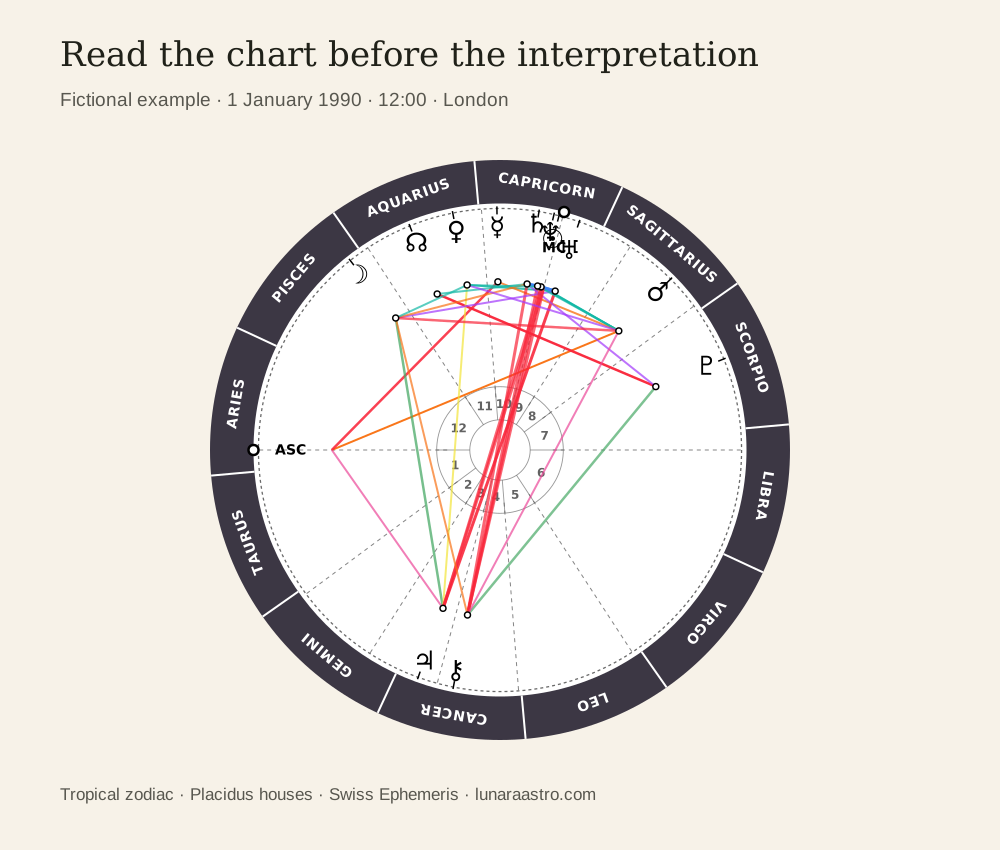
The wheel looks more difficult than it is. You do not have to interpret every line before you can say something useful about your chart.
Start with one placement. Find the planet, read its sign, then check its house if you have a reliable birth time. After that, look at one aspect. Keep the calculated positions separate from what you think they mean.
Below is a worked example using Lunara's own calculator. The birth details are fictional: 1 January 1990, 12:00 noon, London. This is not a customer chart or a claim about a real person's life. You can compare it with the same fictional chart in our sample natal reading.
First, check the chart you are reading
Three choices matter before you open an interpretation:
- Birth details. A date, local time and birthplace are the inputs. “London at noon” is not the same instant as “New York at noon.” Use the clock time recorded at birth, not a time you converted to another zone yourself.
- Zodiac. This example uses the tropical zodiac. A sidereal chart uses a different reference, so a sign difference does not automatically mean one calculator is broken.
- House system. This example uses Placidus. Whole-sign houses organize the wheel differently. Compare like with like before treating a house difference as an error.
Lunara calculates positions with Swiss Ephemeris. That supports the astronomical calculation; it does not scientifically establish a personality reading or a prediction. Astrology here is a symbolic framework for reflection, not a way to diagnose yourself or decide your future.
1. Read a planet and its sign
The planet identifies the subject of an astrological interpretation. The sign supplies a symbolic style. For a first pass, use these three entries:
| Entry | Calculated example | Traditional subject | | --- | --- | --- | | Sun | Capricorn, 10°49′ | Direction, identity and what you try to build | | Moon | Pisces, 3°16′ | Emotional habits, comfort and responses | | Ascendant, also called rising | Aries, 24°57′ | The chart's eastern horizon and first-house starting point |
The Ascendant is an angle, not a planet. Its sign depends on the birth time and location. The Sun and Moon positions also depend on the instant, though they do not move at the Ascendant's pace.
For the Sun in Capricorn, a traditional reading might start with responsibility, structure or sustained effort. That is an interpretation of the position, not a fact calculated by the ephemeris. A useful question is: Where do I enjoy building something that takes time?
For the Moon in Pisces, you might explore sensitivity, imagination or porous emotional boundaries. Try a question you can actually answer: After a difficult day, do I need solitude, conversation, movement or something else?
Your answer is evidence about your life. The chart is a prompt. If a description does not fit, you do not need to explain it away by claiming you are suppressing your “true” sign.
What does 10°49′ mean?
Each zodiac sign occupies 30 degrees. The Sun in this example is 10 degrees and 49 arcminutes into Capricorn. There are 60 arcminutes in a degree; the mark ′ is not a clock minute.
The degree helps you compare positions and aspects. It is not a personality score, a level of spiritual development or a measure of how strongly you “are” your sign.
2. Add the house, if the time supports it
Signs and houses answer different questions. In a traditional reading, the sign gives a style and the house gives an area of life.
Our fictional noon time places:
| Placement | House in this example | Traditional area to explore | | --- | --- | --- | | Sun in Capricorn | 10th | Public responsibilities, work and reputation | | Moon in Pisces | 12th | Privacy, retreat and experiences kept out of view |
You could combine the first row as: Sun + Capricorn + 10th house. A cautious reading might explore identity expressed through long-term public work. It cannot tell you which job to take, how successful you will be or whether other people respect you.
The Moon's 12th-house placement could prompt a question about private emotional space. It does not establish loneliness, hidden trauma or a mental-health condition.
Houses begin at boundaries called cusps. In a Placidus chart, their sizes are not all equal. A planet near a cusp is a reason to check the birth-time accuracy and the calculator's house convention, not a reason to invent a blended verdict.
3. Read one aspect, not the whole web
The lines across the middle of a chart represent angular relationships. Common examples are a conjunction near 0°, a square near 90°, a trine near 120° and an opposition near 180°.
Pick one instead of treating the wheel as a list of problems. In this example:
- Sun: 10°49′ Capricorn.
- Neptune: 12°02′ Capricorn.
- Their angular gap: approximately 1°13′.
They form a Sun–Neptune conjunction under Lunara's aspect settings. The orb of this conjunction is its distance from exact alignment: approximately 1°13′. Other aspects have different exact angles; for a square, the orb is the distance from 90°, not the whole separation between planets.
A traditional interpretation might put direction and identity alongside imagination, ideals or uncertainty. A practical question could be: When I commit to a goal, am I responding to something concrete or to an appealing picture of it?
That question does not prove this fictional person is artistic, confused, deceptive or destined for a particular career. Nor does a conjunction mean the two bodies were close together in space. The chart measures their directions as seen from Earth.
Do red lines mean something bad?
No. Colors are a display convention. Different sites use different palettes and aspect settings. A square may be discussed as tension; a trine may be discussed as ease. Neither is a verdict that an event will go badly or well.
Two calculators can display different lines because they use different orb allowances or include different points. Read the legend before comparing the pictures.
4. Make a short reading you can question
Do not concatenate three descriptions and call the result a diagnosis. Write one sentence, then give yourself a way to disagree with it.
For this fictional chart, a first attempt might be:
“I could explore the tension between wanting to build something solid in public and needing a private, imaginative space to recover.”
This sentence uses the Sun's sign and house alongside the Moon's sign and house. It is an illustrative interpretation, not an observed biography.
Now ask:
- What specific experience makes this feel relevant?
- What experience contradicts it?
- Am I learning anything useful, or just finding familiar words flattering?
You can leave a placement uninterpreted. You can also decide a reading is not useful. No chart requires you to surrender your judgment.
If two descriptions seem to cancel each other out, work through a fictional situation with the Sun, Moon and Venus. That exercise separates a calculated position from a symbolic hypothesis and a practical choice; it does not add more personality labels.
What if you do not know your birth time?
Choose unknown time rather than guessing noon. A representative noon calculation is a computational reference, not your actual rising sign.
Without a reliable time:
- Do not use an invented Ascendant or houses. The house examples above rely on the fictional noon time.
- Check the Moon's possible signs across the local birth day. If it crosses a sign boundary, both possibilities stay open.
- Check the Sun on a sign-change day too. Being born on a calendar “cusp” does not create a blended Sun sign. The exact instant determines which side of the boundary applies; an unknown time can leave that unresolved.
- Be cautious about exact degrees and tight aspects. A noon snapshot must not be presented as the person's settled birth position.
The same limit applies to celebrities. A precise time printed online is not automatically a reliable birth record. A detailed-looking wheel can still be built on an uncertain input.
Your first pass: keep it small
Calculate your chart using the most reliable details you have. Read the Sun and Moon first; add the Ascendant and houses only when the time is supported. Then choose one aspect and write one question about it.
You do not need an encyclopedic interpretation to begin. You need to know which positions you are reading, which assumptions created them and which statements are interpretations rather than facts.
Lunara's calculator is free. A personalized natal reading is optional and paid, with the applicable price shown before Checkout. It expands the chart into written sections you can read online or print with your browser's Print / Save as PDF, including a reflection-notebook page. The fictional sample shows the format before you decide; it is not a customer's result or a promise that astrology will explain everything.
Calculation notes and sources
This example uses 1 January 1990 at 12:00 UTC, London coordinates 51.5074° N, 0.1278° W, a tropical zodiac and Placidus houses. The degrees above are rounded to the nearest arcminute from the same production calculation used by Lunara's fictional sample. The wheel and aspect example are calculated, not generated images.
- Swiss Ephemeris programming documentation: planetary positions, house calculations and time conversion. This documents calculation methods, not evidence for personality claims.
- Astrodienst's introduction to astrology: background on the traditional symbolic vocabulary.
The worked example and image were revised 2 October 2026 to replace an earlier generic tutorial. No real person's birth details were used.