One paragraph says you value discipline. The next says you need to retreat. A third describes independence in relationships. Read them as permanent personality labels and you end up with someone who apparently wants everything at once.
Astrology chart interpretation becomes more useful when you turn those descriptions into questions about a specific situation. You can explore wanting to finish a job, needing rest and making room for another person without declaring any of them your true nature.
The planetary positions are calculated. The meanings attached to them are symbolic interpretations, not scientifically established personality facts. A chart cannot tell you what happened in your childhood, what your partner thinks or which decision will work out.
This guide uses one fictional chart throughout. If you first need help finding signs, houses or aspects on the wheel, use our separate chart-reading walkthrough.
The example: three placements, three different subjects
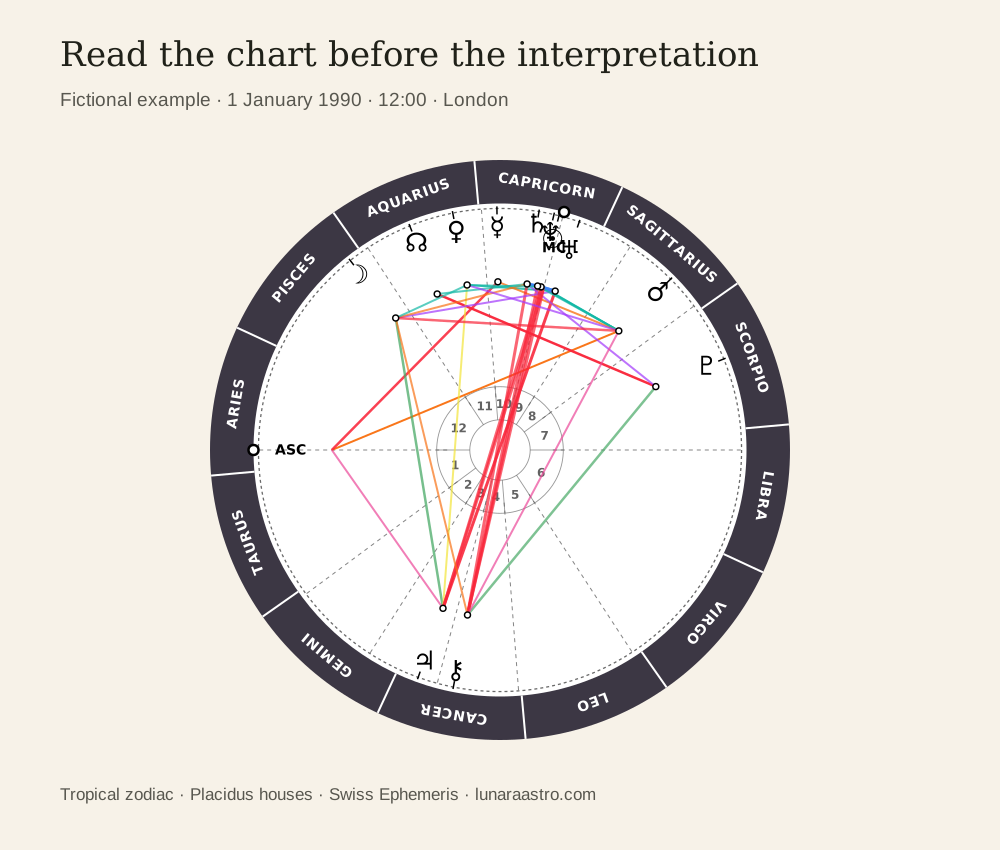
We use the same birth details as Lunara's fictional sample reading: 1 January 1990, 12:00 noon in London, with the tropical zodiac. These are invented details for an example, not a customer's birth record.
| Placement | Calculated degree within the sign | A traditional subject for reflection | | --- | --- | --- | | Sun in Capricorn | 10.81° | Direction, responsibility, sustained effort | | Moon in Pisces | 3.27° | Emotional response, imagination, recovery | | Venus in Aquarius | 6.22° | Affection, friendship, room for individuality |
The degrees come from Lunara's existing Swiss Ephemeris calculation. They are decimal degrees, not degrees followed by arcminutes. This article does not infer anyone's life from them or assign a strength score to a placement.
Notice that the rows address different subjects. An interest in making a long-term commitment does not rule out needing quiet after an exhausting day. Wanting some independence in a relationship does not settle whether you can keep a promise. The broad descriptions only become useful when you ask what, if anything, fits your actual experience.
Put the reading into a situation
Imagine a Friday evening. You have work to finish before Monday. A friend asks for a long call, and someone you are dating wants to make plans. You feel tired. The situation is fictional too; none of these circumstances was calculated from the chart.
A careless interpretation might say:
"Your Capricorn Sun makes you put work first. Your Pisces Moon absorbs everyone's emotions. Your Aquarius Venus makes you emotionally unavailable."
That sentence invents motives, turns symbolism into cause and gives the person little room to disagree. Adding more placements would not repair it.
A more usable reading asks separate questions.
The Capricorn Sun question: what responsibility is actually yours?
Try: "Which part of this deadline matters, and which part is a standard I have added myself?"
Perhaps you agreed to send a finished document. Perhaps you promised a rough draft but now feel compelled to polish every sentence. That distinction comes from the agreement and your own experience, not from Capricorn.
An illustrative answer could be: "I owe a draft on Monday. I do not owe a perfect version tonight." You can then decide whether to work for another hour or stop. The chart does not choose for you.
If you usually have trouble starting rather than stopping, the responsibility prompt may miss the issue. Write that down instead of forcing yourself into a description of a relentless worker.
The Pisces Moon question: what would help you recover?
Try: "When I am tired, does listening to someone help me feel connected, or leave me with less energy?"
You might welcome the call. You might want twenty minutes rather than two hours. You might prefer to talk tomorrow. Your answer can change with the day and the person.
A possible reply is: "I want to hear you, but I only have twenty minutes tonight. Can we talk properly tomorrow?" This is an invented communication example, not advice based on a predicted emotional condition.
The Pisces symbolism does not prove that you absorb emotions, cannot set boundaries or have hidden trauma. If solitude makes you feel worse and company helps, keep that observation. It matters more than making the paragraph fit.
The Aquarius Venus question: what does room for yourself mean here?
Try: "Am I asking for time on my own, or avoiding saying what I want?"
Those are different possibilities. Choosing a quiet evening need not mean rejecting the person you are dating. Repeatedly disappearing without discussing expectations is a different behavior, and a Venus sign does not excuse it.
An illustrative plan might be: "Tonight I need to finish this and sleep. I'd like to see you Saturday afternoon." That names a limit and offers a concrete alternative. It does not prove the other person will like the plan or that the relationship is compatible.
If making plans together feels easy and you rarely want separate time, reject the independence hypothesis. You do not have to search for a hidden version of yourself to rescue it.
Write a short synthesis, then try to disprove it
For the fictional situation, a cautious synthesis could be:
"I want to keep a commitment without using my whole evening. I can check what the deadline really requires, limit a call if I am tired, and make a specific plan with someone I want to see."
This combines questions associated with the three placements. It is not an observed biography. Someone with a completely different chart could find it useful, which is a reason to avoid claiming the advice proves astrology.
Now add two notes:
- An actual occasion when this description fits.
- An actual occasion when it does not.
If you cannot find a relevant example, leave the interpretation open. If only a vague statement such as "I sometimes need space" fits, the reading may not be telling you much. Familiarity is not evidence of a distinctive personality finding.
Choose one small, reversible action if you want to use the exercise: clarify the deliverable, propose a shorter call, or name a time to meet. Afterwards, record what happened. Do not turn a chart paragraph into a reason to leave a relationship, make a financial commitment or ignore professional advice.
Do not use another placement to explain away every disagreement
A reading becomes impossible to question if every objection gets a new astrological explanation. "You don't feel independent because your Moon overrides your Venus" may sound sophisticated, but it still needs a reason beyond wanting the original paragraph to be right.
Before adding houses or aspects, check whether you have a useful question already. You can also choose a different subject. A Venus passage about dating may be irrelevant if what you want to explore is friendship, taste or how you share time.
The same restraint applies to other people. Your chart cannot establish whether someone loves you, why they did not reply or what they will do next. Ask them about their intentions when that is appropriate; do not substitute a placement for their answer.
What changes when the birth time is unknown?
Our noon time is part of a fictional example. It is not a recommendation to enter noon when you do not know your time.
If you do not know your birth time, leave the time field blank in the calculator rather than entering noon, and choose your birth city if you know it so the calculator can check your whole local birth day. Do not make claims about your Ascendant or houses from a representative time. Check whether the Moon crosses a sign boundary during your local birth day; if it does, keep both signs open rather than selecting the description you prefer. Exact degrees and tight aspects also need caution when the instant is uncertain.
This article deliberately avoids house claims. The known noon time supports the sample's calculated positions, but it supplies no evidence about a person's relationships or feelings. A precise-looking chart and a convincing interpretation are different things.
Try the method on your own chart
Start with one situation you want to think about. Calculate your chart with the details you can support, choose a relevant placement, and turn its symbolic description into a question. Give yourself permission to answer "that does not fit."
Lunara's chart calculator is free. The personalized natal reading is optional and paid, with the applicable price shown before Checkout. It organizes the calculated chart into written sections and includes a reflection notebook; you can view it online or use your browser's Print / Save as PDF. Read the fictional sample before deciding whether that format is worth paying for. The sample is a demonstration, not a testimonial or a forecast.
Calculation and editorial notes
The example uses 1 January 1990 at 12:00 UTC, London coordinates 51.5074° N, 0.1278° W. Sun, Moon and Venus positions were taken from Lunara's existing production calculation using Swiss Ephemeris in the tropical zodiac. The linked sample uses Placidus houses; this exercise makes no house-based interpretation.
- Swiss Ephemeris documentation explains the calculation system. Astronomical calculation accuracy does not establish the personality claims of astrology.
This AI-authored article was rewritten 4 October 2026 to replace an earlier generic guide. Its scenarios and suggested wording are invented examples. They have not been reviewed by an independent astrologer, and they are not psychological, medical or relationship diagnoses.