Grace Carter's debut album, When Saturn Returns, is out on October 16, 2026: thirteen songs, thirty-three minutes, released under exclusive licence to UnitedMasters. Clash, reporting the announcement, says the record took years to make, and Carter describes it as made "on my terms".
That's what the sources tell us, and it's worth staying close to it. This isn't a review; we're not writing about the songs. Nor is it a reading of Carter's chart. It's about the phrase in the title: where it comes from, what it actually measures, and why people reach for it when a long piece of work finally lands.
A title is not a birth chart
An astrological phrase in an album title doesn't tell us why Carter chose it, what Carter believes about astrology, or when Carter's own Saturn return falls. We haven't read a statement explaining the choice, and we haven't calculated a chart: no birth date, time or place has been verified here, so this piece has no dates for Carter. If you see a confident "Grace Carter's Saturn return is happening now" somewhere, treat it as a guess.
What we can say is that the phrase has a precise meaning, and it's a good one to know.
What "Saturn returns" measures
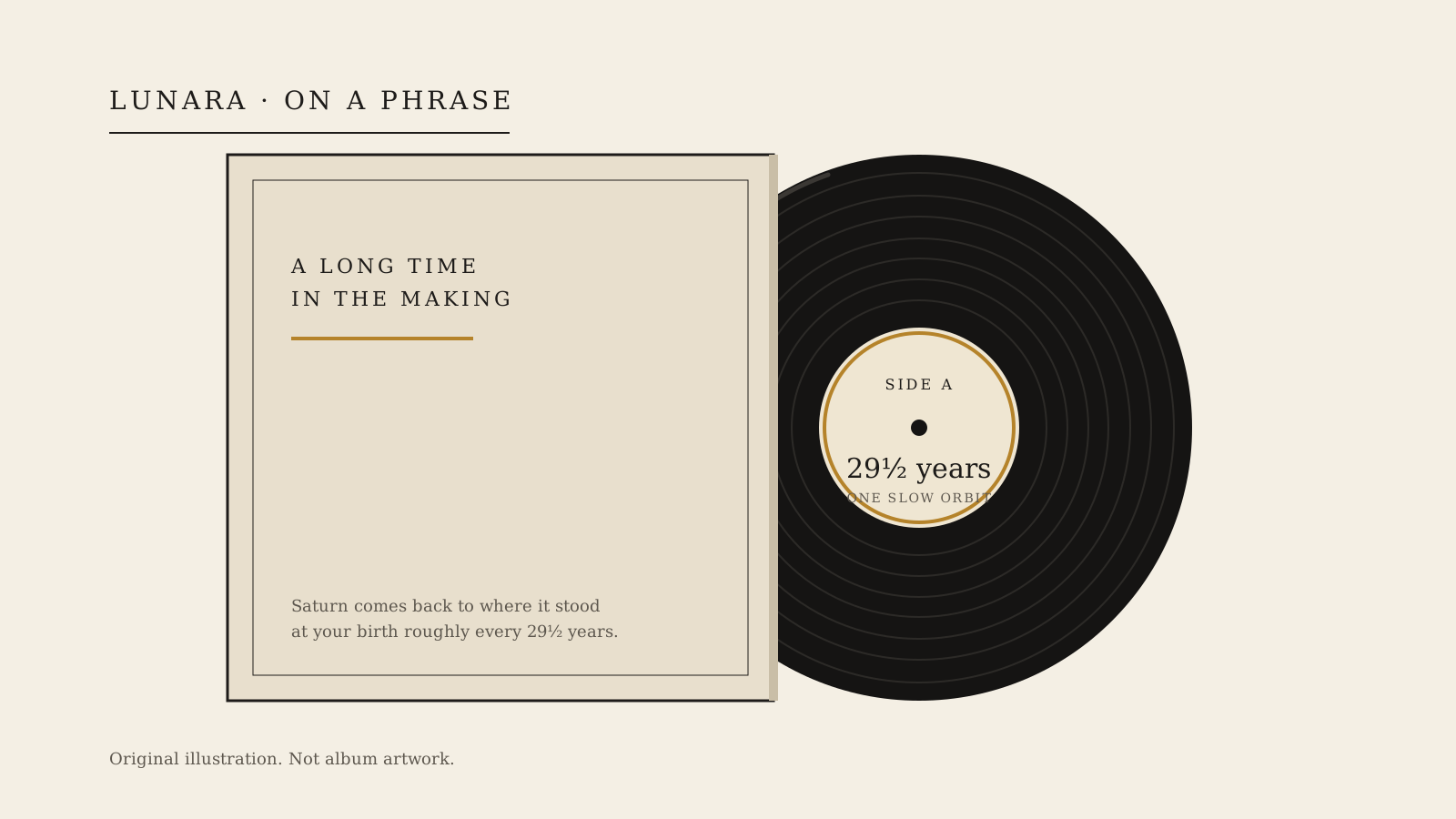
Saturn is the slowest planet you can see with the naked eye. Seen from Earth, it takes about 29½ years to travel once around the zodiac. At the moment you were born it stood at one degree of one sign; astrologers call that your natal Saturn. A Saturn return is Saturn coming back to that same position. Most people meet the first in their late twenties, the second in their late fifties and, if they live long enough, a third in their late eighties.
Two details get lost in the shorthand. First, it's geometry, not an appointment: a planet arriving back at a point on a circle. Second, it's often not one day. For several months each year Saturn appears to move backwards (retrograde), so it can cross your natal degree, slip back over it and cross again. One return can have a single date or three, which is explained step by step in why your Saturn return can have three dates.
Why the phrase belongs to the late twenties
In astrological tradition Saturn is the planet of structure, time, limits and the slow work of making things that last. So the first return, somewhere around 28 to 30, became shorthand for a reckoning: the point where early plans either get built properly or get let go. People use it for moving cities, ending a chapter, changing direction, or finally finishing the thing they'd been circling for years.
Read generously, the tradition is less about catastrophe than about authorship. Saturn's question is what you're willing to take responsibility for, and on whose terms. That's partly why the phrase works so well on anything long in the making, and partly why it's so easy to over-read. Plenty of people finish big things at 29 without any help from Saturn, and plenty of Saturn returns pass quietly. The planet doesn't make the album, the move or the break. Astrology offers a calendar and a vocabulary for looking at them, nothing more binding than that.
Why it lands as a title
There's something apt about a phrase that measures a long arc sitting on a debut that took years. "Return" suggests coming back to where you started, and Saturn's version means arriving there again with about three decades of evidence. You don't need to believe in astrology to recognise that shape: the slow build, the long wait, the moment it's finally yours.
That's as far as the title can take us. Anything more about why Carter chose it is Carter's to say.
Finding your own dates
If the phrase has you wondering about your own timing, Lunara's free Saturn return calculator needs only your birth date. It takes your natal Saturn at 12:00 UTC on that date. Then it finds every moment around your first three returns when Saturn's position exactly matches it, including the extra passes a retrograde loop adds, and lists them as dates in UTC.
Because it doesn't use a birth time, your natal degree is approximate, so treat the dates as estimates. Near a retrograde turn, even a small difference can move a pass noticeably.
The calculator page includes a worked example for a fictional birth date, August 3, 1997: one pass for the first return, in April 2027, and three for the second, in 2056 and 2057. Your list will look different.
A return date is a prompt for reflection, not a forecast. It can't tell you whether something will go well, and it isn't medical, financial or life advice.
If you'd like the wider picture (Saturn's sign and house, and how it fits with the rest of your chart), you can calculate your full birth chart for free. There's also an optional, paid personal birth chart reading that gives a written interpretation of that chart. It's an automated symbolic reading, not a prediction or a consultation, and the price for your country is shown before you decide.
Sources: release date, track count, running time and label from the album's Apple Music listing. Announcement and Carter's statement from Clash, paraphrased with one short quotation. No lyrics, artwork or audio are used, and nothing here describes the songs. Saturn return method from Lunara's calculator, which uses the central Swiss Ephemeris calculation. Written with AI assistance and edited by Lunara; the illustration is original.