You look up your Saturn return and get not one date but three. It's a common surprise, and a reasonable one: a "return" sounds like a single moment. Here's why a Saturn return can arrive in stages, why some arrive all at once, and what the dates can and can't tell you.
What a Saturn return is
At the moment you were born, Saturn occupied a particular point in the zodiac, a specific degree of a sign. That's your natal Saturn. A Saturn return happens when Saturn, moving through the sky, comes back to that same zodiac longitude.
Saturn takes roughly 29 to 30 years to go all the way round. So most people meet it three times in a long life: a first return around the late twenties, a second around the late fifties, and a third, for those who live long enough, in their late eighties.
That's the first kind of "more than one": separate returns, decades apart.
The other kind: several contacts within one return
The three dates people usually ask about are something different. They belong to a single return.
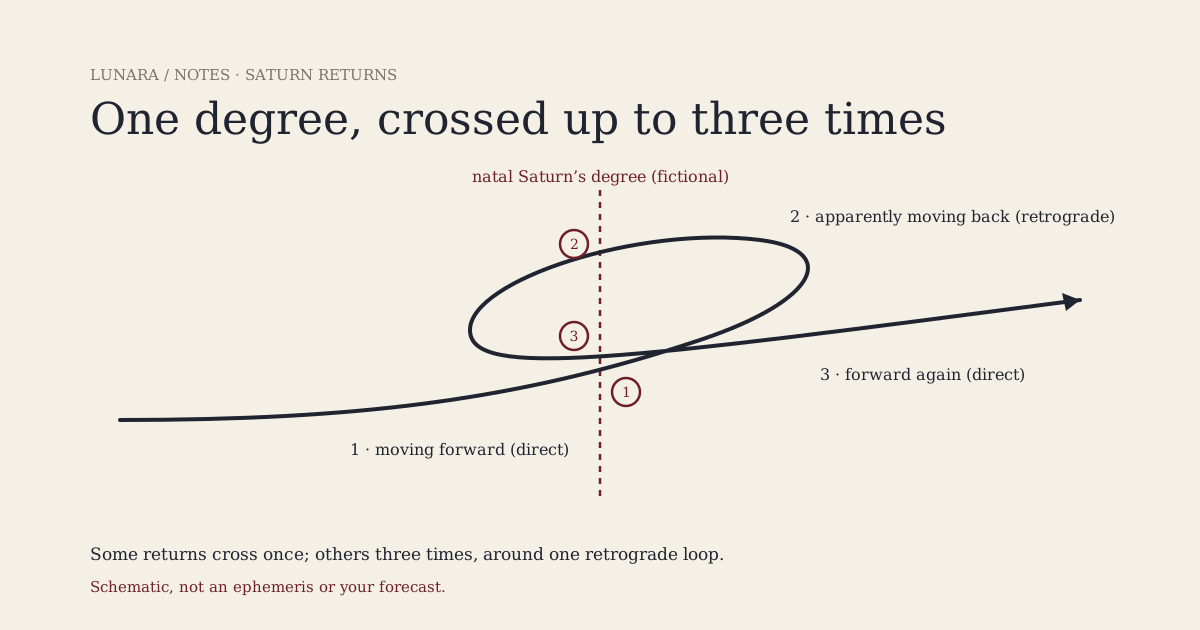
From Earth, Saturn doesn't move forward through the zodiac at a steady pace. For several months each year it appears to slow, stop, move backwards, stop again, and then resume its forward motion. Astronomers call the backward phase apparent retrograde motion. NASA describes it with a running-track picture: Earth, on an inner lane, moves faster than the outer planets, and as it catches up with and passes them, they appear to slide backwards against the background sky (NASA). Nothing about Saturn's real orbit reverses. It's a change of viewpoint.
Now put your natal Saturn degree in the path of that loop. If Saturn reaches your degree while moving forward, then backs over it during retrograde, then crosses it again moving forward, you get three exact contacts in one return:
- First pass: Saturn moving forward, reaching your degree.
- Second pass: Saturn apparently moving backwards, crossing it again.
- Third pass: Saturn moving forward once more, crossing it a final time.
Whether that happens depends on where your natal degree falls relative to the loop. If Saturn's retrograde turn happens just before it reaches your degree, or well after it has passed, the loop never doubles back over it. Then that return has one exact contact. So a return can have one date or three, and the number can differ from one return to the next in the same life.
A reflection for each contact
Astrology traditionally links Saturn with structure, responsibility, time and commitment. If you like working with symbolism, each pass can be a natural checkpoint. These are optional prompts, not a measured cosmic sequence and not a guarantee that anything will happen on a given date.
- At the first pass: What feels like it's asking for more structure, or less pretending?
- At the second pass: What are you revisiting? Is there something you started deciding that needs a second look?
- At the third pass: What are you ready to commit to, or put down, now that you've had time with it?
With a single-contact return, you might use one question that covers all three: what deserves a more honest, durable shape in your life right now?
What the dates do and don't tell you
The dates are useful. They're also easy to over-read.
They do tell you:
- When Saturn, by calculation, is exactly back at your natal Saturn degree.
- Whether your return has one exact contact or three.
- Roughly how long the whole episode spans, from first to last contact.
They don't tell you:
- What will happen to you, or when. A pass date isn't an event date.
- Whether to leave a job, end a relationship, move house or change any medical treatment. Those decisions belong to your actual circumstances, and to the people and professionals involved, not to a planetary timestamp.
- That nothing matters outside the exact dates. Many astrologers talk about a broader Saturn return period of a year or more around the exact contacts. That window is an interpretive convention, not something the calculation measures.
The practical way to use the dates is as reminders to pause and reflect, not as deadlines.
Exact passes and wider windows
It helps to keep two ideas apart.
An exact pass is a calculated moment: Saturn's longitude equals your natal Saturn's longitude. It's arithmetic, and a good ephemeris can find it to well within a day.
An interpretive window is the stretch of time astrologers choose to treat as "your Saturn return". Some use the period from the first pass to the last. Others add months on either side, or start from when Saturn enters the same sign. Just be clear about which one a source is using.
How the free calculator finds your dates
Lunara's Saturn return calculator asks only for your birth date. It takes your natal Saturn at 12:00 UTC on that date. It then searches a window of a few years around each of your first three expected returns and finds every moment when Saturn's longitude exactly matches your natal Saturn's, including the extra crossings around a retrograde turn, refining each one numerically. It lists the passes for each return as calendar dates, shown in UTC, and notes which return you're in now, if any.
Because it uses a noon-UTC reference instead of your birth time, the dates are a close estimate, not a personal timestamp.
When your birth time matters
Saturn moves slowly, usually a small fraction of a degree a day. So your natal Saturn barely changes between the start and end of your birth date, and knowing your exact birth time shifts the pass dates only a little. Near a retrograde turn, where Saturn is almost standing still, even a small change in the natal degree can move a pass by more days than usual. A reliable birth time helps most there, but no method gives perfect certainty about what a date will mean.
Beyond the return
Your Saturn return is one moving planet meeting one point in your birth chart. If you'd like to understand that birth chart itself, the sample natal reading shows how Lunara writes up a full chart. There's also an optional paid personal birth chart reading, an interpretation of your natal chart rather than a Saturn return or transit forecast. What's included and the price are shown before you buy.
Text written with AI assistance.