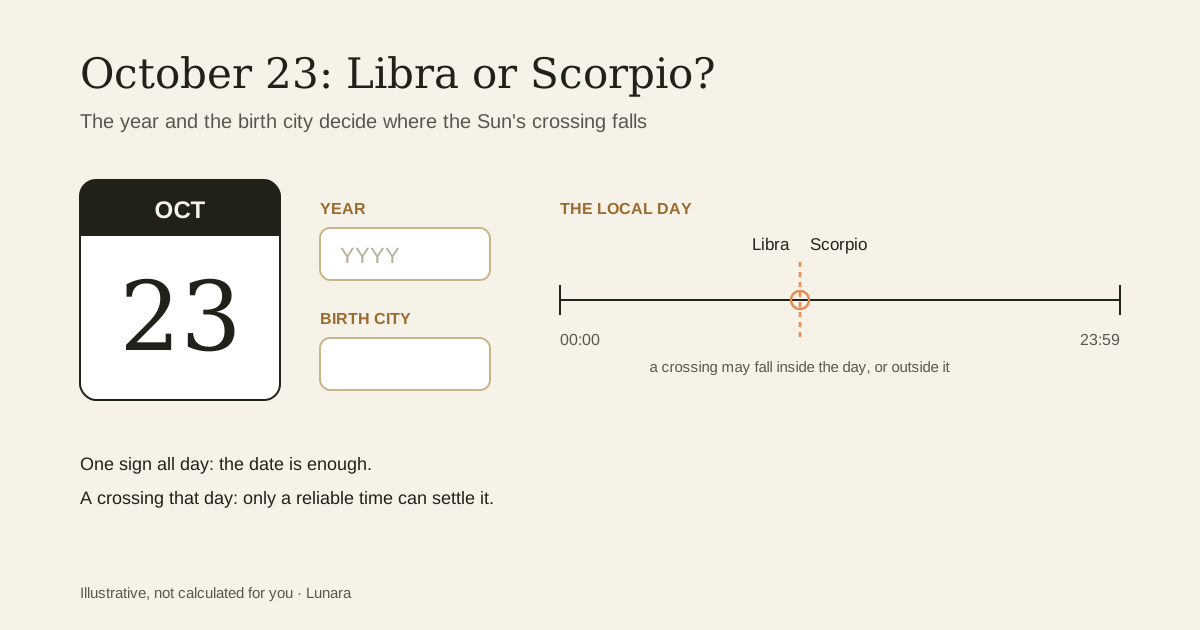
Short answer: someone born on October 23 can have the Sun in Libra or in Scorpio. Both are possible. The date ranges printed in horoscope columns are approximations. Some lists give October 23 as the first day of Scorpio, others as the last day of Libra, and neither is a calculation for your birth.
What decides it is the year you were born, where you were born, and sometimes the time.
One sign at a time, not a blend
In Western astrology, the Sun sign is based on the tropical zodiac, measured from the Earth. The Sun moves steadily along it, and at any given moment it is in exactly one sign. At some instant it leaves the last degree of Libra and enters the first degree of Scorpio.
So a "cusp" birthday isn't a mix of two signs. It's a birthday on which that crossing might fall. The question isn't how much Libra or Scorpio you are. It's which side of the crossing your birth falls on.
Two things this isn't:
- Not the constellation. Tropical signs are twelve equal sections of the Sun's apparent path. They are not the same as the constellations astronomers define, such as Scorpius, whose boundaries and sizes differ.
- Not a sidereal result. Vedic and other sidereal systems measure the zodiac differently, so they give a different Sun sign for most people. This article is about the tropical sign.
Why the year and the city matter
The Sun doesn't cross into Scorpio at the same clock time every year. The crossing moment shifts from year to year, so October 23 sits on the Libra side in some years and the Scorpio side in others, and in some years the change happens partway through the day.
The crossing is also one single moment worldwide, but clocks and calendars differ by place. The same instant can be the evening of October 22 in one city and the morning of October 23 in another. Your birth city tells a calculator which historical timezone and daylight-saving rules applied, so it can work out what "October 23" meant where you were born.
That leads to the two possible outcomes:
- One sign for the whole local day. If the Sun stayed in the same sign from midnight to midnight where you were born, the date is enough. You don't need a birth time to know your Sun sign, provided the date and timezone are right.
- A sign change during your day. Then the time matters, and only a reliable recorded time can settle it. If your time is unknown, or uncertain enough to straddle the crossing, both signs stay possible. Relating more to one description can't choose between them.
How to check your own birth day
Lunara's Sun sign cusp calculator does exactly this check. You can start without a birth time.
1. Enter your real birth date, including the year. Use the full date as it was recorded locally. The tool supports dates from 1900 onwards.
2. Select your actual birth city from the suggestions. Choose where you were born, not where you live now. The place determines the local timezone.
3. Read the result. The tool checks the Sun's geocentric tropical position at the start of your local day and just before the next midnight.
- If the sign is the same at both ends, you have one Sun sign for the whole day.
- If the signs differ, it shows the approximate local time of the change, narrowed to about one minute.
4. Compare a recorded time only if you have one. If your birth certificate, hospital record or family record gives a time, compare it with the displayed crossing. If the time is unknown, or close enough to the crossing that a small error could flip it, keep both signs open.
The tool states its own limits:
- The displayed minute is approximate, not a seconds-level cutoff.
- It assumes the date, city and historical timezone are correct. Historical timezone records, daylight-saving rules and political boundaries can be imperfect, and some clock changes repeat or skip local times or even dates.
- Use the Gregorian local date recorded where you were born, converting from another calendar if needed.
- City selection helps resolve the timezone; it doesn't certify historical birth data.
- It doesn't recover a missing birth time or find your Rising sign and houses.
A worked example: Ryan Reynolds
Ryan Reynolds was born on October 23, 1976, in Vancouver, according to the birth details in Lunara's catalogue, which agree with an indexed Britannica excerpt. We haven't seen a birth certificate.
For an earlier article, Lunara sampled the Sun across that local day in Vancouver's historical timezone, which was on Pacific daylight time that date. The result:
- The Sun was in Scorpio at the start of the local day and at the end, with no sign change during October 23.
- It was only just in Scorpio. The crossing from Libra happened roughly one to two minutes before the local day began.
So on this record, the date alone puts his Sun in Scorpio, and no birth time is needed for that. But the margin is tiny. The answer depends on the date and timezone being exactly right, and a one-minute bracket isn't a certificate-grade, to-the-second boundary. So read it as "Scorpio, on these inputs".
The example shows how close October 23 can run, not what anyone born that day is like.
The Sun is one part of the chart
Your Sun sign is one placement. A natal chart also shows where the Moon and the other planets were, and, with a reliable birth time and place, your Rising sign and houses. You can calculate your free birth chart to see them. If you don't know your birth time, leave it blank rather than guessing; the free chart will show what it can't determine.
If you'd like to see how a written natal reading handles a full set of placements, read the sample natal reading, which uses fictional birth details. If you want one for yourself, there's an optional paid personal birth chart reading. It's an automated, written interpretation of one person's chart. It can't rectify a birth time, fill in missing records or guarantee which side of a boundary your Sun falls on. What's included and the price are shown before you buy.
Text written with AI assistance. The Reynolds positions come from a calculation Lunara saved earlier; nothing new was calculated for this article.