Gwen Stefani's October 3 birthday is a good excuse to look past the Libra–Gemini shorthand. There is a more specific connection in her chart with Blake Shelton: their Mercuries sit close to a trine. They do not have the same Mercury sign.
In a July 2025 archive of PEOPLE's compatibility article, a sentence describes them as "both having Mercury in Gemini" and then calls the connection a trine. That sentence needs a correction. Gwen's tropical Mercury is in Libra; Blake's is in Gemini. Two planets in the same sign cannot be 120 degrees apart.
The interesting part is that the trine itself survives the correction. Getting the relationship between two planets right still requires getting each planet right first.
The positions, with the missing clock left missing
Astrotheme lists Gwen as born October 3, 1969, at 2:09 PM in Fullerton, California. Its AA rating cites a birth certificate or birth record. We have read that catalogue entry, not the underlying certificate.
Blake's entry gives June 18, 1976, in Ada, Oklahoma, with the birth time unknown. We keep it unknown. A noon chart is useful for calculating a reference position, but noon is not a recovered birth time.
We ran those dates through Lunara's existing Swiss Ephemeris calculation, using the tropical zodiac and local time zones. We also calculated Blake's Mercury at every local clock hour and at 23:59.
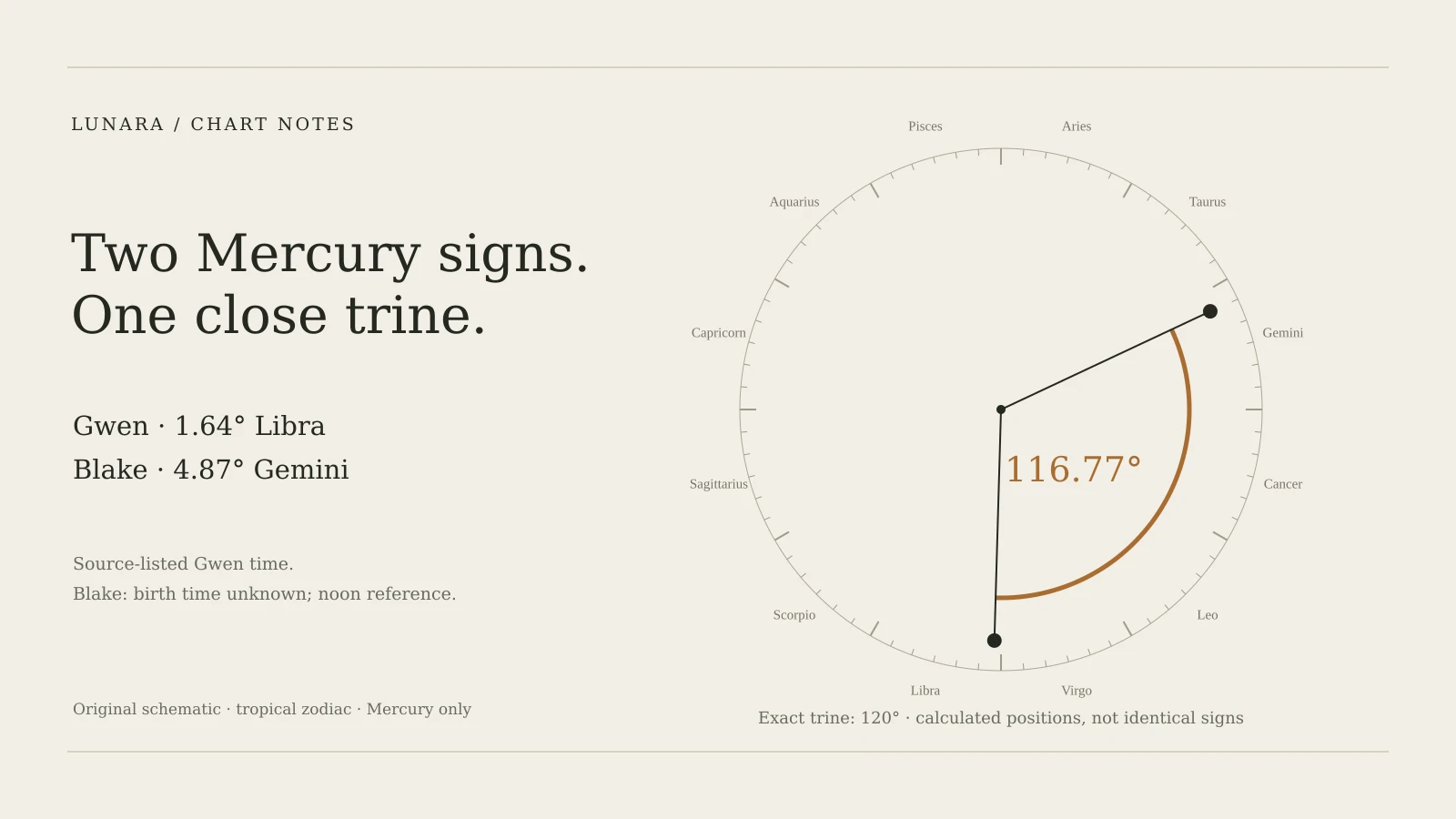
Gwen's Mercury: 1.64° Libra at the source-listed time. This depends on the accuracy of the catalogue's birth record.
Blake's Mercury: 4.87° Gemini at the noon reference. The degree moves during the day; every sampled position stayed in Gemini.
Their separation: 116.77° at the noon reference, and 116.19°–117.33° across our 25 clock samples.
An exact trine is 120 degrees. Those sampled separations are about 2.67–3.81 degrees away from exact. They fit Lunara's 5.8-degree Mercury trine allowance. Different astrologers use different orbs, so a stricter three-degree rule would not give the same answer at every sampled time.
These are sampled positions, not a claim that we have proved continuous bounds for every second. We do not use Blake's hypothetical clocks to invent his Rising sign, houses or Moon aspects. The noon value remains a reference throughout this article.
A Mercury check you can do before trusting a reading
Mercury's orbit gives you a useful shortcut. From Earth it stays close to the Sun; NASA's interview with astronomer Faith Vilas gives a maximum angular distance of about 28 degrees. In a tropical birth chart, that means Mercury can occupy the Sun's sign or one of its two neighboring signs.
For a Libra Sun, the possible Mercury signs are Virgo, Libra and Scorpio. Gemini is too far away. A birth time change cannot turn that Libra Sun into a Libra-Sun/Gemini-Mercury combination.
That check applies to the ordinary geocentric tropical chart used here. Keep the zodiac and calculation system consistent; do not compare a tropical Sun label with a sidereal Mercury label and call the mismatch a discovery.
You can use the same check on your own chart. A claimed Mercury placement several signs away from your Sun is a reason to recheck the input or source before accepting a personality description.
Libra and Gemini can talk easily without talking identically
In symbolic astrology, Gemini Mercury is often read as thinking through alternatives aloud. A question can be a way of testing an idea rather than a final position. Libra Mercury is often read as attending to the exchange: how a sentence lands, whether both people have been heard, and what a fair agreement would look like.
Read together, those descriptions suggest a conversation where one person supplies options and the other helps compare them. That is one possible interpretation of a Mercury trine. It is not evidence that Gwen and Blake actually speak this way in private.
The less flattering version is also useful. A stream of alternatives can feel like an unwillingness to decide. Repeatedly weighing both sides can feel like avoiding a preference. Calling the aspect harmonious does not make either frustration disappear.
For your own relationship, try a question more specific than "Do we communicate well?":
When we disagree, do you want me to think aloud with you, or say what I have decided first?
Give a recent example. Then ask the other person which version would have made that conversation easier. Their answer matters more than the sign description.
Check your pair instead of borrowing theirs
Our example shows how a promising interpretation can rest on a faulty sentence. A source can get the broad conclusion right and still give you the wrong reason to believe it.
Compare your own two charts with the birth times you actually know. Leave an unknown clock blank rather than picking noon as if it were fact. If you want the longer automated symbolic reading, you can see the sample and current price before paying.
Neither the free chart nor the paid reading can establish whether someone listens, keeps promises or will stay. Use the chart to make a better question, then listen to the person.
Source and method notes
The quoted PEOPLE sentence comes from the dated archive linked above. We could not read the current article directly during this research and do not claim the wording is still present. We cannot tell whether the original mismatch was an editorial typo, a transcription issue or a calculation error.
The birth entries are secondary catalogue sources. The positions come from Lunara's centralized Swiss Ephemeris path, not a generated celebrity interpretation. The clock samples describe Mercury only; we omit relationship percentages, private-life claims and predictions.