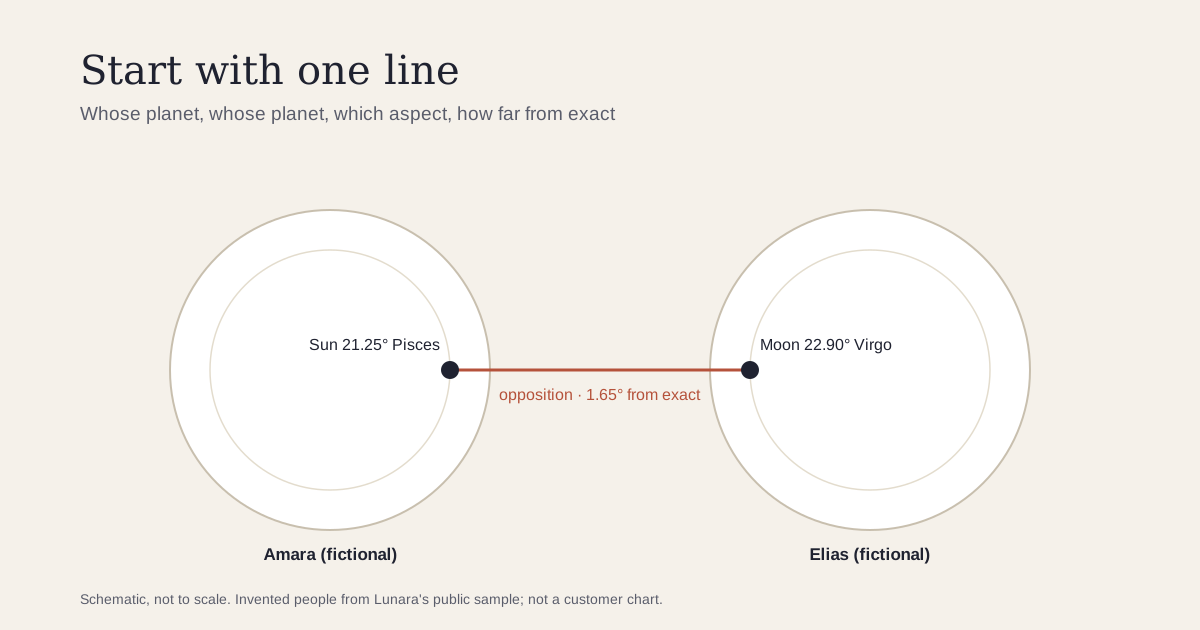
A synastry chart compares two people's birth charts and draws lines between one person's planets and the other's. To read one, don't start with the whole wheel. Pick a single line. Check whose planet sits at each end, which aspect it is and how close to exact. Only then ask what it might mean, and turn that into one question you could actually talk about.
That's the whole method. The rest of this guide walks through it with one real calculated line from a fictional couple.
What you're looking at
Cafe Astrology describes synastry as comparing two individual birth charts, and notes that Sun-sign compatibility on its own is only a general guide. That's the right starting point. A synastry chart isn't a new chart. It's two charts placed side by side or one inside the other.
Apps label them differently. One shows "Chart A" and "Chart B", another puts one person on the inner ring and the other on the outer ring, and some let you swap them. Before reading anything, find out which ring or column belongs to whom. A line from your Venus to their Mars is a different line from their Venus to your Mars.
Then read three things on the line itself:
- The two ends. Which planet, and whose chart it's in.
- The aspect. The angle between them: conjunction (0°), sextile (60°), square (90°), trine (120°), quincunx (150°) or opposition (180°).
- The distance from exact. How many degrees short of or past that angle the two planets are.
Degrees, not just signs
It's tempting to skip straight to signs: both people have planets in water signs, so they must flow. Signs are a rough guide, and the line itself comes from degrees. A planet at 1° Cancer and another at 29° Pisces are in two water signs, but they're about 92° apart. That's close to a square, nowhere near a trine. Matching elements aren't enough. The degrees decide whether there's a line at all.
One line, worked through
Lunara's public sample uses two invented people: Amara, born 12 March 1991 at 8:15 a.m. in Lisbon, and Elias, born 4 November 1988 at 9:40 p.m. in Montreal. Neither is a real person or a customer. Their contacts come from the same central calculation the site uses for anyone.
Here's one line from their chart:
- The ends. Amara's Sun at 21.25° Pisces. Elias's Moon at 22.90° Virgo.
- The distance. Going the shorter way around the zodiac, the two points are 178.35° apart.
- The aspect. The nearest aspect angle is 180°, an opposition. They're 1.65° from exact.
- Does it count? For this pair of planets, Lunara allows up to 7.50° from exact. 1.65° is well inside, so the line is drawn.
Two notes on that last step. First, the 7.50° allowance is our convention. Other software uses wider or narrower allowances, so a contact near the edge can appear on one site and not another. Second, watch the word "orb". Many apps use it for the distance from exact, the 1.65° here. Others use it for the allowance, the 7.50°. On Lunara's free chart, the column labelled "Orb" shows the distance from exact. Check which one you're reading before comparing numbers between sites.
A smaller distance from exact means the geometry is closer. It doesn't mean more love, a stronger bond or a better relationship. It means the two points line up more precisely, and that's all.
From the line to one question
Now the meaning. In astrology the Sun stands for identity and direction: what a person is building and wants recognized. The Moon stands for comfort and needs: what helps someone feel settled. An opposition puts two points at either end of one axis, facing each other.
So this line connects what Amara is steering toward with what Elias needs to feel at ease. As a reading of two invented people, that's as far as it goes. The useful step is turning it into a question either person could answer:
"When what I'm aiming for and what you need to feel settled point in different directions, how do we decide which one comes first today?"
That isn't a diagnosis of Amara or Elias, and it isn't advice to stay or leave. It's a prompt for a conversation.
Oppositions are often filed under "challenging" aspects. That's a description of the geometry, two points pulling across the chart, not a grade for the relationship. Plenty of people find an opposition is where they notice each other most.
A brief contrast: a trine
The same sample has a different kind of line. Amara's Moon at 3.93° Aquarius and Elias's Venus at 7.42° Libra are 116.51° apart: a trine, 3.49° from the exact 120°, inside an allowance of 7.30°.
Trines are usually called flowing or easy, and both signs here are air signs. But an easy line isn't a guarantee of anything. Easy contacts are often the ones nobody notices or talks about. A question for this one might be: "What's something that comes easily between us that we've never actually said out loud?"
Notice that this trine is further from exact than the opposition. That doesn't make it weaker as a relationship feature, and it doesn't make the opposition more important.
When a birth time is missing
Without a birth time, some lines can't be drawn reliably. In Lunara's synastry tools, a chart without a time uses approximate local-noon positions. Its Moon contacts, Ascendant and Midheaven are left out, and its Sun contacts too unless the Sun stayed in one sign all that day. If you don't know a time, leave it blank rather than guessing one. A guessed time draws confident-looking lines from the wrong places.
Synastry is not a composite
A composite chart is a different technique. It blends two charts into one, using the midpoints between each pair of planets, and reads that single chart as the relationship. Synastry keeps the two charts separate and reads the lines between them. Everything in this guide is synastry.
A paper note for each line
If you're reading your own pair, take one line at a time and write four things on paper:
- Whose planet, and whose planet
- The aspect, and its distance from exact
- One sentence on what the two planets stand for
- One question you could ask each other
Then stop. One line read carefully is worth more than twenty skimmed.
Two ways to go further
Calculate your own pair. The free synastry chart shows both people's placements and a table of the calculated contacts between them, each with its distance from exact.
Read an optional written reading. The relationship reading is a paid, automated report. It writes up the supported contacts between the Sun, Moon, Mercury, Venus, Mars, Jupiter and Saturn in six aspect types (conjunction, sextile, square, trine, quincunx and opposition), grouped by theme, each with reflection questions. It doesn't cover every contact in the free table, it isn't written by an astrologer, and it isn't counselling or a forecast. You can read the fictional reading sample first, and the price for your country is shown before you decide.
Sources: the two-chart definition is paraphrased from Cafe Astrology, "Astrology of Relationships - Synastry", read October 15, 2026. The worked example uses Lunara's fictional public sample (invented people, birth details and times), calculated with Lunara's central chart calculation. Aspect allowances are Lunara's settings. Text written with AI assistance. Lunara isn't affiliated with Cafe Astrology. The illustration is original and not to scale.