Some arguments come back like a song you didn't choose. Different day, different trigger, same lines. Often that's because each person is trying to settle a different question while using the same words.
Below are four made-up situations. Each has two plausible readings, and one sentence you could try next. They're examples, not diagnoses. Your relationship may not fit any of them, and that's fine.
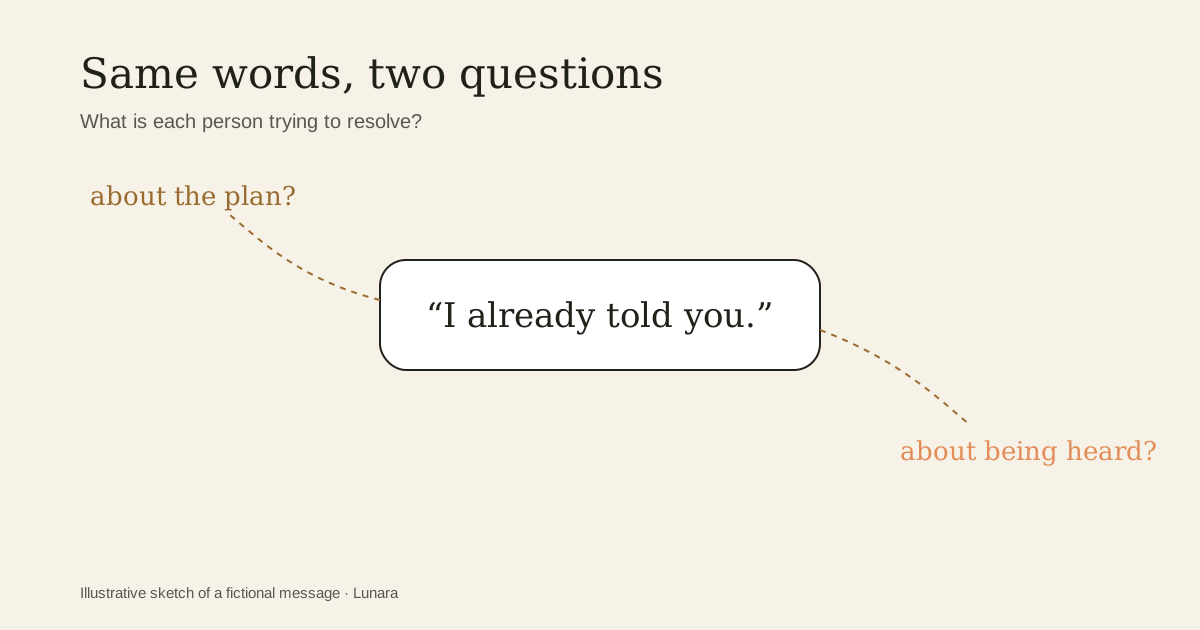
1. "I already told you."
Fictional: Priya mentioned on Monday that her sister arrives Friday. On Thursday night, Tom asks what time the sister is coming. Priya says, "I already told you," and the evening goes sour.
Reading A: it's about logistics. Tom genuinely lost the detail and needs the time and the plan again. For him, the question is practical.
Reading B: it's about acknowledgement. For Priya, the visit has been on her mind all week. Having to repeat it feels like evidence it didn't register. The question for her is whether she was heard.
A next sentence to try: "Are we sorting out the plan, or are you telling me you didn't feel listened to? I can do either, I just want to do the right one."
2. "Can we decide now?"
Fictional: Sam and Alex are choosing between two flats. Sam wants an answer tonight. Alex keeps asking more questions.
Reading A: pace. Sam finds open decisions stressful and wants the relief of a choice. Alex simply needs more time to feel sure.
Reading B: participation. Alex isn't slow; Alex feels the decision is being made for them, and the questions are a way of getting a say.
A next sentence to try: "What would you need to know before you'd be comfortable deciding, and can we set a time for it, say Sunday?"
3. "I just needed you to listen."
Fictional: Jordan comes home after a hard meeting. Within a minute, Casey is suggesting what to say to the manager tomorrow.
Reading A: support. Casey is trying to help, and offering a plan is how Casey shows care.
Reading B: unsolicited fixing. Jordan heard the advice as "you handled it badly", and wanted company in the feeling before any solutions.
A next sentence to try: "Do you want me to just listen right now, or help you think about tomorrow?"
4. "You should have known."
Fictional: Lee booked a weekend away on the date of Morgan's family lunch. Morgan says Lee should have known it mattered.
Reading A: a spoken agreement was broken. If the lunch was discussed and agreed, this is about keeping a promise.
Reading B: an assumed standard. If it was never said, Morgan is holding Lee to an expectation Lee didn't know existed. That's still worth talking about, but it's a different conversation.
A next sentence to try: "Did we actually agree on this, or is it something that matters to you that we haven't talked about yet? Either way, I want to know."
You can also decline, or stop
You don't have to resolve anything in the moment. Saying "I want to talk about this, but not tonight. Can we try tomorrow after dinner?" is a reasonable move, as long as you actually come back to it.
One line matters more than any technique. If a disagreement involves threats, intimidation, controlling behaviour or being afraid of the other person, it isn't a communication style or a compatibility topic. It's a safety issue. Astrology, including this article, has nothing to offer there; contact local support services or emergency help.
An optional astrology angle
Everything above works without astrology. If you do use it, a synastry reading can supply a few more questions, provided you treat them as questions.
Lunara's relationship reading calculates the contacts between two people's charts, and for each supported contact it adds a short written prompt and a question to ask each other. A few of those prompts line up with the situations above:
- When one person's Mercury and the other's Moon are in a calculated aspect, the prompt is about whether a feeling is being heard as a problem to solve. Its question is: "Do you want me to listen, help you find words, or work through a solution with you?"
- When Mercury and Mars are in aspect, the prompt is about the gap between talking and deciding. It asks: "Do you want us to talk this through, or are you ready to decide? How can we make room for both?"
- When Saturn is in aspect with the other person's Sun, the prompt separates real agreements from unspoken expectations. It asks: "Which expectations have we actually agreed to, and which have I assumed you should already know?" Other Saturn pairings have their own versions of the same idea.
A few honest limits:
- These prompts only appear if that contact is actually calculated between your two charts. Two signs that are traditionally "in tension" aren't the same as a measured aspect. Our guide to reading a synastry chart shows how to check one calculated line.
- A chart can't show that either of you behaves this way. The prompts are conversation starters, not evidence.
- If one person's birth time is unknown, the reading uses approximate local-noon positions for that chart and leaves out its Moon contacts, Ascendant and Midheaven (and its Sun contacts too, unless the Sun stayed in one sign all that day). The reading says so.
If you want to try it
The relationship reading is an optional paid, automated reading: computed two-chart contacts with reflection questions beside each one. It isn't counselling, therapy or a forecast, and it can't tell you whether to stay or leave. You can see what one looks like first in the fictional reading sample, where both people and their birth details are invented.
Text written with AI assistance. All four situations are fictional.