You've calculated your birth chart and there's a small Rx next to Mercury. This article explains what that mark means, what it doesn't, and how to tell whether it holds for your birth day.
Two different things called "Mercury retrograde"
The phrase gets used for two separate ideas.
A natal Mercury retrograde is a fact about the moment you were born. It means that, seen from Earth at that moment, Mercury was moving backwards against the background of the zodiac. It is fixed. It's part of your chart's record.
A Mercury retrograde period is a transit. It's a stretch of a few weeks, several times a year, when Mercury appears to move backwards for everyone. That's what news stories and apps mean when they announce that Mercury is retrograde.
A current transit doesn't change your natal chart. If Mercury was moving forward when you were born, it stays that way in your chart, whatever the sky is doing now. The reverse is also true.
What "retrograde" actually is
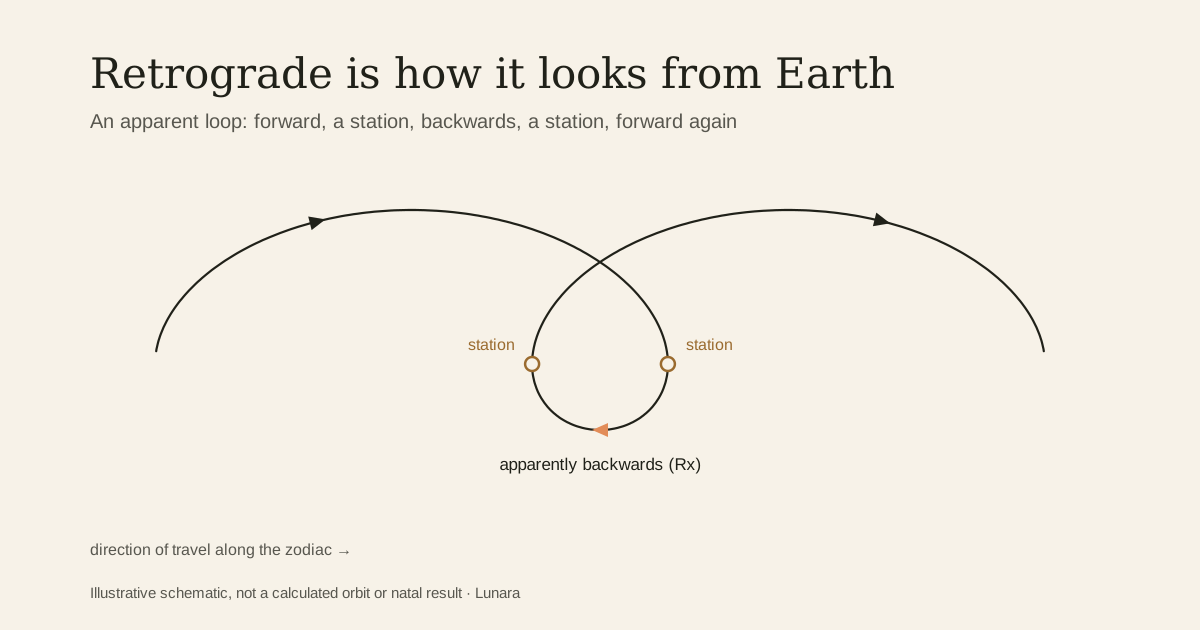
Retrograde motion is apparent, not real. No planet reverses its orbit. Every planet keeps travelling around the Sun in the same direction.
What changes is the view from Earth. Earth is moving too, so the angle we see a planet from keeps shifting. At certain points in the two orbits, that shift makes a planet look as if it has slowed, stopped and drifted backwards across the sky for a while, before it seems to resume.
NASA's Astronomy Picture of the Day explained this for Saturn and Neptune in May 2026: the backward motion is apparent, caused by Earth's changing perspective as it overtakes the slower outer planets. Mercury is an inner planet, so its geometry runs the other way round: it's the faster one, on the inside track. The principle is the same. The backward motion is what we see from Earth, not what Mercury does.
The moments when a planet seems to stop before changing direction are called stations. Around a station, the planet is barely moving.
How to find it on your free chart
On Lunara's free chart, open the section headed Planetary Placements. Mercury is the third card, after the Sun and the Moon, so it shows without tapping "Show all placements".
If Mercury was retrograde, the card shows the label Rx next to the planet's name. That label appears whenever the calculated speed of the planet is negative, meaning it was moving backwards along the zodiac at the calculated moment.
The chart's Special Features section, under Highlights, may also list a count such as "2 retrograde planets", with their names underneath.
When your birth time is unknown
This is the part most guides skip.
If you leave the birth time blank, the calculator still has to calculate positions for some moment. Internally, it uses a representative time: noon on your birth date. The page then treats the chart as date-only. It hides the Rising sign and houses and shows "≈" instead of exact degrees.
The Rx label, though, comes from that representative moment. It tells you Mercury's direction at noon, not across your whole birth day.
Most of the time that makes no difference, because Mercury keeps the same direction for days or weeks. But if you were born close to a station, when Mercury was turning from forward to backward or back again, the direction could change during that day. In that case:
- a chart with no birth time can't settle whether your Mercury was retrograde;
- a guessed time can't settle it either, because the answer depends on which side of the station the real moment fell;
- only a reliable recorded time can.
If you're near a station and don't have a reliable time, the honest answer is "not determined", not a verdict either way.
To check your whole birth date rather than one representative moment, use the birth retrograde calculator. With no birth time, it checks your entire local birth date in your birth city's timezone and shows Mercury as direct or retrograde only when the answer is the same all day. If Mercury stationed that day, it lists Mercury as uncertain, with the approximate local time of the station. The Rx label on the full birth chart stays what it is: a reading at noon, not evidence for the whole day.
What the Rx means in astrological tradition
Astrologers have long given natal Mercury retrograde its own interpretation. Astrodienst's discussion of the planets, The Planets: Celestial Organs and Their Functions, includes a section on natal Mercury retrograde and is one example of that tradition.
In broad terms, Mercury is the planet of thinking, speaking and communication, and retrograde is often read as attention that turns back over things: revising, reconsidering, returning to an idea before letting it go.
That's symbolism. It is not a measurement of intelligence, a learning style, a diagnosis of any kind, or a sign of being luckier or unluckier. It isn't something to cure or fix either. Many people have it, and many don't, and astrology doesn't sort them into better and worse.
An invented example
The following conversation is made up to illustrate the symbolism. It isn't based on a real chart, astrology didn't cause it, and it isn't a finding from psychology.
Sam has been asked by a friend, Jo, to help move house on Saturday. Sam can't make it.
Sam's private draft, written first and not sent:
"Hi! So, I've been thinking about this all week and I really wanted to help, but Saturday is tricky because of a few things, and I didn't want to just say no without explaining, and maybe I could come later, or Sunday, or I could lend you the car instead…"
The message Sam actually sent, twenty minutes later:
"I can't do Saturday, sorry. I could drop the car round on Friday evening if that helps?"
Two revising habits are visible here:
- Draft long, then cut. Get every thought out privately, then keep the one that answers the question.
- Reply short, then follow up. Send the clearest version fast, and add detail only if the other person asks.
Neither is the correct one, and neither proves anything about a Mercury placement.
A small experiment, if you want one: pick a message you need to send this week. Choose one of the two habits, ideally the one you use less, and try it. Afterwards, note whether it was easier, whether the reply was clearer, and whether you'd use it again. Your answer is about you and that message, not about your chart.
Explore further
You can calculate your free birth chart to see whether the Rx label appears on your Mercury card. Add a birth time and city if you have reliable ones; otherwise leave the time blank.
If you'd like to see how a written natal reading handles placements, read the sample natal reading, which uses fictional birth details. If you want one for yourself, there's an optional paid personal birth chart reading. It's an automated, written interpretation of one person's natal chart. It isn't a transit forecast, a retrograde report or a consultation. What's included and the price are shown before you buy.
Text written with AI assistance. No positions were calculated for this article.