Mitski's reported birth date is September 27, 1990, in Japan, which makes her a Libra Sun. Her birth time isn't on record. A public 9 a.m. time circulates, but it was rectified from an approximate time, so this article doesn't use it. What follows is a date-only chart: the planets that stayed in one sign all day, and the Moon, which didn't.
What we know, and what we don't
Astrotheme lists her birth as September 27, 1990, in Tokyo, at 9:00 a.m. It rates that time C and gives its source as "Rectified from approximative time". Rectification means an astrologer worked backwards from life events to estimate a time. It can be interesting, but it isn't a birth record, and two astrologers can rectify the same life to different times.
That matters because the Rising sign moves through all twelve signs in about a day. An estimated clock can easily give the wrong one, and the houses depend on it too. So this piece has no Rising sign, houses or exact degrees. We also don't rely on a birth city: only the date and Japan's time zone.
Lunara's central Swiss Ephemeris calculation sampled that day in Japan time every hour from midnight to 11 p.m., plus 11:59 p.m., in the tropical zodiac. (A Tokyo location was used only to run the calculation. Planetary signs don't depend on the city.)
| Placement | Every sample | Lens used here | | --- | --- | --- | | Sun | Libra | Comparing versions | | Mercury | Virgo | Editing | | Mars | Gemini | Trying another version | | Moon | Sagittarius until about 3:36 a.m. Japan time, then Capricorn | Unknown without a time |
The Moon changed sign early that morning, so either sign is possible. The rectified 9 a.m. would put it in Capricorn, but choosing it would mean trusting the estimate we've just set aside. These are hourly samples, not a minute-by-minute proof. Nothing else came close to changing sign.
One decision from a 2026 interview
In a March 2026 interview with The Current, by Gannon Hanevold and Natalia Toledo, Mitski talked about making her album Nothing's About to Happen to Me, released in February 2026. She described her usual order: she writes the songs, takes them to Patrick Hyland to demo, and then they move into a professional recording.
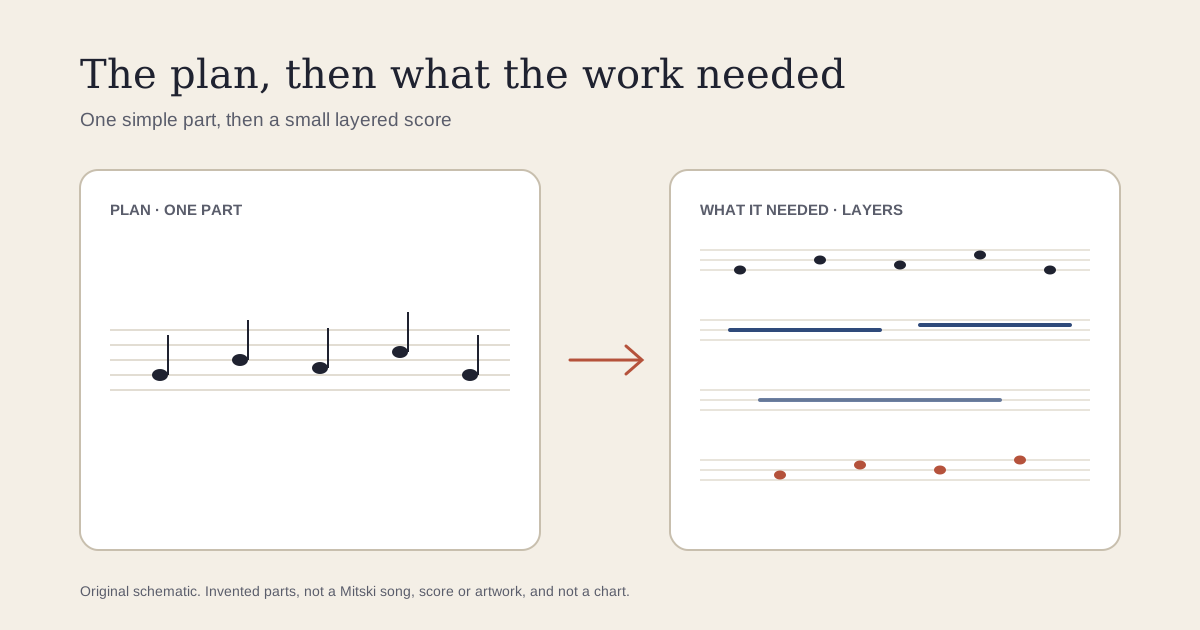
At the demo stage, she said, she was set on a stripped-down rock record with as few instruments as possible, closer to her punk roots. After they'd tried that, she wanted an orchestra, and in the end a choir as well. Her explanation was that "the songs eventually show you what they need", and that sometimes you can't force your will onto a song.
That's the only part of the interview we use. It's a description of a working process, not a window into her private life, and her songs aren't a diary for an astrology article to read. A lyric can be written in a voice or from a character's point of view. What's useful is the decision itself: a clear plan, tested, then changed when the work asked for something else.
Three lenses, not an explanation
None of the placements below explains Mitski's music, her talent or how she feels. Plenty of people born that week share them and have never written a song. Astrology offers traditional symbols, and here they work as questions.
Comparing versions: the Libra Sun. Libra is traditionally the sign of weighing and balance, of holding two options side by side before choosing. As a lens, it asks: have you actually heard both versions, or are you defending the first one because it came first?
Editing: Mercury in Virgo. Mercury is the planet of words and working method. Virgo is associated with detail, sorting and what can be cut. Here the question is: what does each part do, and which part isn't doing anything?
Trying another version: Mars in Gemini. Mars is read as drive and action. Gemini is associated with variety, curiosity and two of everything. That gives you: what's one more option you could try quickly, before you decide it's wrong?
The order matters less than having all three questions available. A plan needs testing, testing gives you something to compare, and comparing tells you what to cut or keep.
For a chart where a sourced birth time adds the Rising sign and houses, see how Rosalía built Lux from the words up.
An invented example
This one is made up. It isn't Mitski's session, a song of hers or anyone's chart.
A songwriter plans an acoustic-only demo: one guitar, one voice. Most of it works. But the bridge sounds like the verse again, and the song sags there. Rather than rewriting the whole song, she adds one instrument to the bridge only, a low synth line. She records both versions and listens back a day later. The synth gives the bridge somewhere to go, so it stays. If it hadn't, she'd have taken it out and tried something else.
The original plan wasn't a mistake. It was the starting point that showed her what was missing.
Lorde made a similar point in public by sharing 49 demo versions of her Virgin songs; our Lorde birth chart piece turns that into a two-version exercise.
Your turn
You don't need to make music for this. It works for a report, a room you're arranging or a plan for the week.
- My original plan: ___
- What the work needs now: ___
- One change I can try without rewriting everything: ___
Keep it on paper. The point is to test one change, not to throw out the plan.
Find your own placements
Calculate your free birth chart to see your Sun, Mercury and Mars signs. If you don't know your birth time, leave it blank. The calculator won't invent one, and it'll show both signs when your Moon could be in either. Our guide to a birth chart without a birth time explains what you can still read.
If you'd like your own chart written out, there's an optional, paid personal birth chart reading. It's automated and written from Lunara's interpretation copy for your birth placements, not by an astrologer. It doesn't assess creative work or give you any access to a celebrity. You can read the complete fictional sample first, and the price for your country is shown before you decide.
Sources: process details from The Current, "Interview: Mitski talks about 'Nothing's About to Happen to Me,' cats, and being trapped in your own mind", by Gannon Hanevold and Natalia Toledo, published March 3, 2026, read October 14, 2026. The one quotation is attributed to that interview and the rest is paraphrased. Reported birth date, and the rectified time not used here, from Astrotheme, read October 14, 2026. Planetary positions from Lunara's saved whole-day calculation (Swiss Ephemeris, tropical, geocentric, Asia/Tokyo, hourly samples plus 23:59). No birth time used. Text written with AI assistance and checked against those sources. Lunara isn't affiliated with Mitski, The Current or Astrotheme. The illustration is original.