You know your birthday and where you were born, but nobody wrote down the time. A calculator offers a noon chart. It looks complete: planets, degrees, perhaps even a wheel with twelve houses.
A complete-looking diagram does not mean the missing information has been recovered. Some of that chart may be usable. Other parts depend on a clock time you do not have.
The Moon gives us a concrete example.
One birthday, two possible Moon signs
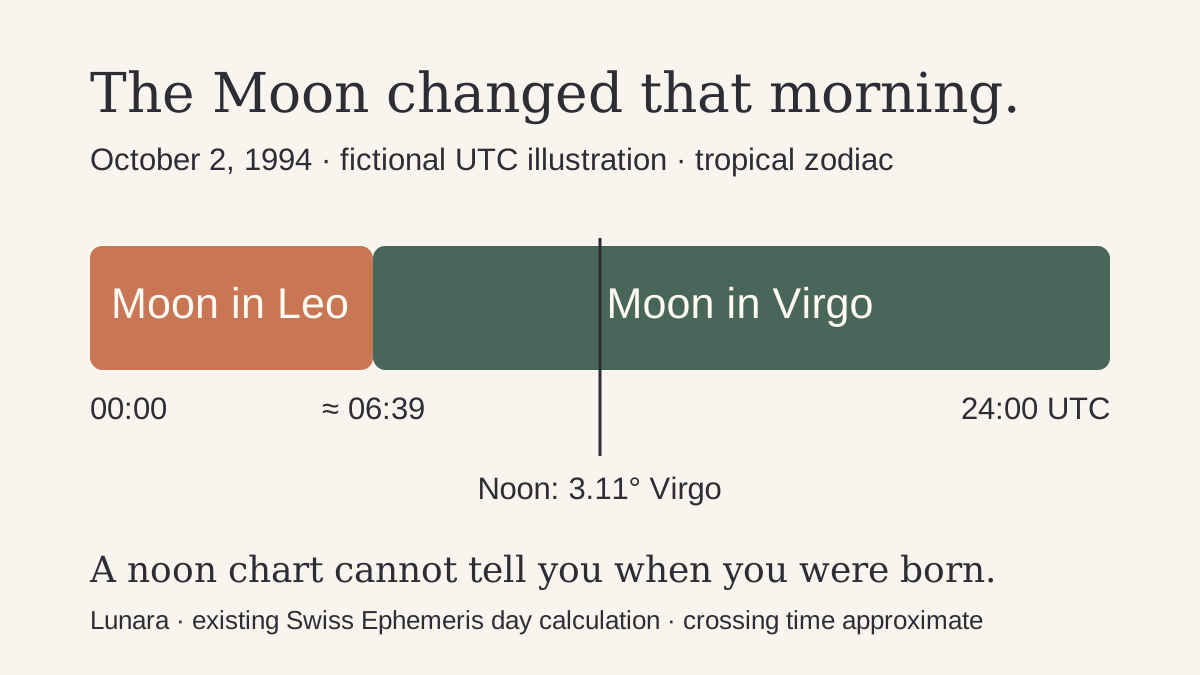
We ran Lunara's existing Swiss Ephemeris calculation for October 2, 1994, in UTC. This is a fictional worked date, not a customer's chart. We use the tropical zodiac and the whole UTC civil day; a person's local birth date needs the timezone of their birthplace instead.
The calculation returns:
- At the start of the day, the Moon is in Leo.
- Around 06:39 UTC, it enters Virgo. This is an approximate sign-crossing time, not a birth time.
- At the end of the day, it is still in Virgo.
- At noon, the representative Moon position is 3.11° Virgo.
If we simply select noon and print "Moon in Virgo," we have described the Moon at noon. We have not established that a person with this birthday was born after the crossing. Someone born before it would have a Leo Moon; someone born after it would have a Virgo Moon.
For comparison, on October 1, 1994, in UTC, the Moon stays in Leo throughout the day. A date-only calculation can establish its sign in that example, but not its exact natal degree.
The Sun remains in Libra across both example days. That does not make every Sun sign safe to infer from a date: on a Sun-ingress birthday, the same kind of check is necessary.
What to keep, and what to leave open
Moon sign: keep it when the Moon stays in one sign for the entire local birth date. When it changes sign, keep both possibilities until better time information narrows them. Even a stable sign does not establish an exact Moon degree or lunar aspects.
Sun and slower planets: a full-day check can confirm a sign that stays the same. Their exact positions still move. Noon positions are representative values, and an aspect close to an orb cutoff can change over the day; a precise-looking number is not a recovered natal measurement.
Rising sign, Midheaven and natal houses: leave them open without a reliable time and birthplace. A noon house wheel, a sunrise chart or houses counted from the Sun can be chosen conventions, but they do not establish the houses at your birth.
CHANI's explanation of unknown birth times makes the Moon-crossing and rising-sign limits explicit. Our numerical example comes from Lunara's own central calculation, not from that article. Swiss Ephemeris supplies the astronomical position calculations; it does not validate personality descriptions.
Do not choose the time by choosing the description you like
Suppose both Moon signs remain possible. You might find a Leo-style question useful: "Where do I hesitate to ask for recognition?" You might also find a Virgo-style question useful: "When does improving the details become a way to avoid saying what I need?"
Those are symbolic reflection prompts. Finding one more relatable does not establish your Moon sign or birth time. You can use both, reject both, or answer with a real situation that contradicts the suggested pattern.
For instance, write down a recent disagreement. What did you actually ask for? What did you leave unsaid? The answer tells you something about that situation. It is not evidence that you were born before or after 06:39.
A useful record search does not require inventing a minute
A hospital record or more detailed birth record may contain a time. Availability depends on the jurisdiction and when the birth was recorded. If you can lawfully access those records and want to look, they are a better starting point than a personality quiz.
A relative's "late afternoon" is a remembered range. Do not convert it into an exact 16:00 entry and forget where the number came from. If someone proposes a time through astrological rectification, treat it as an estimate and ask how its uncertainty is being handled, rather than treating it as a newly discovered official record.
When using Lunara's form, leave both birth-time fields blank if you do not know your birth time. Typing 12:00 into the known-time field tells the software that noon is your supplied birth time; it is different from asking for a clearly marked representative calculation.
Before you pay for a natal reading
If your main question requires your Rising sign or natal houses, do not buy a report expecting it to recover a missing birth time. Paying for more paragraphs cannot supply that input.
A partial reading can still suit someone who wants symbolic reflection from the usable placements, understands the limits, and prefers written questions to a precise natal-house interpretation. Lunara's reading is system-generated, not a live consultation or a birth-time investigation. It does not predict events or establish facts about your personality, health or relationships.
Read the fictional sample before deciding. Its birth inputs are not yours; use it to judge the writing and workbook format, not to identify your placements. The personal birth-chart reading page explains the existing paid offer and export options. You can decline the reading if the missing information is the part you wanted answered.