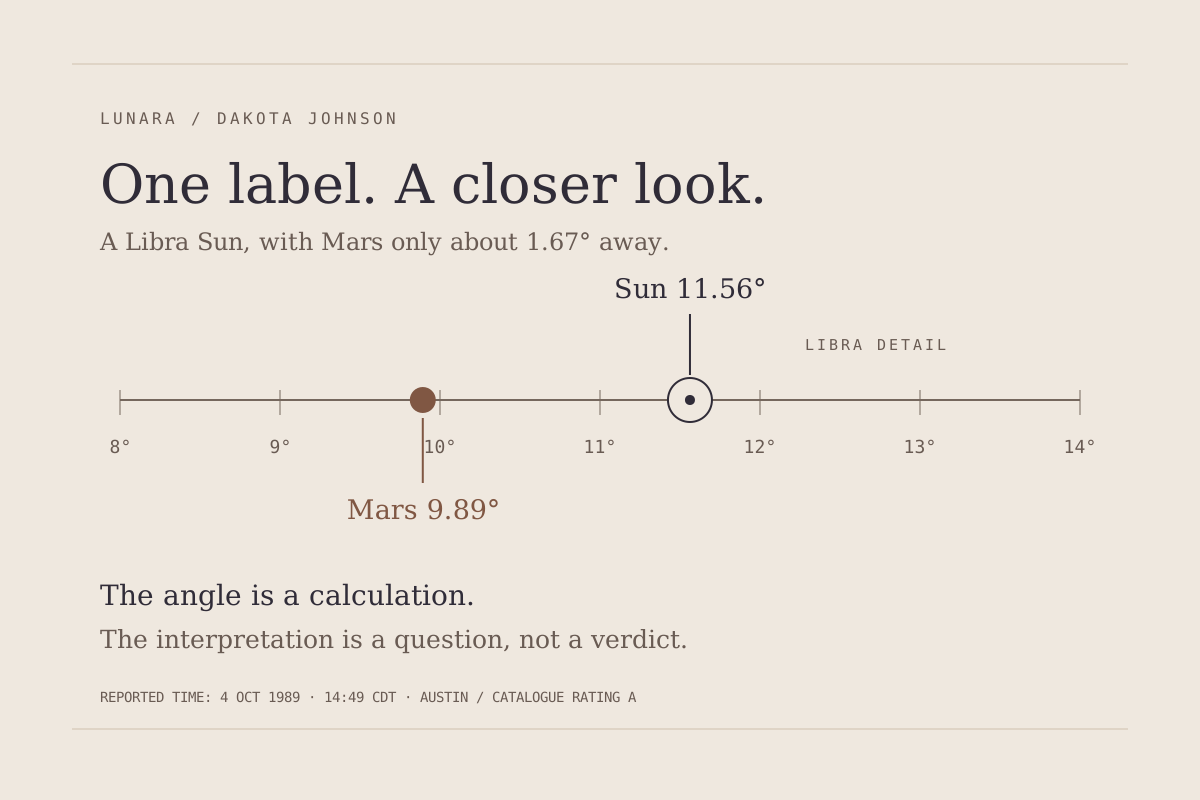
Dakota Johnson turns 37 on October 4, 2026. She is also Vogue's October cover subject; the magazine dates the opening of her new film Verity to October 2. That makes this a timely occasion to read her natal chart—not a reason to predict her next year or explain her private life.
The familiar label is Libra. The less obvious detail is that Mars sits only about 1.67° from her Sun. Her Mercury and Venus are in different signs again. A single zodiac label leaves all three details out.
The clock is reported, not firsthand verified
Astrotheme's public entry gives October 4, 1989, at 2:49 p.m. in Austin, Texas. It labels the time A, lists “News report” as the source and Lois Rodden as contributor; its biography names David Dozier as the birth-time source.
Those are the catalogue's statements. Lunara has not inspected the underlying report or a birth certificate. A is not the same classification as AA, and a confidently displayed clock is not proof by itself.
For the calculation below, 14:49 in Austin's historical civil timezone was 19:49 UTC. Using Lunara's existing tropical Swiss Ephemeris calculation:
- Sun: 11.56° Libra.
- Mars: 9.89° Libra.
- Mercury: 25.80° Virgo.
- Venus: 25.67° Scorpio.
Values are rounded. The illustration marks positions along zodiac longitude, not physical distances between planets.
Libra does not mean “always agreeable”
A conjunction is a close meeting in longitude. This Sun and Mars are not on the same exact mark, but their 1.67° separation is much more specific than sharing a sign, which can put two planets almost 30° apart.
In astrological symbolism, the Sun concerns identity and agency; Mars concerns action, assertion and the way someone pursues something. Read together in Libra—the language of relationship, proportion and negotiation—the combination can suggest a useful tension:
How do I stand for something without turning every disagreement into a contest?
Keep the question for yourself. An actor's movie roles and public interviews cannot tell us how well a chart description fits her private life.
Or ask it from the other direction: When does keeping the peace stop being a choice I actually want to make? You might find a recent example; you might find that neither question fits.
Mercury and Venus change the vocabulary
Virgo Mercury offers a symbolic language of detail, distinctions and revision. A reflection might ask: “Am I making this clearer, or polishing it past the point of usefulness?”
Scorpio Venus brings a language of trust, depth and what someone chooses to reveal. Try: “What do I want to keep private, and can I say that plainly?”
It is tempting to find a familiar Johnson clip and call it "so Virgo Mercury." Choosing an anecdote after seeing the symbols is an easy way to make a story sound convincing. It does not establish causation.
In your own chart, give each planet its own question. A Sun-sign description cannot do all four jobs.
Would a missing birth time erase this example?
Across 25 sampled local clocks on October 4, 1989—each hour plus 23:59—the Sun–Mars separation ran from about 1.46° to 1.80°. The four signs listed above were unchanged in those samples.
That is a sampled illustration, not a proof of continuous bounds or a claim that the sampled clocks are equally likely. It supports a limited point: this particular close pair is less clock-sensitive than a rising sign or house assignment. We have deliberately left houses and the Ascendant out of this reading.
If your own clock is missing, this worked date-only chart explains what you can and cannot know. Do not quietly turn a noon placeholder into a verified birth time.
Borrow the question, not the celebrity's personality
Take one decision you are facing. Write two short answers:
- What do I want to stand for here?
- What agreement would still leave that choice feeling like mine?
Then name a counterexample—a time when compromise was genuinely right for you. No response needs to be posted, and no astrological placement is required to do the exercise.
To work from your own calculated positions, make your free natal chart. Before paying for a longer symbolic reading, read Lunara's actual fictional natal sample. The paid product is a natal reading with reflection prompts, not a birthday forecast, a solar-return report or a reading of Johnson's future.
For another October 4 Libra with a different close contact, Alicia Silverstone's Sun and Pluto are about 13 arcminutes apart. The shared date is a resemblance, not an identical chart.
Sources and method
Vogue's cover interview by Alessandra Codinha, published September 18, 2026, supplies the current editorial occasion. Astrotheme supplies the reported birth data and its own reliability classification. No interview prose, portrait photograph or catalogue interpretation is reproduced. Calculations use Lunara's central Swiss Ephemeris path, geocentric tropical longitude, city-centre coordinates and America/Chicago's historical timezone. Astrology is used here as a symbolic reflection practice, not established scientific evidence of personality, private behaviour or future events.