In a CBS News Sunday Morning interview with Seth Doane, published September 27, 2026, RAYE talked about one trade-off of working independently. "I can choose what to invest," she said. One of her choices, as she described it, is a stage full of musicians, even when that isn't the cheapest way to put on a show. The story places that choice after she left her record label.
That's her account in one dated interview. We haven't analysed the business side, and this piece doesn't try to.
RAYE turns 29 on October 24, 2026. Here we use her reported choice as a starting point for a reflection, then look at one pattern in her date-only birth chart. The two stay separate. The interview reports a decision; the chart offers symbols. The chart doesn't explain her career, and her career doesn't prove anything about the chart.
What the chart can and can't show
Her date and place, 24 October 1997 in Tooting, London, come from public secondary sources (we checked Wikipedia on October 5, 2026), not from a birth certificate. There's no independently verified birth time. A time stored in an astrology catalogue with a low reliability grade exists, and we don't use it.
So there's no Rising sign, no houses, no Midheaven and no Moon degree here, and no noon chart passed off as her birth time. Instead, Lunara's central Swiss Ephemeris calculation sampled every hour of that London day, from 00:00 to 23:00 plus 23:59, using the tropical zodiac. In every sample:
- the Sun is in Scorpio, in its first degree or two;
- the Moon is in Leo;
- Mercury is in Scorpio;
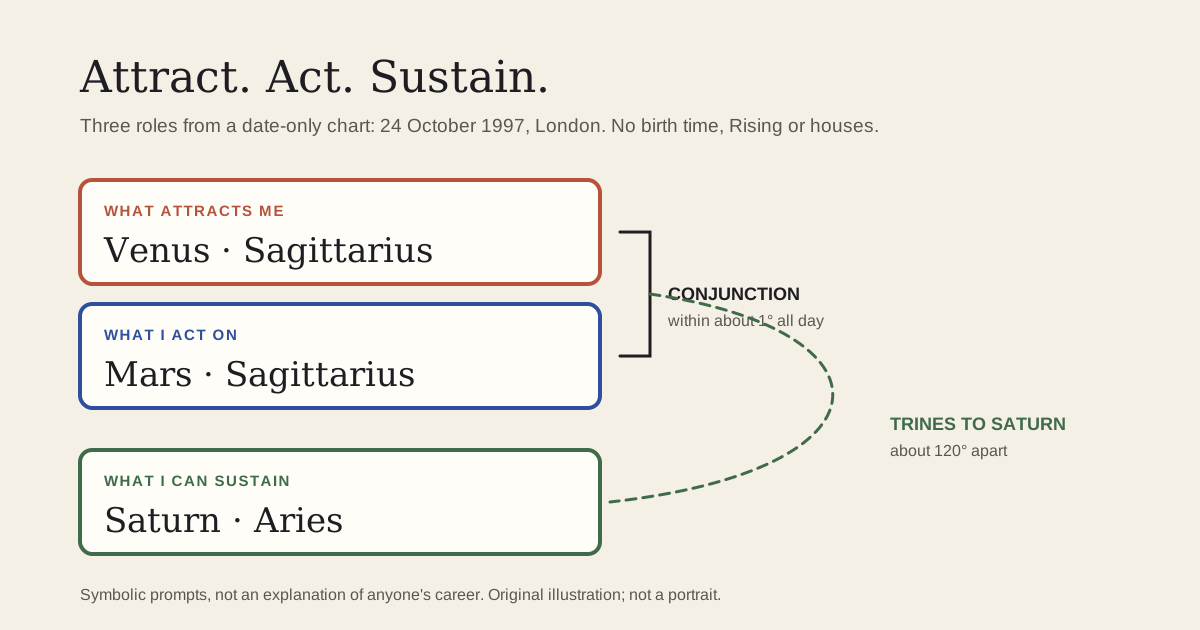
- Venus and Mars are both in Sagittarius;
- Saturn is in Aries.
Those hold whatever time she was born. That's enough for the pattern below.
Three roles instead of one label
"Scorpio Sun" is the label most people reach for. It's a real placement, but on its own it says very little about how anyone chooses what to spend their effort on.
A more useful question is to split that choice into three roles. Astrologers traditionally give each one to a different planet:
- What attracts me. Venus is read as taste, what we value and what we're drawn towards.
- What I act on. Mars is read as drive, what we actually go after and push for.
- What I can sustain. Saturn is read as structure, time and limits: what keeps an effort going after the first rush.
Looking at how those three relate in a chart gives you more to think with than a single sign.
Venus with Mars, both trine Saturn
In RAYE's date-only chart, Venus and Mars form a conjunction in Sagittarius. A conjunction means two planets sit at a small angular separation along the zodiac. Here they're within about a degree of each other, near 18° Sagittarius, throughout the saved samples.
Both also form a trine to Saturn in Aries. A trine means two points are about 120 degrees apart, give or take a conventional allowance of a few degrees. Saturn sits near 16° Aries, roughly 120 degrees from the pair, and both trines stay within about three degrees of exact all day. That's a measured angle, not just two signs that happen to share the fire element.
Read symbolically, the conjunction describes taste and drive moving together: what's attractive and what gets acted on point the same way. Sagittarius gives that pairing an outward, wide-ranging quality, wanting more room and more range. The trine to Saturn is traditionally read as a supportive link to structure, so the enthusiasm has something steady to lean on rather than burning out.
It would be easy to map the stage full of musicians onto this, and we'd rather not. Plenty of people with no such pattern make that kind of choice, and plenty with it don't. The pattern is more useful as the shape of a question you can ask about your own life.
Your turn: three prompts
Take ten minutes with these. Write the answers down if that helps.
- What deserves more room? One thing you'd give more time, attention or space to if you could.
- What is one small action? Something you could do this week, small enough that it actually happens.
- What limit makes it sustainable? A boundary of time, money or energy that keeps it going rather than burning out.
Here's an invented example, not about RAYE or anyone real. Someone wants more room for drawing. Their small action is one sketch on the bus each morning. Their limit is twenty minutes, and no new supplies this month, so it stays a habit rather than a project they abandon.
This is your own reflection. There's no score, no right answer and no compatibility result.
For another musician's interview read the same way, our piece on Sombr's birth chart splits songwriting into separate questions using different placements. And Olivia Dean's birth chart starts from how she describes love in an interview, and turns it into a prompt about asking clearly.
See your own three roles
For RAYE's fuller date-only reading, including the other patterns in her chart, see her birth chart profile.
To see where Venus, Mars and Saturn sit in your own chart, calculate your free birth chart. If you don't know your birth time, leave it blank; the calculator won't make one up.
If you'd like your chart written out, an automated personal birth chart reading is optional and paid. It's a written symbolic interpretation, not a consultation, a prediction or career advice, and it works from the details you enter. You can read the complete fictional sample first, and the current price for your country is shown before you decide.
Sources: interview context from a CBS News Sunday Morning article by Seth Doane, published September 27, 2026, read October 14, 2026; the one quotation is attributed to that article and the rest is paraphrased. Birth date and place from Wikipedia, checked October 5, 2026 (secondary source). Planetary positions from Lunara's saved whole-day calculation (Swiss Ephemeris, tropical, geocentric, Europe/London, hourly samples plus 23:59). No birth time used. Text written with AI assistance and reviewed against those sources. Lunara is not affiliated with RAYE or CBS. The illustration is original.