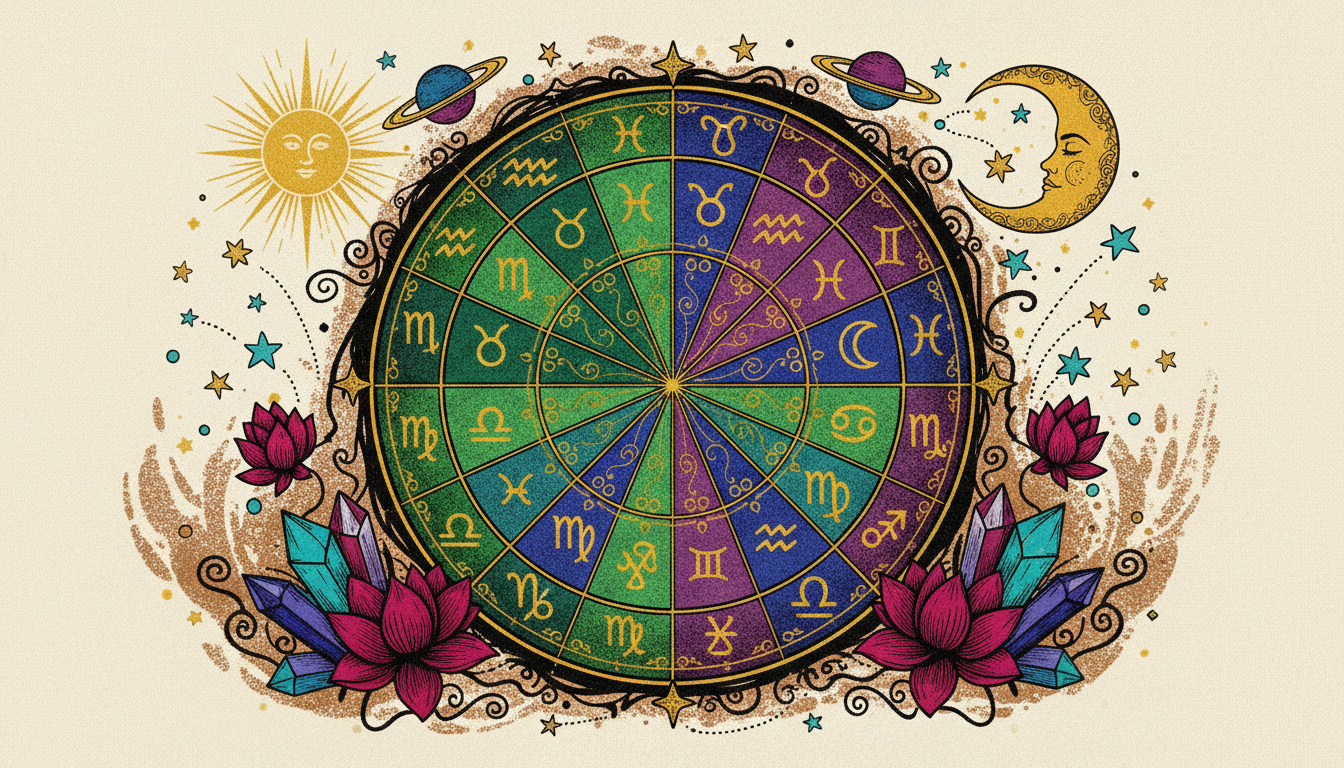
If you've ever been curious about what an astro chart is and what it can reveal about you, you're not alone.
An astro chart (short for astrology chart, also called a birth chart or natal chart) is a map of the sky at the exact moment you were born. It shows where every planet was positioned in the zodiac and how they relate to each other—creating a unique cosmic fingerprint that describes your personality, potential, relationships, and life path.
Think of it as the ultimate personality profile—far more detailed and accurate than any personality test or generic horoscope you've read.
In this complete guide, we'll explain what an astro chart is, what all those symbols mean, how to get yours, how to read it, and what insights you can gain from understanding your chart.
What Is an Astro Chart?
An astro chart is a snapshot of the sky from your specific location at the exact moment of your birth.
It's a circular diagram divided into 12 sections (houses), showing:
-
Where each planet was located in the zodiac
-
Which astrological houses the planets occupied
-
The angles (aspects) planets made to each other
-
Your rising sign (ascendant) and other important points
Why it's unique to you:
Your astro chart is as individual as your fingerprint. Even someone born on the same day as you will have a different chart if they were born:
- At a different time (even minutes matter)
- In a different location (different cities = different charts)
This precision is why astrology can be so accurate when done properly—it's not based on just your sun sign, but on the entire cosmic landscape of your birth moment.

What an Astro Chart Reveals
Your astro chart is like a cosmic blueprint containing information about:
1. Your Core Personality
- Sun sign: Your conscious identity and ego
- Moon sign: Your emotional nature and inner world
- Rising sign: Your outward personality and approach to life
These three alone (called "The Big Three") explain why you might not relate to typical descriptions of your sun sign.
2. Your Communication and Learning Style
Mercury shows how you think, process information, and communicate with others.
3. How You Love and Relate
Venus reveals what you value, how you express affection, and what you find beautiful.
Mars shows what you desire and how you pursue it.
4. Your Life Purpose and Career Path
Your Midheaven (10th house cusp) and planets in the 10th house reveal your public role, career direction, and reputation.
5. Your Relationships and Partnerships
Your 7th house and its planets show what you seek in committed relationships and how you approach partnership.
6. Your Challenges and Growth Areas
Saturn shows where you'll face obstacles but also where you'll build mastery through effort.
Chiron reveals your deepest wound and healing potential.
7. Your Emotional Needs and Security
Your Moon's sign and house show what you need to feel emotionally safe and fulfilled.
8. Your Karmic Path and Soul Purpose
Your North Node points to what you're meant to develop in this lifetime.
A simple daily horoscope based only on your sun sign can't tell you any of this—but your complete astro chart can.
The Components of an Astro Chart
When you look at an astro chart, you're seeing several key elements working together:
1. The Circle and Houses
The chart wheel is divided into 12 sections called houses, numbered 1-12 counterclockwise.
Each house represents a life area:
-
Self and identity
-
Money and values
-
Communication and learning
-
Home and family
-
Creativity and romance
-
Health and work
-
Partnerships and marriage
-
Transformation and shared resources
-
Philosophy and travel
-
Career and reputation
-
Friendships and community
-
Spirituality and the unconscious
2. The Zodiac Signs
Around the outer rim, you'll see the 12 zodiac signs. Each house begins with a specific sign based on your birth time and location.
The signs color how planetary energy expresses itself:
-
Fire signs (Aries, Leo, Sagittarius): Bold, passionate
-
Earth signs (Taurus, Virgo, Capricorn): Practical, grounded
-
Air signs (Gemini, Libra, Aquarius): Intellectual, social
-
Water signs (Cancer, Scorpio, Pisces): Emotional, intuitive
3. The Planets
Scattered throughout the chart are symbols (glyphs) representing planets:
Personal Planets (fast-moving, unique to you):
-
☉ Sun: Core self
-
☽ Moon: Emotions
-
☿ Mercury: Mind
-
♀ Venus: Love
-
♂ Mars: Drive
Social Planets:
- ♃ Jupiter: Expansion
- ♄ Saturn: Structure
Outer Planets (slow-moving, generational):
- ♅ Uranus: Innovation
- ♆ Neptune: Spirituality
- ♇ Pluto: Transformation
4. The Aspects
Lines connecting planets show their relationships (aspects):
-
Conjunction (0°): Planets blend together
-
Sextile (60°): Harmonious, supportive
-
Square (90°): Tension, challenge
-
Trine (120°): Easy flow, talent
-
Opposition (180°): Polarity, awareness
Blue/green lines typically indicate harmonious aspects Red lines typically indicate challenging aspects
5. The Angles
Four critical points:
- Ascendant (AC/ASC): Rising sign, left horizon line
- Descendant (DC/DSC): Relationships, right horizon line
- Midheaven (MC): Career and life direction, top
- Imum Coeli (IC): Roots and home, bottom
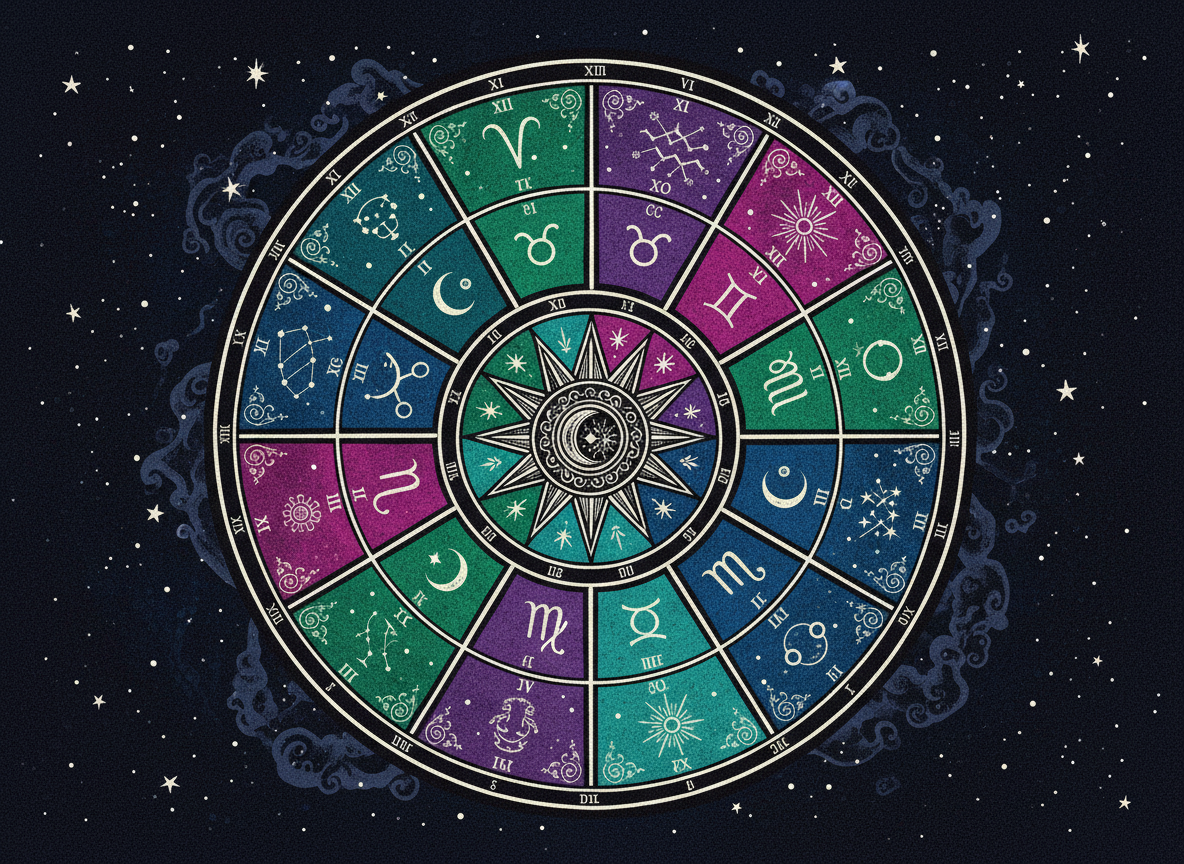
Type: Educational Diagram Dimensions: 1200x800 Alt Text: Astro chart anatomy showing all components labeled
Description: Comprehensive educational diagram of an astro chart with clear labels. Central chart wheel with numbered callouts pointing to: 1) Houses (with numbers), 2) Zodiac signs (outer rim), 3) Planets (symbols inside), 4) Aspect lines (center), 5) Ascendant (left), 6) Midheaven (top). Each callout has brief explanation. Style: Clean, instructional, professional. Color palette: White background, purple chart sections, gold symbols, teal callout lines, clear dark text. Priority: High File Name: astro-chart-anatomy.jpg Priority: High

How to Get Your Astro Chart
Getting your astro chart is simple and free. Here's what you need:
What You Need
- Birth date (month, day, year)
- Birth time (hour and minute, as exact as possible)
- Birth location (city and country)
Important: Birth time is critical. Your rising sign and house placements change every two hours, so even being off by 30 minutes can alter your chart significantly.
Where to find birth time:
-
Birth certificate (most reliable)
-
Hospital records
-
Baby book or family documents
-
Ask parents or relatives present at birth
Step-by-Step Process
-
Choose a calculator: Use a free online astro chart calculator:
-
Our Free Natal Chart Calculator: Clean, modern, easy to use
-
Astro.com: Comprehensive, detailed
-
Cafe Astrology: Beginner-friendly
-
-
Enter your birth data: Input date, time, and location carefully (double-check AM vs. PM!)
-
Generate your chart: Click calculate and your chart appears instantly
-
Save it: Download, screenshot, or save to an account—you'll reference it many times
How to Read Your Astro Chart (Beginner's Guide)
Looking at an astro chart for the first time can be overwhelming. Here's where to start:
Step 1: Find Your Big Three
Sun Sign: Look for ☉ symbol. What zodiac sign is it in?
- This is your core identity
Moon Sign: Find ☽ symbol. What sign is it in?
- This is your emotional nature
Rising Sign: Look at the left horizontal line (marked AC or ASC). What sign is there?
- This is your outward personality
These three form your foundation.
Step 2: Identify Your Personal Planets
Mercury (☿): Your thinking and communication style Venus (♀): How you love and what you value Mars (♂): How you take action and pursue desires
Note which signs these are in.
Step 3: Notice House Placements
Look at which house each planet sits in. This tells you where that planetary energy operates in your life.
Example:
- Sun in Leo in 10th house: Identity expressed through career and public recognition
- Moon in Cancer in 4th house: Emotional needs met through home and family
Step 4: Look for Patterns
- Stellium: 3+ planets in one sign or house = major life theme
- Element emphasis: Lots of fire? You're action-oriented. Lots of water? Emotionally driven.
- Empty houses: Not a problem—they're still active
Step 5: Read Interpretations
Most calculators provide basic interpretations. Read these for each placement, then start noticing how placements interact.
Step 6: Dive Deeper
As you learn more, explore:
-
Aspects between planets
-
Your chart ruler (ruling planet of your rising sign)
-
Saturn's placement (your challenges and lessons)
-
North Node (your soul's purpose)
Common Astro Chart Questions
Q: Can I get an astro chart without birth time?
A: You can get a partial chart showing planetary signs, but you'll miss houses and rising sign—about 40% of the chart. Make every effort to find your birth time.
Q: Why do different calculators give slightly different results?
A: Planetary positions should match. Differences usually come from:
- Different house systems (Placidus vs. Whole Sign)
- Different aspect orbs
- Inclusion/exclusion of asteroids
Core data is identical.
Q: Are free astro chart calculators accurate?
A: Yes. They use the same astronomical data (ephemeris) as professional astrologers. As long as you enter accurate birth information, results are precise.
Q: Is my astro chart different from my horoscope?
A: Yes. Your astro chart is a fixed map of your birth moment—it never changes. A horoscope is a forecast based on current planetary movements relative to your chart or sun sign.
Q: Can two people have the same astro chart?
A: Technically yes, if born at the exact same time and location (twins, for example). In practice, even twins have slightly different birth times, creating small differences. And even identical charts can manifest differently based on free will and life circumstances.
Types of Astro Charts
Your birth chart isn't the only chart in astrology:
Natal Chart (Birth Chart)
Your personal astro chart—the foundation. Fixed at birth.
Transit Chart
Shows current planetary positions and how they interact with your natal chart. Used for timing and forecasts.
Progressed Chart
Your natal chart "progressed" symbolically as you age, showing inner development and life phases.
Solar Return Chart
Calculated for the moment the Sun returns to its exact natal position each year (your birthday). Shows themes for the coming year.
Synastry Chart
Compares two people's charts to assess compatibility and relationship dynamics.
Composite Chart
Creates a single chart representing the relationship itself by finding midpoints between two people's charts.

What to Do After Getting Your Astro Chart
-
Start with the basics: Focus on Sun, Moon, and Rising
-
Research your placements: Read about each planet's sign and house
-
Journal: Note what resonates and what doesn't
-
Observe patterns: Notice themes that repeat across your chart
-
Track transits: See how current planets activate your chart
-
Get a professional reading (optional): For deeper synthesis and specific questions
-
Study: Learn chart reading as an ongoing practice
Free vs. Paid Astro Chart Services
Free Options
Pros:
-
Accurate astronomical calculations
-
Instant results
-
Often include basic interpretations
-
Accessible to everyone
Cons:
-
Limited depth of interpretation
-
May have ads
-
Less customization
Best for: Most people, especially beginners
Paid Options
Pros:
-
Detailed written reports (20-40+ pages)
-
Professional-quality interpretations
-
Transit forecasts and compatibility reports
-
Personalized readings with live astrologers
Cons:
- Cost ($10-$200+)
- Can be overwhelming for beginners
Best for: People wanting in-depth analysis or professional guidance
For most people, a free calculator provides everything needed to begin understanding your chart.
Key Takeaways
-
An astro chart is a map of the sky at your birth moment
-
It reveals personality, relationships, career, and life path
-
You need birth date, time, and location to calculate it
-
The chart contains planets, signs, houses, and aspects
-
Start by learning your Big Three: Sun, Moon, Rising
-
Free calculators are accurate and perfect for beginners
-
Your astro chart is unique to you and never changes
-
Chart reading is a learnable skill that deepens with practice
Frequently Asked Questions
Q: How accurate is an astro chart? A: With accurate birth data (especially birth time), astro charts are remarkably accurate for describing personality patterns, tendencies, strengths, and challenges. They don't predict specific events but reveal underlying themes and potentials.
Q: Can my astro chart predict my future? A: Your natal chart shows your inherent nature and potentials. For timing and future trends, astrologers use transits, progressions, and solar returns in relation to your natal chart. But astrology describes influences, not fixed outcomes—free will always matters.
Q: How often should I look at my astro chart? A: Your natal chart never changes, but you can reference it anytime. Many people check it when facing major decisions, during significant life transitions, or when tracking current transits.
Q: What's the most important part of an astro chart? A: There's no single "most important" element. Sun, Moon, and Rising form your foundation, but the entire chart works as a system. Context and synthesis matter most.
Q: Can I learn to read astro charts myself? A: Absolutely. Start with your own chart, learn the basics (planets, signs, houses, aspects), and practice. Many professional astrologers are self-taught through books, courses, and practice.
Get your complete astro chart now
Stop wondering who you're meant to be. Calculate your free astro chart instantly and discover your sun, moon, rising, and all planetary placements.
Related Articles: