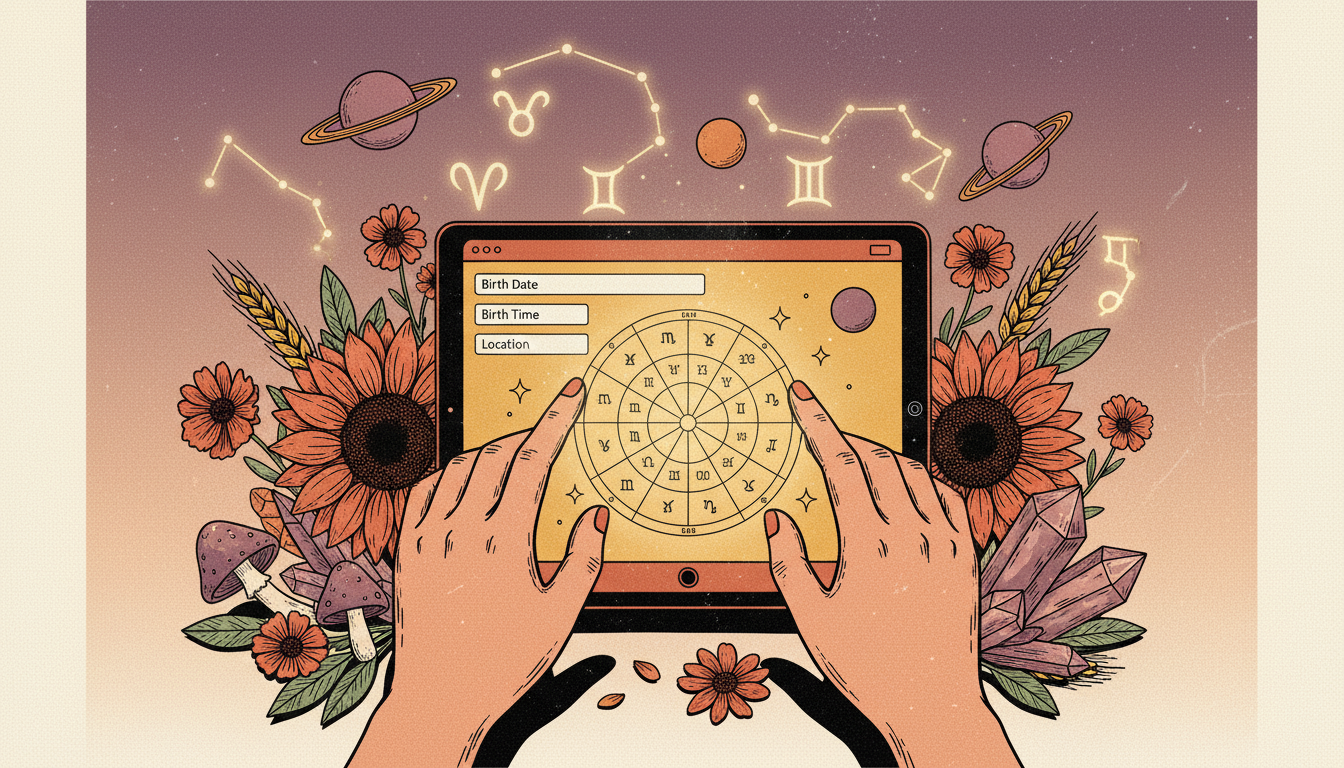
You know your sun sign. Maybe you've even dug into your moon sign or rising sign. But if you really want to understand the full picture of who you are—your strengths, shadows, relationship patterns, and life purpose—you need your complete birth chart.
And getting it is easier than you think.
A birth chart calculator takes your birth date, time, and location and instantly generates a map of where every planet was positioned at the moment you were born. No PhD in astronomy required. No complex math. Just a few pieces of information and you're looking at your cosmic blueprint.
In this guide, we'll walk you through how birth chart calculators work, what information you need, what your chart reveals, and how to start interpreting it. By the end, you'll know exactly how to pull up your chart and what to do with it.
What Is a Birth Chart Calculator?
A birth chart calculator is a digital tool that computes the exact positions of the sun, moon, and planets at the moment of your birth. It converts astronomical data into a visual diagram—your natal chart—showing which zodiac signs and houses each planet occupied when you entered the world.
Think of it as a cosmic snapshot, frozen in time, that astrologers use to understand your personality, potential, and path.
Here's what goes into the calculation:
Your Birth Date
This determines which zodiac sign the sun was in (your sun sign), along with the approximate positions of slower-moving planets like Jupiter, Saturn, and the outer planets.
Your Birth Time This is crucial. Your rising sign (ascendant) changes approximately every two hours, and it determines the entire house system of your chart. Without an accurate birth time, about 40% of your chart is missing or inaccurate.
Your Birth Location
Astrology is geocentric, meaning it's calculated from your specific vantage point on Earth. The same moment in time looks different from New York versus Tokyo. Your location ensures precision.
The calculator uses this data to determine:
-
Which sign each planet was in
-
Which house each planet occupied
-
The angles (aspects) planets made to each other
-
Your rising sign and Midheaven
Modern calculators do all of this instantly. What used to take astrologers hours of manual calculation with ephemeris tables now happens in seconds.

Why You Need Your Birth Time
Let's be blunt: if you don't know your birth time, your birth chart will be incomplete.
Your sun and moon signs don't change much throughout the day, so you'll get those right. But your rising sign? That changes every two hours. And since your rising sign determines the entire house system, not knowing your birth time means you won't know:
-
Which life areas (houses) your planets influence
-
Your rising sign (how you present yourself to the world)
-
Your Midheaven (career and public image)
-
Accurate aspects between planets
Some calculators will let you generate a chart without a birth time, using 12:00 PM as a default. This gives you your planetary signs but not your houses. It's better than nothing, but it's like watching a movie with half the screen blacked out.
Where to Find Your Birth Time
If you don't know your exact birth time, try these:
-
Birth certificate: Most reliable source
-
Hospital records: Contact the hospital where you were born
-
Baby book or family records: Sometimes parents wrote it down
-
Ask your parents or relatives: They might remember
-
Chart rectification: Some astrologers can work backward from major life events to estimate your birth time (advanced technique)
Even being off by 15-30 minutes can shift your houses and rising sign, so precision matters.
Type: Infographic Dimensions: 800x600 Alt Text: Infographic showing what birth data is needed for accurate chart calculation Description: Clean, modern infographic with three icons representing the three required pieces of data: calendar (birth date), clock (birth time), and map pin (birth location). Each icon has a brief explanation of why it's important. Central visual: birth chart wheel being assembled piece by piece. Color palette: Deep purple background, white icons and text, gold accents. Style: Minimalist, modern, instructional.
File Name: birth-chart-calculator-required-data.jpg Priority: Medium
How to Use a Birth Chart Calculator
Using a birth chart calculator is straightforward. Here's the step-by-step process:
Step 1: Gather Your Birth Information You'll need:
-
Birth date (month, day, year)
-
Birth time (as exact as possible, including AM/PM)
-
Birth location (city and country)
Step 2: Choose a Calculator There are dozens of free birth chart calculators online. Popular options include Astro.com, Cafe Astrology, and Co-Star. Many are accurate, but some provide more detailed interpretations than others.
Get your free natal chart here for a clean, ad-free experience with clear interpretations.
Step 3: Enter Your Information Input your birth data into the calculator. Double-check for accuracy—especially the time and AM/PM designation. A small error can throw off your entire chart.
Step 4: Generate Your Chart
Click "Calculate" or "Generate Chart." Within seconds, you'll see a circular diagram covered in symbols, lines, and numbers.
Step 5: Review Your Chart Most calculators will show you:
-
A visual chart wheel
-
A list of your planetary placements (e.g., Sun in Gemini, Moon in Scorpio)
-
Your rising sign and Midheaven
-
Major aspects between planets
Some also provide written interpretations, which can be helpful if you're new to astrology.

What Your Birth Chart Reveals
Once you've generated your chart, you'll see a lot of information. Here's what the key components mean:
The Big Three
Sun Sign: Your core identity, ego, and life force. This is the "you" you grow into over time.
Moon Sign: Your emotional world, instincts, and subconscious needs. How you feel and process emotions privately.
Rising Sign (Ascendant): The mask you wear, your first impression, and how you approach life. It's the lens through which you experience the world.
The Planets
Each planet represents a different part of your psyche:
-
Mercury: Communication, thinking, learning style
-
Venus: Love, beauty, values, relationships
-
Mars: Drive, ambition, anger, sexuality
-
Jupiter: Expansion, luck, philosophy, growth
-
Saturn: Discipline, structure, challenges, lessons
-
Uranus, Neptune, Pluto: Generational themes and deep transformation
The Houses
Your chart is divided into 12 houses, each representing a life area:
-
Self and identity
-
Money and values
-
Communication and learning
-
Home and family
-
Creativity and romance
-
Health and daily routine
-
Partnerships and marriage
-
Transformation and shared resources
-
Philosophy and travel
-
Career and public image
-
Friendships and community
-
Spirituality and subconscious
Where your planets fall shows where you'll experience those energies most intensely.
The Aspects
Aspects are the angles planets make to each other. They show how different parts of your personality interact:
-
Conjunction (0°): Blending of energies
-
Sextile (60°): Harmonious opportunity
-
Square (90°): Tension and growth
-
Trine (120°): Easy flow and natural talent
-
Opposition (180°): Balance and awareness through contrast
A chart full of squares and oppositions isn't "bad"—it just means you'll have more internal friction that, when worked through, leads to growth.
Type: Diagram Dimensions: 800x800 Alt Text: Labeled birth chart diagram showing all key components
Description: Clean, educational diagram of a birth chart with clear labels pointing to: the 12 houses, planetary symbols, zodiac signs, rising sign, Midheaven, and aspect lines. Use a real-looking chart as the base, but with annotations that make it easy to understand for beginners. Style: Clean, modern, instructional. Color palette: Deep purple background, white chart lines, gold labels and arrows, colored planets. Priority: High File Name: birth-chart-calculator-chart-components.jpg Priority: High
Free vs. Paid Birth Chart Calculators
Most birth chart calculators are free and accurate. The calculations themselves are based on astronomy, so whether you use a free tool or a paid one, the planetary positions will be the same.
The difference is in the presentation and interpretation:
Free Calculators
-
Accurate planetary positions
-
Basic chart wheel
-
Often include free interpretations
-
May have ads or upsells
Paid Calculators or Readings
-
Same accurate data
-
Often more polished interface
-
Detailed written reports
-
Professional astrologer interpretations
-
May include transit forecasts or compatibility reports
For most people, a free calculator is more than enough to get started. You can always invest in a professional reading later if you want deeper, personalized guidance.

Common Birth Chart Calculator Questions
"I don't know my exact birth time. Can I still get my chart?" Yes, but it will be incomplete. Without a birth time, you'll know your planetary signs but not your houses or rising sign. Some people use 12:00 PM as a placeholder, but understand that this is an approximation.
"Why do different calculators give me slightly different results?" Most reputable calculators use the same astronomical data and will give identical results. Differences usually come from:
- Different house systems (Placidus, Whole Sign, Equal House, etc.)
- Inclusion or exclusion of asteroids and minor points
- Rounding of degrees
The core planetary placements should always be the same.
"Can I calculate someone else's birth chart?" Yes, as long as you have their birth date, time, and location. Many people explore the charts of partners, family members, or public figures to understand them better or check compatibility.
"How often should I check my birth chart?" Your natal chart never changes. The planets were where they were when you were born, and that's fixed. However, current planetary transits move constantly. Many people check transits regularly to see what energies are active in their lives.
What to Do After You Generate Your Chart
Seeing your birth chart for the first time can be overwhelming. Here's how to start making sense of it:
1. Start with Your Big Three Look up interpretations of your sun, moon, and rising signs. These three placements form the foundation of your personality and will give you the most immediate insights.
2. Explore Your Venus and Mars
These show how you love (Venus) and what you desire (Mars). If you're curious about relationships or career drive, start here.
3. Notice Any Stelliums A stellium is when you have three or more planets in the same sign or house. This indicates a major focus area in your life. If you have a stellium, pay attention to it—it's a core theme in your chart.
4. Look at Your Saturn Placement
Saturn shows where you'll face the most challenges and do the hardest work. It's also where you'll eventually gain mastery. Understanding your Saturn can reframe struggles as growth opportunities.
5. Consider a Professional Reading If you're feeling lost or want a synthesis of all the pieces, a professional astrologer can walk you through your chart and answer specific questions. Think of the calculator as giving you the raw data, and the astrologer as translating it into your personal story.

Why Birth Charts Matter
You might be wondering: why go through all this? What's the point of knowing where Saturn was when I was born?
Here's why birth charts resonate with so many people:
Self-Awareness Your chart explains contradictions in your personality. Why you're outgoing but also need alone time. Why you're ambitious but also crave stability. It validates parts of yourself you might have been told to suppress.
Compassion Understanding your chart—and others'—cultivates empathy. That person who drives you crazy with their need for control? Maybe they have a Virgo moon. The friend who's always late? Probably a Sagittarius rising. Astrology doesn't excuse behavior, but it contextualizes it.
Timing By tracking transits (current planetary movements) against your natal chart, you can identify favorable times for major decisions—starting a business, moving, committing to a relationship. It's not fortune-telling; it's cosmic weather forecasting.
Purpose Your chart can point toward your strengths, natural talents, and the areas where you're meant to grow. It won't tell you exactly what to do with your life, but it can illuminate what kinds of paths will feel most aligned.
Key Takeaways
-
A birth chart calculator generates a map of planetary positions at the moment of your birth
-
You need your birth date, time, and location for an accurate chart
-
Your birth time is critical—without it, you're missing your rising sign and house placements
-
Free calculators are accurate and sufficient for most people
-
Your chart reveals your sun, moon, rising, planetary placements, houses, and aspects
-
Start by exploring your Big Three (sun, moon, rising) and go deeper from there
Frequently Asked Questions
Q: Are birth chart calculators accurate? A: Yes. They use precise astronomical data (ephemeris) to calculate planetary positions. As long as you enter accurate birth information, the chart will be accurate. Interpretation quality varies, but the data itself is reliable.
Q: Can I use a birth chart calculator if I was born during daylight saving time? A: Enter the time exactly as it appears on your birth record, with your birth date and birthplace, and follow the calculator's instructions. A calculator that applies historical time-zone rules for your birthplace handles daylight saving itself, so don't subtract an hour unless it explicitly asks for standard time. If your time falls in an hour that repeated when the clocks went back, see our guide to daylight saving time and your birth chart.
Q: What's the best house system to use? A: Placidus is the most common, but Whole Sign is gaining popularity for its simplicity. Try both and see which resonates. The planetary signs stay the same; only the house boundaries shift.
Q: Can my birth chart change? A: No. Your natal chart is fixed. However, you evolve in how you express your chart, and current planetary transits continuously interact with your natal placements, creating new themes and opportunities throughout your life.
Ready to see your cosmic blueprint?
Stop guessing at who you are. Get your free natal chart now and discover the planetary patterns that shape your personality, relationships, and life path.
Related Articles: