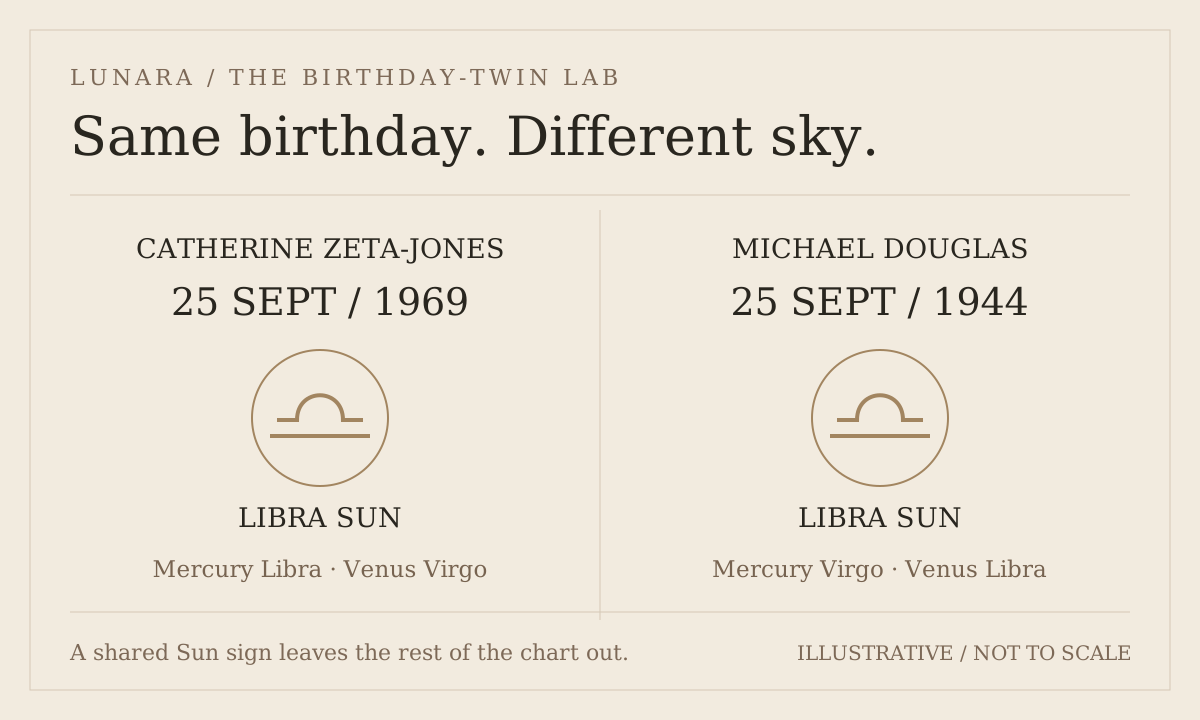
Catherine Zeta-Jones and Michael Douglas share September 25 as their birthday. He was born in 1944; she arrived in 1969. Both have a Libra Sun. If astrology stopped there, a comparison of their charts would be very short.
Their recent birthday tributes give us a reason to look again. HOLA's September 25, 2026 report describes Douglas sharing a recollection from his forthcoming memoir, One Helluva Ride, about first seeing Zeta-Jones on screen. She posted a birthday message of her own. These are public celebrations, not evidence that an astrological placement caused their relationship to last.
The interesting chart detail is a swap: her Mercury is in Libra and Venus in Virgo; his Mercury is in Virgo and Venus in Libra. The same two signs do different jobs. Their Mars placements differ too. You can explore those differences above, and switch off the published birth times to see why a shared date cannot settle every placement.
One Libra label, two ways of using it
In a tropical chart, the Sun's sign describes one part of the reading. It does not make the rest of the sky repeat on the same calendar date each year. Mercury and Venus move on their own cycles; Mars takes much longer to return. The Moon can change signs during a single birthday.
Libra is traditionally read through balance, proportion and the relationship between two people. A pair of Libra Suns offers that common symbolic vocabulary. It cannot tell us whether the people communicate alike, enjoy the same gestures of affection or handle a disagreement in the same way.
For these birthdays, both Suns stay in Libra across their respective local dates. The other personal planets give the comparison more texture:
- Zeta-Jones: Mercury in Libra, Venus in Virgo, Mars in Capricorn.
- Douglas: Mercury in Virgo, Venus in Libra, Mars in Libra.
Those signs appear consistently in hourly samples of each local birthday, including 23:59. That is our sampling result, not a mathematical proof of every instant between samples. We are comparing signs here, not claiming exact degrees or measuring a synastry aspect.
Mercury and Venus exchange roles
Mercury is the planet astrologers use when discussing thought and speech. Libra Mercury is often read as weighing another perspective, looking for fair wording or trying to make a conversation work for both people. Virgo Mercury is often read as noticing what is specific: the detail, the practical distinction, the part that needs clarifying.
Venus supplies a different question: what feels pleasing, affectionate or worth choosing? Virgo Venus brings a symbolic emphasis on care through attention. A small, well-chosen action can matter more than an elaborate declaration. Libra Venus brings the shared experience into focus: the atmosphere between people, mutual consideration, the pleasure of doing something together.
Put those placements next to each other and there is more to discuss than “Libra plus Libra.” The language associated with one person's Mercury appears in the other person's Venus. We can use that as a prompt about whether words and gestures carry the same meaning to both people. We cannot use it to tell you what happens inside this marriage.
For your own relationship, think of a recent kind gesture. Did it feel kind because someone noticed a practical need, or because they made time for a shared experience? Neither answer is a compatibility verdict. It is a more useful conversation than comparing Sun-sign labels alone.
Mars adds another difference
Zeta-Jones's Mars is in Capricorn; Douglas's is in Libra. Traditionally, Capricorn Mars is read through directed effort, a plan and something concrete to accomplish. Libra Mars is read through negotiating action with other people and considering what is fair before moving.
Those themes can work together, or they can give two people different ideas of what “getting on with it” means. Someone wants to agree on the terms; someone wants to start the plan. Whether that happens in this couple is not information a chart gives us.
You can ask the question without assigning anyone a role: when you have a problem to solve together, do you need a clear next step first, or agreement about how the decision should be made?
The clock matters, even for birthday twins
Astrotheme's Zeta-Jones entry lists September 25, 1969, 14:40 in Swansea, with a reliability label of A: memory or autobiography. It names Frank C. Clifford as contributor. Its Douglas entry lists September 25, 1944, 10:30 in New Brunswick, New Jersey, with AA: birth certificate or birth record, contributed by Steinbrecher.
Those are the publisher's classifications. Lunara has not inspected the underlying birth records. At the listed times, our calculation places her Moon in Pisces and his in Capricorn.
Remove the times and both Moon signs become conditional. On Zeta-Jones's local birth date, the Moon moves from Pisces into Aries at approximately 16:55, GMT+1. On Douglas's local date, it moves from Sagittarius into Capricorn at approximately 03:55, GMT−4. We use the historical civil zones, Europe/London and America/New_York, rather than applying today's offsets to old birthdays.
That is why the switch above changes the Moon row to two possibilities. It does not mean either person has a blended Moon. It means that a date-only comparison cannot choose between the possibilities. The reported times do choose; the strength of that claim remains tied to the sources.
For a different Libra example, Alicia Silverstone's Sun and Pluto sit only about 13 arcminutes apart. Sharing a sign and making a close conjunction are different statements.
A birthday match is a starting point
A shared birthday makes a good story. It does not establish a shared chart, a percentage of compatibility or a reason a marriage succeeds. We have kept houses and rising signs out of this comparison, and have not used planetary placements to predict a breakup, explain private behavior or claim that the couple are destined for each other.
If you came here because you and someone close to you share a sign, compare your own two charts. The free calculator starts with your actual dates and places. When a birth time is unknown, leave it unknown; its reduced comparison explains what it omits rather than substituting a precise-looking noon chart for a verified birth time.
This is symbolic astrology for reflection, not a scientifically validated account of personality or relationship outcomes. The birth-data sources and the calculation limits are available in the lab above.