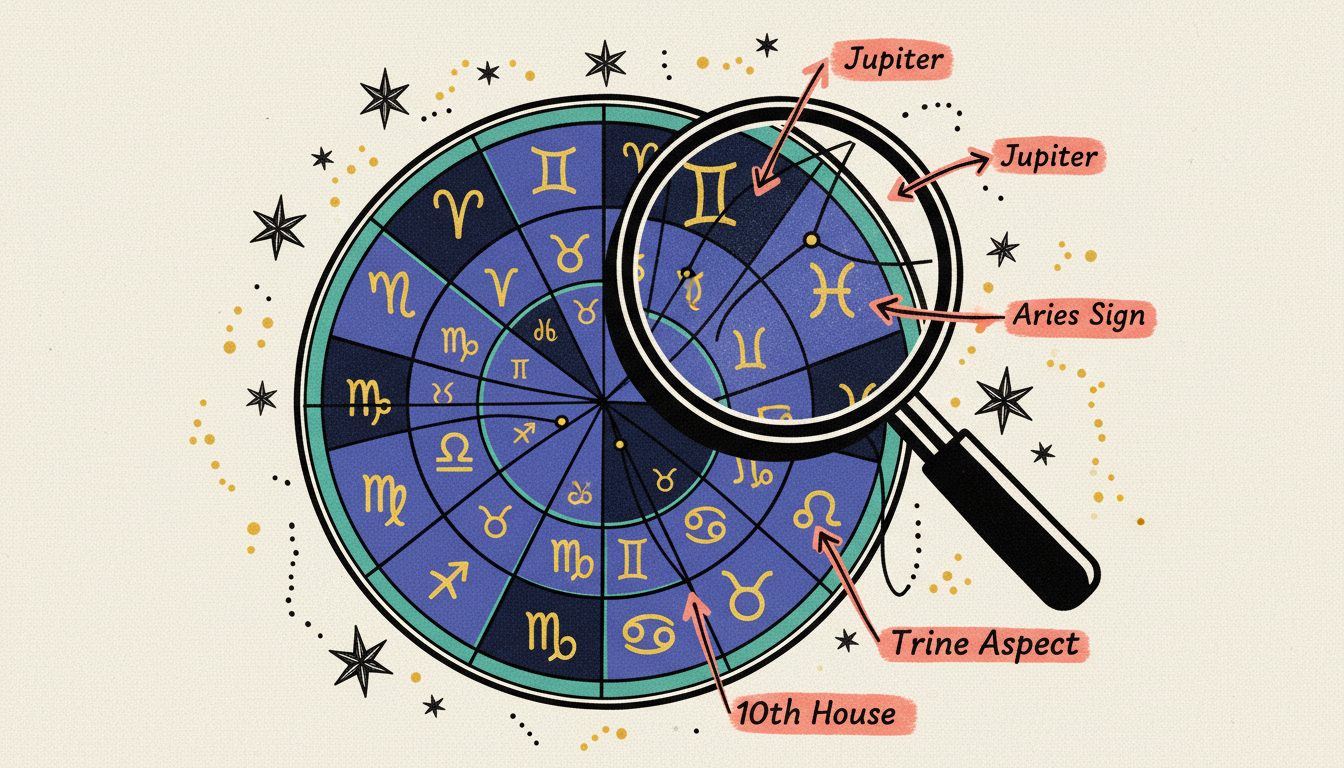
You've generated your birth chart. You're staring at a wheel full of symbols, lines, and numbers that might as well be hieroglyphics. Maybe you recognize your sun sign. Maybe you've heard of a "rising sign." But putting it all together? That's where most people get stuck.
Here's the truth: reading a natal chart isn't as complicated as it looks. Once you understand the basic building blocks—planets, signs, houses, and aspects—the chart starts to tell a story. Your story.
In this guide, we'll walk you through exactly how to read a birth natal chart, step-by-step, so you can move from overwhelmed to empowered. By the end, you'll know how to interpret the key pieces and start synthesizing them into meaningful insights about your personality, relationships, and life path.
The Four Building Blocks of a Natal Chart
Every birth chart is made up of four main components. Think of them as the alphabet of astrology. Once you know these, you can start reading.
1. The Planets: What
The planets represent different parts of your psyche and life experience. They're the what—what aspects of yourself are being expressed.
-
Sun: Core identity, ego, vitality
-
Moon: Emotions, instincts, inner self
-
Mercury: Communication, thinking, learning
-
Venus: Love, values, beauty, relationships
-
Mars: Drive, ambition, anger, sexuality
-
Jupiter: Growth, expansion, luck, philosophy
-
Saturn: Discipline, structure, challenges, mastery
-
Uranus: Innovation, rebellion, sudden change
-
Neptune: Dreams, spirituality, illusion, compassion
-
Pluto: Transformation, power, death and rebirth
2. The Signs: How
The zodiac signs describe how each planet expresses itself. They add flavor, style, and method to the planetary energy.
-
Aries: Bold, direct, impulsive
-
Taurus: Steady, sensual, stubborn
-
Gemini: Curious, communicative, adaptable
-
Cancer: Nurturing, emotional, protective
-
Leo: Confident, expressive, dramatic
-
Virgo: Analytical, practical, perfectionist
-
Libra: Harmonious, diplomatic, indecisive
-
Scorpio: Intense, secretive, transformative
-
Sagittarius: Adventurous, philosophical, blunt
-
Capricorn: Ambitious, disciplined, pragmatic
-
Aquarius: Innovative, detached, humanitarian
-
Pisces: Intuitive, compassionate, escapist
3. The Houses: Where
The 12 houses represent different areas of your life. They show where each planetary energy plays out.
-
1st House: Self, identity, appearance
-
2nd House: Money, possessions, values
-
3rd House: Communication, siblings, local environment
-
4th House: Home, family, roots
-
5th House: Creativity, romance, pleasure
-
6th House: Health, work, daily routine
-
7th House: Partnerships, marriage, relationships
-
8th House: Transformation, sex, shared resources
-
9th House: Philosophy, travel, higher learning
-
10th House: Career, reputation, public image
-
11th House: Friendships, community, aspirations
-
12th House: Spirituality, unconscious, solitude
4. The Aspects: Why
Aspects are the angles planets make to each other. They show why certain planetary energies interact the way they do—whether harmoniously or with tension.
-
Conjunction (0°): Planets blend together
-
Sextile (60°): Harmonious, supportive
-
Square (90°): Tension, challenge, growth
-
Trine (120°): Easy flow, natural talent
-
Opposition (180°): Polarity, balance, awareness
Now let's put these pieces together.

How to Read Your Natal Chart: Step-by-Step
Step 1: Identify Your Big Three
Start with the foundation: your sun, moon, and rising signs. These three placements form the core of your identity.
Your Sun Sign Look for the sun symbol (☉) on your chart. The sign it's in is your sun sign. This is your core self, your ego, your life force. It's who you're growing into over the course of your life.
Example: Sun in Leo = confident, expressive, seeks recognition
Your Moon Sign Find the moon symbol (☽). The sign it's in is your moon sign. This governs your emotional world, instincts, and what you need to feel safe.
Example: Moon in Cancer = deeply emotional, nurturing, needs security
Your Rising Sign (Ascendant)
Your rising sign is marked by "AC" or "ASC" on your chart. It's the sign that was on the eastern horizon when you were born. This is your outward personality, first impressions, and how you navigate the world.
Example: Virgo Rising = appears organized, helpful, detail-oriented
Together, your Big Three give you a snapshot of who you are:
-
Sun = your essence
-
Moon = your emotional needs
-
Rising = your mask or approach to life
Step 2: Look at Your Personal Planets
After your Big Three, examine your personal planets: Mercury, Venus, and Mars. These govern your day-to-day experience.
Mercury: How you communicate and think
- Mercury in Gemini = fast thinker, loves conversation, easily bored
- Mercury in Capricorn = practical, strategic, thinks long-term
Venus: How you love and what you value
-
Venus in Scorpio = intense, passionate, all-or-nothing in love
-
Venus in Libra = romantic, seeks harmony, values partnership
Mars: How you take action and what you desire
- Mars in Aries = direct, impulsive, competitive
- Mars in Pisces = indirect, idealistic, motivated by inspiration
Step 3: Identify House Placements
Now look at which house each planet occupies. This shows where in your life that planetary energy will be most active.
Example: Venus in the 10th house = you value career success and public reputation, and may attract opportunities through charm and social grace
Example: Mars in the 4th house = you direct your energy toward home, family, and creating a secure foundation
If you have several planets in one house (a stellium), that area of life will be a major focus for you.
Step 4: Notice the Aspects
Look at the lines connecting planets on your chart. These are aspects. They show how different parts of your personality work together—or clash.
Harmonious Aspects (Trines, Sextiles) These are easy, natural flows of energy. You might not even notice them because they come so effortlessly.
Example: Sun trine Jupiter = natural optimism, luck, confidence
Challenging Aspects (Squares, Oppositions) These create tension and friction—but also growth. They're the parts of yourself that require conscious work to integrate.
Example: Moon square Saturn = emotional restriction, difficulty expressing feelings, but can lead to emotional maturity over time
Don't fear challenging aspects. They're often where your greatest growth happens.
Step 5: Look for Patterns
Once you've examined individual placements, step back and look for patterns:
Element Balance
-
Fire (Aries, Leo, Sagittarius): Passion, action, enthusiasm
-
Earth (Taurus, Virgo, Capricorn): Practicality, stability, materialism
-
Air (Gemini, Libra, Aquarius): Intellect, communication, ideas
-
Water (Cancer, Scorpio, Pisces): Emotion, intuition, sensitivity
Do you have a lot of planets in one element? You'll express that energy strongly.
Modality Balance
- Cardinal (Aries, Cancer, Libra, Capricorn): Initiators, leaders
- Fixed (Taurus, Leo, Scorpio, Aquarius): Stable, stubborn, persistent
- Mutable (Gemini, Virgo, Sagittarius, Pisces): Adaptable, flexible, changeable
Dominant Planets or Signs
If one planet makes many aspects or one sign appears multiple times, it will flavor your entire personality.
Type: Infographic Dimensions: 800x1000
Alt Text: Step-by-step flowchart for reading a natal chart Description: Clean, modern flowchart showing the 5 steps to read a natal chart. Each step is a box with an icon: 1) Big Three (sun, moon, rising icons), 2) Personal planets (Mercury, Venus, Mars symbols), 3) Houses (house wheel), 4) Aspects (lines connecting), 5) Patterns (element/modality symbols). Arrows connect each step. Style: Educational, clear, minimalist. Color palette: White background, purple boxes, gold icons, dark text. Priority: High File Name: how-to-read-a-birth-natal-chart-flowchart.jpg Priority: High

Putting It All Together: An Example
Let's say someone has:
-
Sun in Gemini in the 10th house
-
Moon in Scorpio in the 3rd house
-
Virgo Rising
-
Venus in Taurus in the 9th house
-
Mars in Leo in the 12th house
Here's how you'd read this:
Core Identity: Gemini Sun in the 10th house = Communicative, curious, values intellectual stimulation. Career and public reputation are central to identity. Likely drawn to media, writing, teaching, or anything that involves sharing information publicly.
Emotional World: Scorpio Moon in the 3rd house = Intense, private emotions. Thinks deeply and obsessively. Needs emotional depth in communication. Sibling relationships or early learning environment may have been transformative or difficult.
Outward Persona: Virgo Rising = Appears organized, analytical, helpful. First impression is competent and detail-oriented, even if inner world (Scorpio Moon) is much more intense.
Love Style: Venus in Taurus in the 9th house = Values stability, loyalty, sensuality in relationships. Attracted to partners who are philosophical, adventurous, or from different cultures. Love may blossom through travel or education.
Drive & Ambition: Mars in Leo in the 12th house = Creative, dramatic drive, but often expressed behind the scenes or privately. May struggle with self-promotion despite having talent. Energy is directed toward spirituality, art, or hidden pursuits.
Overall Theme: This person is intellectually driven and publicly visible (Gemini Sun in 10th), but has a rich, private inner world (Scorpio Moon, Mars in 12th). They seek stable, meaningful love (Venus in Taurus) and need to balance public achievement with emotional depth and spiritual fulfillment.
See how it starts to form a cohesive story?

Common Mistakes When Reading a Natal Chart
1. Reading placements in isolation Don't just look up "Mars in Aries" and stop there. Consider which house it's in and what aspects it makes. Context is everything.
2. Forgetting the houses Many beginners focus only on signs and ignore houses. But houses show where the energy manifests, which is just as important as how (sign).
3. Fearing "bad" placements There are no bad placements. Only challenging ones that require conscious work. Saturn in the 7th isn't a curse; it's a call to take relationships seriously and build lasting partnerships.
4. Ignoring aspects Aspects show how your placements interact. A Venus in Aries might be impulsive in love—unless it's trine Saturn, which adds caution and commitment.
5. Overcomplicating it Start simple. Master the basics before diving into asteroids, minor aspects, and advanced techniques.

How Long Does It Take to Learn to Read Charts?
Honestly? It depends.
- Basic literacy (reading your own chart): A few hours of study
- Intermediate understanding (synthesizing multiple charts): A few months
- Advanced interpretation (professional-level readings): Years of practice
Start with your own chart. Spend time with it. Research each placement. Notice how the pieces fit together. Then move on to charts of people you know well—partners, family, friends. See if the chart matches what you observe.
Reading charts is part knowledge, part intuition. The more you practice, the more fluent you become.
Tools to Help You Read Your Chart
Free Chart Generators
- Astro.com (Astrodienst)
- Cafe Astrology
- Our free natal chart calculator
Books
- The Inner Sky by Steven Forrest
- Astrology for the Soul by Jan Spiller
- The Twelve Houses by Howard Sasportas
Apps
- Co-Star
- The Pattern
- TimePassages
Key Takeaways
-
A natal chart has four main components: planets (what), signs (how), houses (where), and aspects (why)
-
Start by identifying your Big Three: sun, moon, and rising
-
Add personal planets (Mercury, Venus, Mars) for more detail
-
Look at house placements to see where energies manifest
-
Notice aspects to understand how placements interact
-
Step back to see patterns in elements, modalities, and dominant energies
Frequently Asked Questions
Q: Do I need to know my exact birth time? A: Yes, for houses and your rising sign. Without it, you can still read planetary signs, but you'll miss a significant portion of the chart.
Q: How accurate are online chart interpretations? A: They're generally accurate for individual placements but lack synthesis. A professional astrologer weaves everything together into a cohesive story, which automated reports can't fully do.
Q: Can I learn to read charts on my own, or do I need a teacher? A: You can absolutely self-teach using books, websites, and practice. A teacher or course can accelerate learning, but it's not required.
Q: What if my chart contradicts itself? A: That's normal. You might have a social sun sign and a reclusive moon sign, or an impulsive Mars with a cautious Saturn. These contradictions make you complex and human. The art is learning to honor all parts of yourself.
Ready to dive into your cosmic blueprint?
Generate your free natal chart now and start uncovering the planetary patterns shaping your life.
Related Articles: