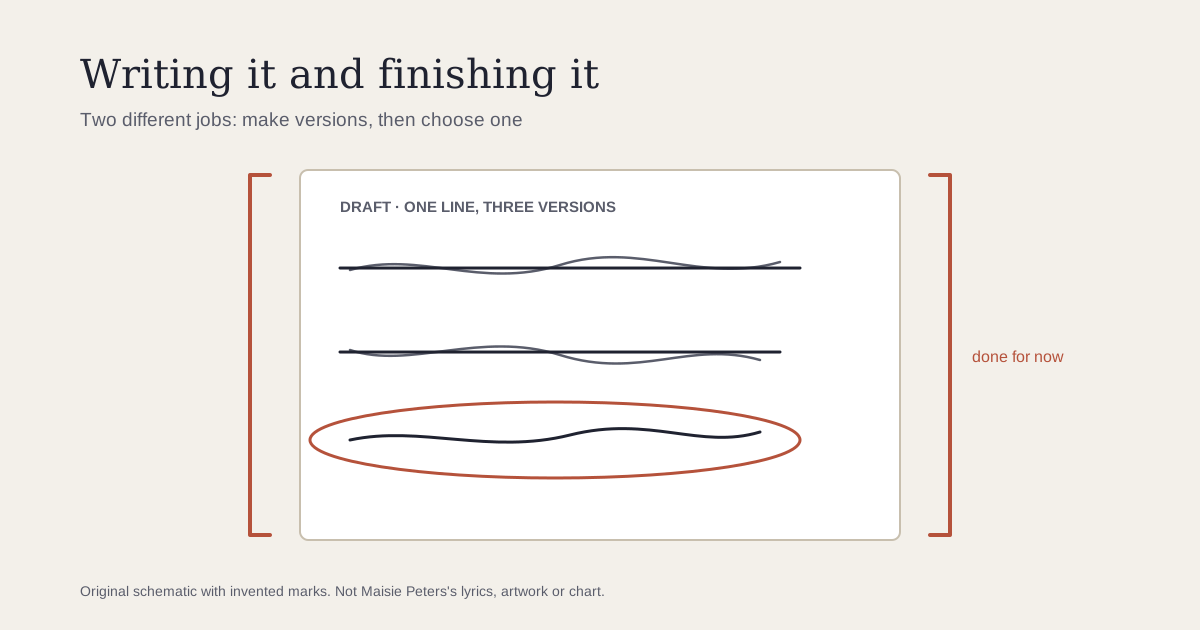
Most songwriters get asked how they write. Maisie Peters gave a more useful answer to a different question. In a March 2026 interview with The Unseen, she said the hardest thing about making her third album, Florescence, "wasn't really the writing, but it was the finishing."
She meant the last stretch: working with her team, other writers and producers to get the songs to a final state. What she took from it was that "nothing is going to feel done", and that sometimes you have to trust other people's opinions as well as your own. She also said she didn't know the album's title until the album was finished. She needed the whole thing in front of her to see the story running through it.
That's the subject of this piece: writing a song and finishing one are different jobs. Her chart, read symbolically, has a lot to say about the first job and a quieter, slower voice for the second.
Birth data and method
- Born: May 28, 2000, Steyning, England, as listed by Wikipedia (a secondary biography, read October 15, 2026). We haven't seen a birth record.
- Birth time: none published that we could find. We didn't pick one.
- Calculation: Lunara's central chart calculation (Swiss Ephemeris, tropical zodiac, geocentric), sampled every hour of the local day from midnight to 11 p.m. British Summer Time, plus 11:59 p.m.
- Kept: only positions that stay in the same sign at every sample. No Rising sign, houses or Midheaven, because those need an exact time.
At every sample:
- Sun in Gemini, about 7°
- Venus in Gemini, about 3° to 4°
- Mars in Gemini, about 17°
- Mercury in late Gemini, about 26° to 28°
- Jupiter and Saturn together in Taurus, about 22°, within a tenth of a degree of each other
The Moon changes sign that day. Our calculation puts it in Pisces until about 11 a.m. and in Aries after that, so her Moon sign depends on a time we don't have. Both stay open here. Hourly samples show what holds across the day, not the exact minute anything changed.
The Jupiter–Saturn meeting in Taurus is a slow, generational event that happens roughly every twenty years. Everyone born in those weeks has some version of it. It isn't a personal signature, but it's a useful contrast to everything else that's going on.
Four planets in a sign of options
Gemini is the sign astrologers associate with variety: words, conversation, trying a second idea before the first one is cold. Four planets there is a lot. The Sun is identity, Mercury is how you think and phrase things, Venus is what you find beautiful, and Mars is how you go after something. In this chart, all four sit in the same sign.
Read as a single lens, that's a chart built for producing versions. Another line, another angle, another way to say the same feeling. That's a real strength for a songwriter. It also has an obvious cost. A sign of options doesn't come with a built-in moment where the options stop.
Two slow planets that keep things
Jupiter and Saturn in Taurus point the other way. Taurus is the sign of keeping: holding on to what works, building something that lasts. Saturn in particular is the planet of limits, deadlines and structure, the part of a chart that says "this is the shape now."
Put the two groups side by side and you get a tension that's a useful frame for what she described. One part of the chart keeps generating. Another part wants to settle on something and make it permanent. Neither is the "real" one. Finishing is the moment the second voice gets the final say over the first.
It also shows up in a simple count. Our modality calculator gives each of the ten planets one vote. It needs a recorded birth time, so it can't run on her chart directly. Counted by hand from the positions above, she has five or six planets in mutable signs (the changing ones) and four in fixed signs (the keeping ones). The split depends on which side of the Moon's sign change she was born.
None of this explains her talent, her choices or what she was thinking while she made the album. It's a lens we're offering, not something we discovered about her. Plenty of people born that week have never written a song.
An exercise: three decisions for one stubborn line
This is Lunara's invented exercise, not Peters's documented routine.
Picture a chorus that already works, except for one line the writer keeps changing. There are six versions in the notebook now. Each one is fine. None feels done, which, by her account, is normal.
The task has three possible decisions:
- One more alternate. Write a seventh version, but only if you can say what's wrong with the first six.
- Keep a working choice. Pick the best of the six, mark it as the line for now and move on to the rest of the song.
- Release the draft. Hand it to someone you trust and let their reaction decide.
The point isn't that one decision is always right. The point is to choose one on purpose, instead of drifting into version seven because writing feels better than deciding.
Before you start, set a closing condition, a rule that tells you when you're done. For example: "I stop when two people I trust can't pick which version is better," or "I stop at the end of Sunday." The condition is yours. A chart can't set it for you.
Three prompts for your own unfinished work
- What are you still generating versions of, when the real job is choosing one?
- Whose opinion would you trust enough to let it settle the question?
- What's your closing condition, written down before you start the next round?
Your own chart
If you know your birth time from a certificate or hospital record, use it, and your Rising sign and houses will be included. Calculate your free birth chart to see which signs your planets are in. If you don't know your time, read how a birth chart works without a birth time first. The calculator won't guess one.
You can read a complete fictional sample reading to see what a full written chart looks like. If you want your own, there's an optional, paid personal birth chart reading. It's automated and written from Lunara's interpretation copy for your placements, not written or reviewed by an astrologer, and it doesn't assess creative work. The price for your country is shown before you decide.
Sources: interview details from The Unseen, "I've Had the Best Few Years: Maisie Peters on Her Upcoming Album Florescence", by Andy, published March 2, 2026, read October 15, 2026. The two short quotations are from that interview; the rest is paraphrased. Birth date and place from Wikipedia, read October 15, 2026; it's a secondary source, and no birth time is established. Positions from Lunara's central calculation (Swiss Ephemeris, tropical, geocentric), sampled hourly across the local day in Europe/London time. Text written with AI assistance and checked against those sources. Lunara isn't affiliated with Maisie Peters or The Unseen. The illustration is original.