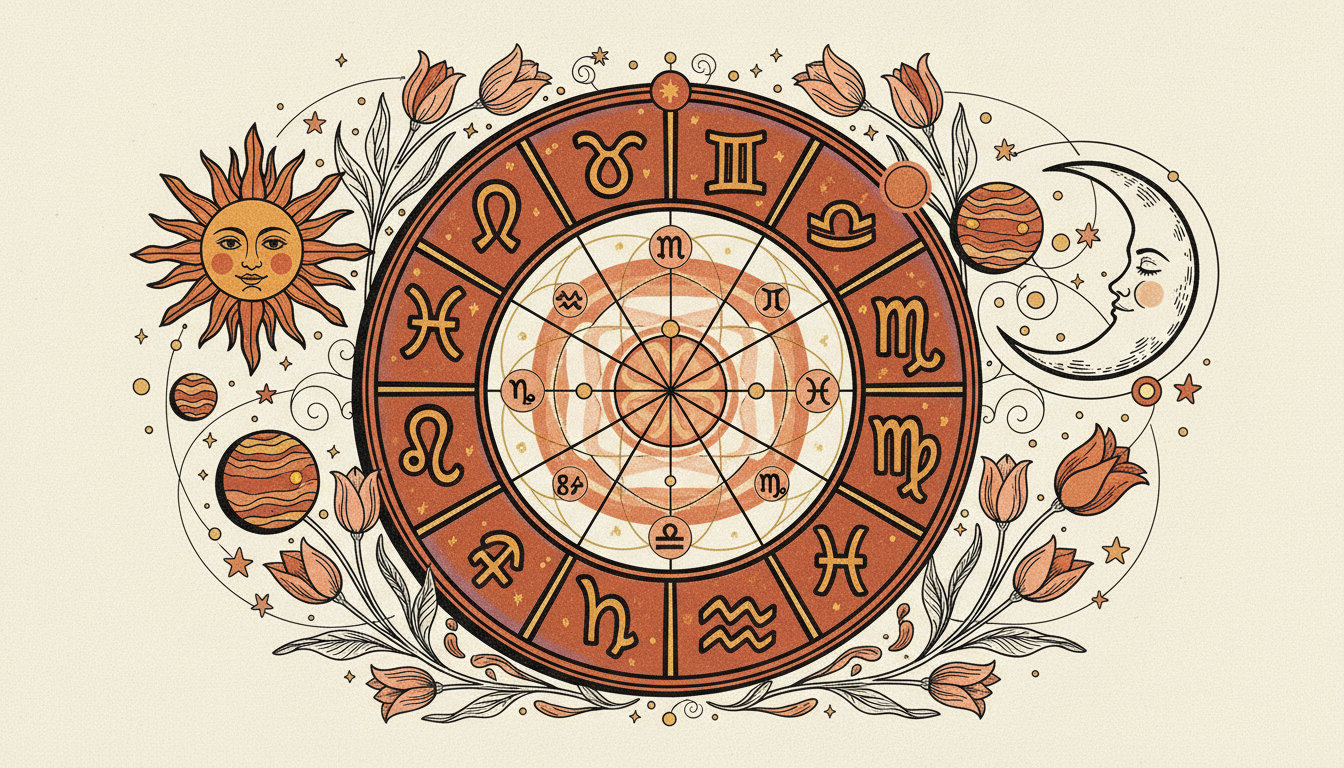
Your natal birth chart is the most personal astrological tool you have—a precise map of the sky at the moment you took your first breath. But having the chart and understanding what it means are two very different things.
Natal birth chart interpretation is the art of translating planetary positions, zodiac signs, houses, and aspects into meaningful insights about who you are, why you're here, what you need, and how you can live most authentically.
This isn't fortune-telling or generic personality descriptions. Skilled natal chart interpretation reveals startlingly specific information about your inner world, relationship patterns, career path, emotional needs, and soul's purpose—information you may not have consciously recognized but deeply know to be true.
In this comprehensive guide, we'll explore everything about natal birth chart interpretation: what it is, how professional astrologers approach it, what to look for in your own chart, and how to move from isolated facts to integrated understanding.
What Is Natal Birth Chart Interpretation?
Natal chart and birth chart mean the same thing: a chart calculated for the exact moment of birth.
Interpretation is the process of analyzing this chart to understand:
-
Personality structure and identity
-
Emotional patterns and needs
-
Mental processes and communication style
-
Relationship dynamics and attraction patterns
-
Career strengths and life direction
-
Challenges and growth opportunities
-
Soul purpose and evolutionary path
The Difference Between Calculation and Interpretation
Calculation (objective):
-
Determining where planets were at birth
-
Mathematical, precise, identical across calculators
-
Anyone with birth data can generate a chart
Interpretation (subjective/skilled):
-
Making meaning from planetary positions
-
Requires knowledge, experience, intuition
-
Varies based on astrologer's approach and expertise
Most people can get a natal chart in seconds. Interpreting it meaningfully takes study, practice, and synthesis.

The Foundation of Natal Chart Interpretation
Every thorough natal chart interpretation examines these core components:
1. The Three Pillars: Sun, Moon, Rising
These form your fundamental identity:
Sun: Your conscious self, ego, identity, life force
-
What you're becoming
-
Your core purpose and vitality
-
Where you shine
Moon: Your emotional nature, unconscious patterns, needs
-
What you need to feel secure
-
Your instinctual responses
-
Your inner emotional world
Rising (Ascendant): Your outward personality, approach to life
-
How you appear to others
-
Your natural style and demeanor
-
The "mask" you wear (but it's still authentic)
Example:
-
Cancer Sun: Nurturing, emotional, protective core
-
Capricorn Moon: Needs structure, achievement, emotional control
-
Libra Rising: Appears charming, diplomatic, relationship-oriented
Already you see complexity: nurturing core, disciplined emotions, charming exterior.
2. Personal Planets: Daily Experience
Mercury: How you think, communicate, learn, process information
Venus: What you value, how you love, what brings pleasure Mars: How you take action, assert yourself, pursue desires
These shape your day-to-day life and relationships.
3. Social Planets: Growth and Structure
Jupiter: Where you expand, find luck, seek meaning, grow
Saturn: Where you face challenges, build mastery, learn discipline
These balance growth (Jupiter) and structure (Saturn).
4. Outer Planets: Transformation and Transcendence
Uranus: Innovation, rebellion, sudden change, awakening Neptune: Spirituality, dreams, illusion, transcendence
Pluto: Transformation, power, depth, regeneration
These are generational (everyone born in a certain period shares the sign), but house placement personalizes them.
5. Houses: Where Energy Operates
The 12 houses show where planetary energy manifests in your life:
-
Self, identity, approach
-
Money, values, possessions
-
Communication, learning, siblings
-
Home, family, roots
-
Creativity, romance, children
-
Health, work, service
-
Partnerships, marriage
-
Transformation, shared resources
-
Philosophy, travel, meaning
-
Career, reputation, achievement
-
Friendships, groups, aspirations
-
Spirituality, unconscious, secrets
6. Aspects: How Planets Interact
Angles between planets create dynamics:
Harmonious (trines 120°, sextiles 60°): Ease, flow, talent Challenging (squares 90°, oppositions 180°): Tension, growth, motivation Intense (conjunctions 0°): Fusion, emphasis
Aspects show how different parts of your psyche work together—or clash productively.
Type: Educational Framework Dimensions: 1200x800 Alt Text: Natal chart interpretation framework showing all key components
Description: Comprehensive diagram showing the framework for natal chart interpretation. Central birth chart wheel surrounded by six sections explaining core components: 1) Sun/Moon/Rising (with keywords), 2) Personal planets (Mercury/Venus/Mars), 3) Social planets (Jupiter/Saturn), 4) Outer planets (Uranus/Neptune/Pluto), 5) Houses (life areas), 6) Aspects (relationships). Each section has icons, brief descriptions, and connecting lines to relevant chart parts. Style: Professional, educational, comprehensive yet clear. Color palette: White background, purple section dividers, gold planetary symbols, teal connecting lines, clear dark text. Priority: High File Name: natal-birth-chart-interpretation-framework.jpg Priority: High
The Professional Interpretation Process
Here's how experienced astrologers approach natal chart interpretation:
Step 1: Overall Chart Pattern
Before details, look at the whole:
Element Emphasis:
-
Fire dominant? Action-oriented, passionate, spontaneous
-
Earth dominant? Practical, grounded, material focus
-
Air dominant? Intellectual, social, communicative
-
Water dominant? Emotional, intuitive, empathetic
Modality Emphasis:
- Cardinal dominant? Initiating, starting, leading
- Fixed dominant? Sustaining, maintaining, persisting
- Mutable dominant? Adapting, changing, flexible
Hemisphere:
- Above horizon? Outer-world focus (public, social)
- Below horizon? Inner-world focus (private, personal)
- Eastern half? Self-directed, independent
- Western half? Other-directed, relationship-focused
This gives context for everything that follows.
Step 2: Ascendant and Chart Ruler
Rising Sign: The lens through which life is experienced
Chart Ruler: The planet ruling your rising sign
-
This planet is extremely important
-
Often more revealing than the Sun
Example:
- Scorpio Rising → Mars (and Pluto) is chart ruler
- Mars in Gemini in 8th house → Life path involves communicating (Gemini) about deep, transformative subjects (8th house). Possible paths: psychology, research, detective work, sexuality education.
The chart ruler is a major key to understanding the entire chart.
Step 3: Sun and Moon Analysis
Sun's sign, house, and aspects:
-
Core identity and how it's expressed
-
Where you shine and find vitality
-
What you're developing consciously
Moon's sign, house, and aspects:
-
Emotional needs and patterns
-
What makes you feel secure
-
Unconscious responses and habits
Sun-Moon relationship:
-
Harmonious aspect: Inner coherence
-
Challenging aspect: Internal conflict that drives growth
-
No aspect: Separate development of identity and emotions
Example:
-
Sun in Aries in 10th house: Bold, pioneering identity expressed through career and public achievement
-
Moon in Cancer in 1st house: Deep emotional sensitivity visible in personality; needs nurturing
-
Sun square Moon: Tension between ambitious drive (Aries) and emotional safety needs (Cancer)
Step 4: Personal Planet Interpretation
For Mercury, Venus, and Mars:
Mercury:
-
Sign: How you think (e.g., Mercury in Virgo = analytical, detailed)
-
House: Where mental energy focuses (e.g., 3rd house = communication, learning)
-
Aspects: How thinking connects to other functions (e.g., Mercury trine Jupiter = optimistic, expansive thinking)
Venus:
-
Sign: How you love and what you value
-
House: Where love and values express
-
Aspects: How love connects to other energies
Mars:
-
Sign: How you take action and pursue desires
-
House: Where you direct energy and assertion
-
Aspects: How drive interacts with other parts
Step 5: Jupiter and Saturn—Expansion and Contraction
Jupiter shows where life flows easily, where you grow, where you find meaning.
Saturn shows where you face challenges, where you build mastery through discipline.
These two balance each other: expansion and structure.
Example:
- Jupiter in Sagittarius in 9th house: Natural luck with travel, education, philosophy, teaching
- Saturn in Gemini in 3rd house: Communication challenges early in life, but eventual mastery of writing/speaking
Step 6: Outer Planets and House Placement
Uranus, Neptune, and Pluto are generational, but where they fall in your houses personalizes them:
Example:
- Pluto in 7th house: Transformation through relationships; intense, powerful partnerships; possible control dynamics to work through
Step 7: Aspect Patterns and Configurations
Look for major patterns:
Stellium (3+ planets in one sign/house): Concentrated energy and focus
T-Square (two planets oppose, both square a third): Dynamic tension driving achievement; focal planet is key
Grand Trine: Natural talent; possibly too easy (lack of motivation)
Grand Cross: Maximum tension and productivity
Yod ("Finger of God"): Fated theme requiring constant adjustment
Step 8: Synthesis and Integration
Now create a narrative:
Key questions:
-
What are the 3-5 major themes repeating across the chart?
-
Where do contradictions exist? (They're real—honor them)
-
What does this person need for fulfillment?
-
What are their gifts and challenges?
-
How do all the pieces fit into a coherent whole?
Example Synthesis:
"This is someone with deep intensity and psychological insight (Scorpio stellium). Their core identity involves transformation and depth (Scorpio Sun in 8th), but they approach the world with grace and diplomacy (Libra Rising). There's inherent tension between their need for deep intimacy and their need to maintain pleasant social relationships.
Emotionally, they're sensitive and nurturing (Cancer Moon), but this squares their Aries Mars, creating frustration when emotions don't align with their drive to act. They need to integrate sensitivity with assertion.
Career and public life are central (10th house emphasis with Venus and Mercury), suggesting success through communication, relationship-building, or aesthetic work. Saturn in the 6th shows they must work hard and maintain health discipline.
The gift: Extraordinary depth combined with social grace. The challenge: Balancing intimacy needs with independence; integrating sensitivity with assertion. The path: Using psychological insight in career; transforming relationship challenges into wisdom."

Advanced Natal Chart Interpretation Techniques
1. Planetary Dignity
Planets in certain signs express more easily:
Domicile (home): Natural expression (e.g., Mars in Aries) Exaltation: Elevated expression (e.g., Venus in Pisces) Detriment: Challenged expression (e.g., Mars in Libra)
Fall: Weakened expression (e.g., Sun in Libra)
2. Ruling Planets and Dispositorship
The planet ruling each placement's sign:
Example:
-
Sun in Virgo → Mercury rules it
-
Where is Mercury? How is Mercury doing?
-
Mercury's condition affects how Sun expresses
3. Sect: Day or Night Chart
Born with Sun above horizon (day chart) or below (night chart)?
Day charts emphasize: Sun, Jupiter, Saturn
Night charts emphasize: Moon, Venus, Mars
4. Fixed Stars and Asteroids
Advanced astrologers include:
-
Fixed stars (Regulus, Aldebaran, etc.)
-
Asteroids (Chiron, Juno, Pallas, Vesta, etc.)
-
Arabic Parts (especially Part of Fortune)
5. Harmonic Charts
Dividing the chart mathematically reveals hidden patterns.
6. Evolutionary Astrology
Using North and South Nodes to understand soul evolution and karmic patterns.
Common Natal Chart Interpretation Mistakes
1. Cookbook Interpretation
Reading keywords from a book without context.
Wrong: "Sun in Leo = arrogant and dramatic" Right: "Sun in Leo suggests natural self-expression, creativity, and need for recognition—how this manifests depends on house, aspects, and overall chart"
2. Ignoring the Whole Chart
Focusing only on Sun sign while ignoring everything else.
3. Being Fatalistic
Treating chart as fixed destiny rather than map of potentials.
4. Overvaluing Difficult Placements
Assuming challenging aspects mean "bad" outcomes.
Squares and oppositions drive growth and achievement.
5. Projection
Assuming your experience of a placement is universal.
6. Information Overload
Giving someone 50 details instead of focusing on major themes.

Interpreting Natal Charts for Different Life Areas
Personality and Identity
Focus on: Sun, Moon, Rising, 1st house, chart ruler
Relationships and Love
Focus on: Venus, Mars, 7th house, 5th house, Juno
Career and Life Purpose
Focus on: Midheaven, 10th house, Sun, Saturn, North Node, 2nd house
Family and Home
Focus on: Moon, 4th house, IC, Cancer placements
Communication and Learning
Focus on: Mercury, 3rd house, 9th house, Gemini/Sagittarius placements
Emotional Patterns and Healing
Focus on: Moon, 4th house, 12th house, Chiron, Water placements
Developing Your Natal Chart Interpretation Skills
1. Start With Your Own Chart
You know yourself best, making verification easier.
2. Read Charts of People You Know Well
Practice where you can verify accuracy.
3. Study Celebrity Charts
Public lives allow you to see how charts manifest.
4. Keep Notes
Journal interpretations and check back later.
5. Read Books and Take Courses
Recommended:
- The Inner Sky by Steven Forrest
- Astrology for the Soul by Jan Spiller
- The Twelve Houses by Howard Sasportas
6. Practice Regularly
Interpretation improves with repetition.
Key Takeaways
-
Natal chart interpretation synthesizes all chart elements into meaning
-
Start with Sun, Moon, Rising (the Big Three)
-
Add chart ruler, then personal planets
-
Look for themes that repeat across multiple placements
-
Context is everything—never interpret in isolation
-
Contradictions are real and reveal complexity
-
Charts show potentials, not fixed outcomes
-
Synthesis and integration are where real insight emerges
-
Interpretation is a learnable skill that improves with practice

Frequently Asked Questions
Q: How accurate is natal chart interpretation? A: With accurate birth data (especially time), natal chart interpretation can be remarkably specific about personality patterns, needs, and tendencies. It doesn't predict specific events but reveals underlying dynamics.
Q: Can I interpret my own natal chart objectively? A: Yes, but it's challenging. We all have blind spots. Combine self-interpretation with occasional professional readings for fuller perspective.
Q: How long does it take to learn natal chart interpretation? A: Basic interpretation: weeks. Proficiency: 6-12 months of study and practice. Mastery: years to lifelong. Start simple and build gradually.
Q: Do I need exact birth time for natal chart interpretation? A: For complete interpretation—yes. Without birth time, you lose rising sign, houses, and angles (roughly 40-50% of the chart). You can still interpret planetary signs and aspects.
Q: Why do astrologers interpret the same chart differently? A: Different astrologers use different techniques, have different experiences, and emphasize different elements. Good astrologers will identify the same major themes even if specifics vary.
Get your complete natal chart interpretation
Stop wondering what your chart means. Calculate your free natal chart now and discover your sun, moon, rising, and complete planetary profile with instant interpretation.
Related Articles: