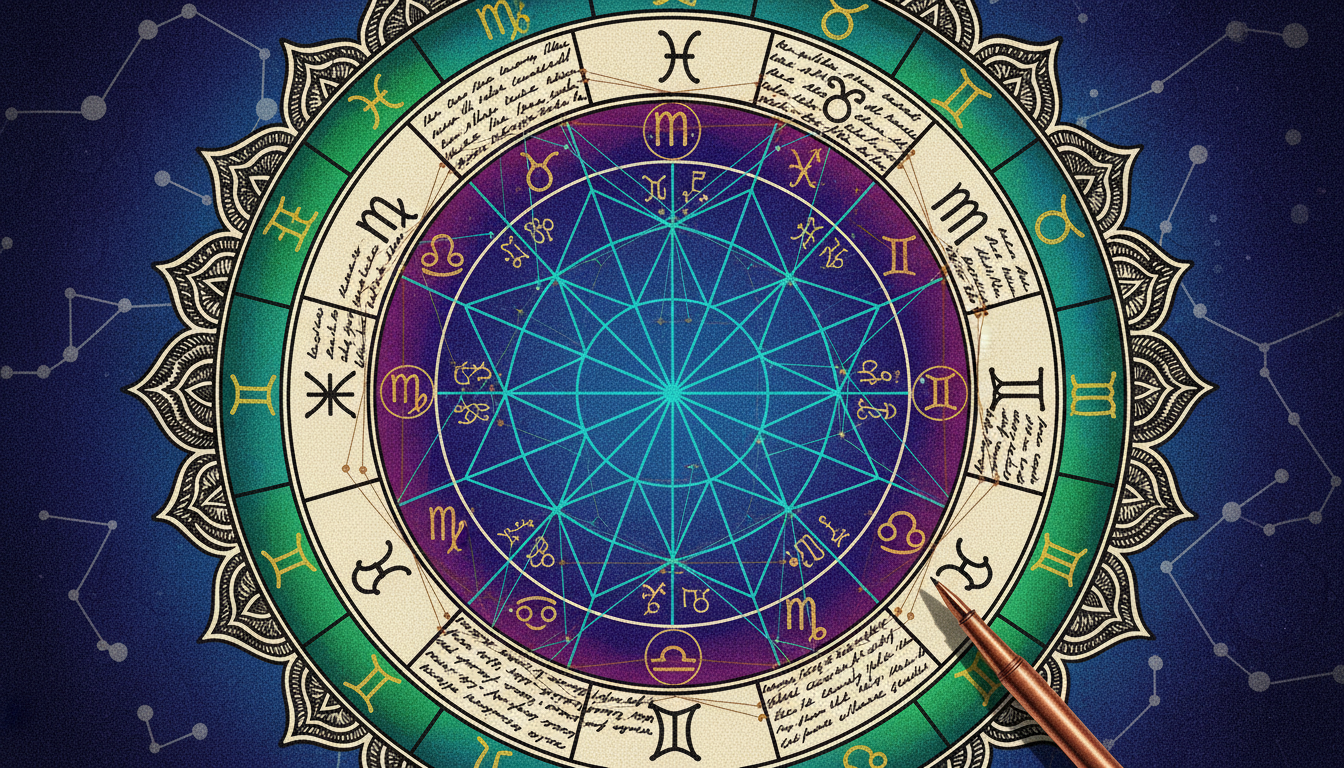
You've calculated your birth chart and you're staring at a wheel full of symbols, lines, and numbers. What now?
Astrological birth chart interpretation is where the magic happens. It's one thing to know you're a Cancer sun with Leo rising—it's another to understand what that actually means for your life, relationships, career, and personal growth.
The good news? Interpreting a birth chart is a learnable skill. You don't need to be psychic or have studied for decades. With the right framework and approach, you can start reading your own chart (and others') with real insight.
In this comprehensive guide, we'll break down exactly how to interpret an astrological birth chart step by step, from the basics to more advanced techniques. You'll learn what to look for, how to synthesize information, and how to avoid common mistakes.
What Is Astrological Birth Chart Interpretation?
Astrological birth chart interpretation is the art and science of analyzing a natal chart to understand someone's:
-
Core personality and identity
-
Emotional patterns and needs
-
Relationship styles and compatibility
-
Career strengths and life purpose
-
Challenges and growth opportunities
-
Timing of life events and cycles
A birth chart is calculated data—the positions of planets at a specific moment. Interpretation is making meaning from that data.
Think of it like this:
- Calculation = Taking a photograph
- Interpretation = Understanding what the photograph reveals
The calculation is fixed and objective. The interpretation requires skill, experience, and intuition.

Why Learn Birth Chart Interpretation?
Self-Understanding Without Filters
No personality test or quiz can match the depth of astrological insight. Your birth chart reveals patterns you may not consciously recognize about yourself.
Relationship Clarity
Understanding your Venus, Mars, and 7th house illuminates why you're attracted to certain people and what you need in partnership.
Career Direction
Your Midheaven, 10th house, and Saturn placements show your professional strengths and calling.
Timing and Cycles
Learning interpretation allows you to track transits and progressions—understanding when opportunities, challenges, and shifts will occur.
Empowerment
You're not at the mercy of generic horoscopes. You understand your unique blueprint and can work with your chart, not against it.
The Foundation: Key Components of a Birth Chart
Before interpreting, you need to understand what you're looking at. Every birth chart contains:
1. Planets (What)
The "actors" in your chart. Each planet represents a different part of you:
-
Sun: Core identity, ego, vitality
-
Moon: Emotions, instincts, needs
-
Mercury: Communication, thinking style
-
Venus: Love, values, beauty
-
Mars: Drive, sexuality, action
-
Jupiter: Growth, luck, philosophy
-
Saturn: Discipline, responsibility, lessons
-
Uranus: Innovation, rebellion, change
-
Neptune: Dreams, spirituality, illusion
-
Pluto: Transformation, power, depth
2. Signs (How)
The "costumes" planets wear. Signs color how a planet expresses itself:
-
Fire signs (Aries, Leo, Sagittarius): Bold, enthusiastic, direct
-
Earth signs (Taurus, Virgo, Capricorn): Practical, grounded, material
-
Air signs (Gemini, Libra, Aquarius): Intellectual, social, detached
-
Water signs (Cancer, Scorpio, Pisces): Emotional, intuitive, sensitive
3. Houses (Where)
The "stages" where planetary energy plays out. Houses represent life areas:
-
1st: Self, identity, appearance
-
2nd: Money, values, possessions
-
3rd: Communication, siblings, learning
-
4th: Home, family, roots
-
5th: Creativity, romance, children
-
6th: Health, work, service
-
7th: Partnerships, marriage
-
8th: Transformation, shared resources, intimacy
-
9th: Philosophy, travel, higher education
-
10th: Career, reputation, public life
-
11th: Friendships, groups, aspirations
-
12th: Spirituality, unconscious, hidden matters
4. Aspects (Relationships Between Planets)
Angles planets make to each other, creating dynamics:
-
Conjunction (0°): Fusion, intensity
-
Sextile (60°): Opportunity, ease
-
Square (90°): Tension, growth
-
Trine (120°): Flow, talent
-
Opposition (180°): Polarity, balance
Type: Educational Diagram Dimensions: 1000x800 Alt Text: Birth chart interpretation framework showing planets, signs, houses, and aspects
Description: Clean educational diagram with four quadrants explaining the core components. Top left: planets with symbols and keywords. Top right: zodiac signs grouped by element. Bottom left: house system wheel with life areas labeled. Bottom right: aspect lines with degree markers. Center: small sample chart showing all components working together. Style: Clean, modern, instructional. Color palette: White background, purple section dividers, gold planetary symbols, teal aspect lines, clear labels in dark text. Priority: High File Name: astrological-birth-chart-interpretation-components.jpg Priority: High

The Interpretation Framework: Where to Start
Interpreting a birth chart can feel overwhelming. Here's the step-by-step approach used by professional astrologers:
Step 1: The Big Three (Sun, Moon, Rising)
Start here. These three points form your core identity.
Sun Sign: Your conscious self, ego, and life force. This is who you are at your core.
Moon Sign: Your emotional nature, instincts, and needs. This is how you feel and what makes you secure.
Rising Sign (Ascendant): Your outward personality and approach to life. This is how you appear to others.
Example interpretation:
-
Sun in Scorpio: Intense, passionate, deeply emotional core
-
Moon in Gemini: Needs variety, mental stimulation, communication to feel safe
-
Virgo Rising: Appears analytical, helpful, detail-oriented to the world
Notice the complexity already. This person has deep Scorpio intensity but a light, curious Gemini emotional style and comes across as practical Virgo. That's the richness of chart interpretation.
Step 2: Personal Planets (Mercury, Venus, Mars)
These shape your daily experience and relationships.
Mercury: How you think, communicate, and process information
Venus: What you value, how you love, what brings pleasure Mars: How you take action, assert yourself, and pursue desires
Example:
-
Mercury in Sagittarius: Thinks big-picture, optimistic, direct communicator
-
Venus in Capricorn: Values loyalty and commitment, loves seriously
-
Mars in Pisces: Acts intuitively, pursues desires creatively or passively
Step 3: Social and Outer Planets (Jupiter through Pluto)
These show generational themes and deeper life patterns.
Jupiter: Where you find luck, growth, and meaning
Saturn: Where you face challenges, limitations, and build mastery Uranus, Neptune, Pluto: Generational planets, but house placement personalizes them
Step 4: House Placements
Where do these planets operate in your life?
Example:
- Sun in Scorpio in the 10th house: Intensity and power expressed through career and public life
- Moon in Gemini in the 5th house: Emotional needs met through creativity, romance, and playfulness
- Venus in Capricorn in the 12th house: Love expressed privately, values spirituality, possibly hidden relationships
House placement localizes planetary energy.
Step 5: Aspects
How do planets interact?
Harmonious aspects (trines, sextiles): Natural talents, ease Challenging aspects (squares, oppositions): Tension that drives growth
Example:
- Sun trine Jupiter: Natural optimism and confidence
- Moon square Saturn: Emotional restriction, difficulty expressing feelings, but also emotional maturity over time
- Venus opposite Mars: Tension between love and desire, passionate relationships, learning balance
Step 6: Patterns and Themes
Look for:
-
Stelliums: 3+ planets in one sign or house = major life theme
-
Element emphasis: Mostly fire? You're action-oriented. Mostly water? Emotionally driven.
-
Modality emphasis: Mostly cardinal? You initiate. Mostly fixed? You sustain. Mostly mutable? You adapt.
-
Empty houses: Not a problem. Ruled by signs, they're still active.
-
Chart shapes: Bowl, bundle, splay, etc. (advanced technique)
The Art of Synthesis: Putting It All Together
Here's where interpretation becomes art. You have dozens of pieces of information. How do you create a coherent picture?
Prioritize
Not all placements are equal. Emphasize:
-
Sun, Moon, Rising
-
Chart ruler (ruling planet of rising sign)
-
Planets in angular houses (1st, 4th, 7th, 10th)
-
Stelliums
-
Tight aspects (within 1-2 degrees)
Look for Themes
If someone has:
- Sun in Scorpio
- Mars in 8th house
- Pluto conjunct Ascendant
You're seeing a theme: intensity, power, transformation, depth. Don't interpret each separately—weave them together.
Notice Contradictions
Charts often contain contradictions. That's realistic. People are contradictory.
Example:
- Sun in Aries (bold, assertive)
- Moon in Cancer (sensitive, needs security)
This person is both courageous and cautious, independent and emotionally dependent. That inner tension is real and creates complexity.
Use Aspects as Plot
Aspects tell the story:
- Harmonious aspects: Where life flows easily
- Challenging aspects: Where growth happens through friction
Example:
- Venus (love) square Saturn (restriction): Relationships involve serious lessons, fear of rejection, but also potential for lasting commitment and mature love
Common Interpretation Mistakes to Avoid
1. Reading Placements in Isolation
Don't say "Venus in Scorpio means possessive relationships" without considering:
- What house is Venus in?
- What aspects does Venus make?
- What's the condition of Scorpio's ruler (Pluto)?
Context changes everything.
2. Being Overly Deterministic
Charts show potentials, not destinies. Someone with Saturn in the 7th isn't doomed to difficult relationships—they're called to develop maturity and commitment in partnership.
3. Ignoring House Systems
There are multiple house systems (Placidus, Whole Sign, Koch, etc.). Choose one and stick with it. Results differ slightly.
4. Overvaluing Minor Aspects and Asteroids
Master the basics before adding obscure asteroids and 30-degree aspects. Keep it simple.
5. Projecting Your Own Chart
Your Scorpio moon feels intense to you. Someone with Gemini moon experiences emotions totally differently. Don't assume your experience is universal.
Advanced Techniques in Chart Interpretation
Once you've mastered the basics, explore:
Dignity and Rulership
Planets in their home signs (e.g., Mars in Aries) or exaltation (e.g., Venus in Pisces) express easily. Planets in detriment (e.g., Mars in Libra) or fall (e.g., Sun in Libra) face challenges.
Chart Ruler
The planet ruling your rising sign is your "chart ruler" and carries extra weight.
Example:
- Sagittarius rising → Jupiter is chart ruler
- If Jupiter is in Cancer in the 8th house, this person's life path involves emotional depth, transformation, and possibly working with shared resources
Dispositorship Chains
Track the ruling planet of each placement to see how energy flows through the chart.
Midpoints
The mathematical midpoint between two planets creates a sensitive point.
Progressions and Transits
Your natal chart is a blueprint. Progressions and transits show how it evolves over time.

Interpreting Birth Charts for Others
If you're reading someone else's chart:
1. Ask Questions
Don't just tell them what you see. Ask: "Does this resonate?" "How does this show up in your life?"
2. Focus on Empowerment
Frame challenges as growth opportunities. Saturn in the 7th isn't "bad relationships"—it's "mastery through partnership."
3. Be Specific
Avoid vague statements. Instead of "You're creative," say "With Sun in the 5th and Venus trine Neptune, you express yourself creatively, possibly through art, music, or romance."
4. Respect Free Will
Charts show tendencies, not fate. Emphasize choice and agency.
Tools for Chart Interpretation
Free Resources
- Astro.com: Extended chart selection with detailed interpretations
- Cafe Astrology: Beginner-friendly chart readings
- Our Free Natal Chart Calculator: Clean, modern tool with interpretations
Books
-
The Inner Sky by Steven Forrest (evolutionary astrology)
-
The Twelve Houses by Howard Sasportas
-
Aspects in Astrology by Sue Tompkins
Software
- Solar Fire: Professional-level (Windows)
- Astro Gold: Mobile app (iOS/Android)
Key Takeaways
-
Birth chart interpretation synthesizes planets, signs, houses, and aspects
-
Start with Sun, Moon, and Rising, then build complexity
-
Context matters—don't interpret placements in isolation
-
Look for themes and patterns, not just individual pieces
-
Contradictions in charts reflect real human complexity
-
Charts show potentials, not fixed destinies
-
Interpretation improves with practice and study
Frequently Asked Questions
Q: How long does it take to learn birth chart interpretation? A: Basics can be learned in weeks. Proficiency takes months to years. Mastery is a lifelong journey. Start with your own chart and practice regularly.
Q: Can I interpret my own chart accurately? A: Yes, though it requires objectivity. We all have blind spots. Combine self-study with occasional professional readings for balance.
Q: What's the most important placement in a chart? A: There's no single "most important" placement. Sun, Moon, and Rising form the foundation, but emphasis depends on the whole chart.
Q: Do I need to know exact birth time for interpretation? A: Exact birth time is critical for houses and rising sign—about 40-50% of interpretation. Without it, you can still interpret planetary signs and aspects.
Q: Why do different astrologers interpret the same chart differently? A: Astrology is both science and art. Calculation is objective, but interpretation involves emphasis, experience, and style. Good astrologers will identify the same major themes even if wording differs.
Discover what your birth chart really means
Stop guessing. Calculate your birth chart now and get instant insights into your sun, moon, rising, and all planetary placements—free.
Related Articles: