You've probably read a horoscope—maybe this morning, maybe in a magazine at the dentist's office. A quick prediction about your day or week based on your sun sign. It might have been vague. It might have been weirdly accurate. But did it feel personal?
Here's the secret: daily horoscopes aren't actually about you. They're about one-twelfth of the population.
But a natal chart horoscope is different. It's the cosmic reading that's exclusively, intimately yours.
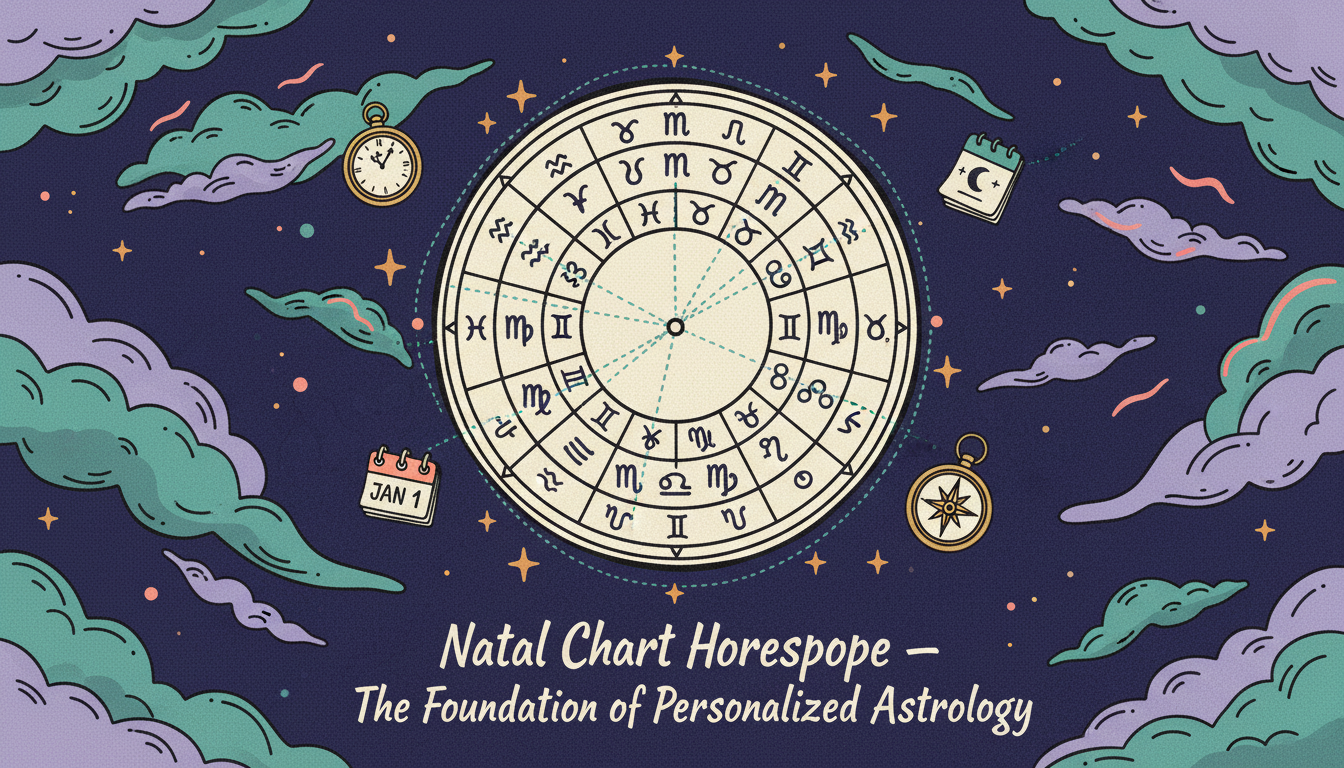
Your natal chart is the precise astronomical snapshot of where every planet, the Sun, and the Moon were positioned at the exact moment you were born. When an astrologer creates a horoscope for you—a real, personalized one—they're reading this chart. They're not just glancing at your sun sign. They're synthesizing your entire cosmic blueprint into a horoscope that explains who you are, what you're here to do, and how to navigate your life with intention.
Let's explore what a natal chart horoscope actually is, how it's created, and most importantly, how to use it as the foundation for understanding yourself at a much deeper level.
What's the Difference Between a Natal Chart and a Horoscope?
This is where people get confused, because the words get used interchangeably. But they're related but distinct concepts.
Your Natal Chart is the map. It's the astronomical data—a snapshot of the sky at your birth.
A Horoscope is the interpretation of that map. It's the story astrologers tell using your natal chart as the source material.
Think of it this way:
- Your natal chart is like a musical score.
- A horoscope is like the performance of that score—the meaning, the emotion, the way it all comes together.
When someone says "I'm getting my natal chart horoscope read," they're asking an astrologer to take their birth chart and interpret it into a personalized horoscope—a reading that explains them.

The Natal Chart as the Foundation
Your natal chart contains:
-
The Big Three: Your Sun sign (core identity), Moon sign (emotional self), and Rising sign (outer personality)
-
All Nine Planets: Mercury (communication), Venus (love and values), Mars (action and drive), Jupiter (growth and luck), Saturn (challenges and mastery), Uranus (innovation and disruption), Neptune (dreams and spirituality), Pluto (transformation and power), and Chiron (wounds and healing)
-
The 12 Houses: Life areas where planetary energies manifest (relationships, career, home, health, etc.)
-
Aspects: Angles between planets showing how they interact and influence each other
-
Special Points: North Node (soul's direction), South Node (past gifts and patterns), Midheaven (career and public image), and more
This is the raw material. Everything else in astrology—personal forecasts, relationship compatibility, timing for major decisions, understanding why you are the way you are—flows from this natal chart.
Without your natal chart, a horoscope is just a generic prediction. With it, a horoscope becomes your story.
How Your Natal Chart Creates Your Personalized Horoscope
Let's walk through how this works, because it's actually fascinating.
An astrologer doesn't wake up one morning and guess what your year will be like. Instead, they:
1. Calculate Your Natal Chart They take your birth date, exact birth time, and birth location, and they generate your birth chart. This is pure astronomy—where the planets actually were on the date and time you were born, as seen from your birthplace.
2. Identify Your Core Patterns They look at your Sun, Moon, Rising signs and other major placements. These form your psychological foundation—who you are at the deepest level. Everything in your horoscope flows from these.
3. Examine Your Houses Each of the 12 houses governs a different life area. House placements show where certain themes will play out in your life. For example, if you have many planets in your 7th house (relationships), your horoscope will emphasize partnership, marriage, and collaborations.
4. Study the Aspects Aspects are angles between planets. Some aspects create harmony (supportive relationships between planets). Others create tension (dynamic, challenging aspects). These show how your energies flow—easily or with friction.
5. Look at Transits A transit is when a current planet moves into an angle with your natal planet. Astrologers look at upcoming transits to understand the timing of your horoscope forecast. For example, if Saturn is about to transit your 10th house (career), your horoscope will reflect a major career-focused period ahead.
6. Weave It All Together A skilled astrologer synthesizes all this information into a narrative that makes sense. They're not just listing placements. They're telling your story—the cosmic narrative that explains who you are, what you're working through, and where you're heading.
That synthesis? That's your personalized horoscope. It's infinitely more detailed and accurate than "Aries: A financial opportunity arrives this week."

Why Your Natal Chart Matters for Daily Life
You might be thinking, "This is all interesting, but does it actually help me live my life better?"
Yes. Here's how:
Understanding Your Patterns
Your natal chart reveals recurring patterns in your life that you might not have noticed consciously. If you keep attracting the same relationship dynamic, your Venus (love) and Mars (desire) placements likely show why. Instead of being confused or blaming yourself, your chart gives you clarity: "Ah, that's my chart at work."
Knowing Your Strengths
Everyone has gifts and challenges in their chart. Once you know yours, you stop fighting yourself. A person with Mars in a "difficult" aspect to Saturn might struggle with motivation—but they also have incredible endurance and discipline. A person with a strong Neptune might seem flaky—but they're visionary and intuitive. Knowing your chart means playing to your actual strengths, not judging yourself by someone else's.
Timing Your Decisions
Your natal chart interacts with current planetary movements (transits). An astrologer reading your chart can say, "This is a year for taking action on your career" or "This is a year for rest and internal processing." You can align your major life decisions with these themes instead of swimming upstream.
Healing and Growth
Many people use their natal chart as a tool for therapy and growth. When you see your wounds reflected in your chart (say, Moon in a challenging aspect), you stop thinking of yourself as broken. You see it as a pattern you can consciously work with. That shift from shame to curiosity changes everything.
Relationships
Understanding your chart and your partner's chart explains so much about your dynamic. You stop thinking, "They're just difficult" and start thinking, "Their Saturn is in my Venus, which means they're cautious about showing affection—but they're also deeply loyal." You can work with the astrology instead of against it.
Getting Your Natal Chart Horoscope
You have a few paths:
1. Online Chart Generators (Free)
You can generate your chart for free on sites like astro.com or cafeastrology.com. You'll get a visual wheel showing all your placements.
The downside? A chart is just data. You still have to interpret it, which requires learning astrology. It's doable but time-consuming.
2. DIY with Resources (Free-Low Cost)
Once you have your chart, you can look up each placement and piece together your horoscope. Many books and online resources break down what each sign means in each placement.
This is rewarding if you enjoy research, but it's also easy to get overwhelmed or oversimplify. A chart reading is nuanced, and DIY approaches sometimes miss the synthesis.
3. Professional Astrologer (Moderate Cost)
An experienced astrologer will generate your chart, study it beforehand, and walk you through a personalized reading—usually 60-90 minutes. They weave all the pieces together into a coherent story that feels eerily accurate.
This is the most expensive option, but you get an expert interpretation and immediate clarity.
Type: Infographic Dimensions: 800x600 Alt Text: Natal chart horoscope creation process flow diagram Description: A visual flowchart showing how a natal chart becomes a personalized horoscope. Steps: Birth data input → Chart calculation → Pattern identification → Transit analysis → Personalized horoscope output. Use icons for each step, arrows showing the progression. Color palette: Purples, blues, golds. Style: Clean, modern, educational. Include brief text descriptions for each step.
File Name: natal-chart-horoscope-process.jpg Priority: Medium

Using Your Natal Chart Horoscope for Personal Growth
Once you have your personalized horoscope—whether from a reading or self-study—how do you actually use it?
Start With Your Big Three
Your Sun, Moon, and Rising signs form your foundation. Understand these deeply. Your Sun is your conscious identity. Your Moon is what you need emotionally. Your Rising is how you come across. These three form the core of your horoscope—everything else builds on them.
Map Your Houses
Look at which planets occupy which houses in your chart. If you have planets in your 2nd house (money and values), your horoscope will involve financial themes. If you have planets in your 8th house (intimacy and shared resources), your chart is pushing you toward deeper connections.
Work With Your Challenges
Every chart has challenging placements—aspects that create tension or require conscious work. Instead of ignoring them or seeing them as defects, work with them. They're often where your greatest growth happens.
For example, a difficult Saturn aspect might mean you struggle with self-doubt. But it also builds resilience and eventually deep confidence. That's part of your horoscope—understanding that this challenge is part of your soul's curriculum.
Track Transits
The major planets move slowly and create predictable cycles. Saturn returns happen around age 29. Uranus returns around 84 (but a Uranus opposition at 42 is significant). Jupiter returns every 12 years. When you understand these cycles, you can see why your life naturally shifts in certain ways—and you can prepare.
Journal and Reflect
Use your natal chart horoscope as a mirror for reflection. When something significant happens in your life, look back at your chart and transits. You'll often see the pattern. Over time, you develop a felt sense of how your chart is unfolding in real time.
The Truth About Natal Chart Horoscopes
Here's what matters most to understand:
Your natal chart is not your destiny. It's your weather.
Your chart shows the climate you were born into—your natural gifts, innate challenges, psychological patterns, and the kinds of experiences your soul is drawn to. But you always have free will in how you express it.
Someone with a "difficult" Saturn doesn't have a bad life. They have a life that requires discipline and builds mastery. Someone with a "lucky" Jupiter doesn't succeed without effort. They have natural enthusiasm and people support them, but they still have to show up.
A personalized horoscope reads your chart and tells you: "Here's the weather you're in. Here's how to work with it. Here's where you're going."
Your job is to read that horoscope, understand your chart, and then consciously author your own story.
Key Takeaways
-
Your natal chart is the astronomical map of your birth; a horoscope is the interpretation of that map
-
Your natal chart contains your core identity (Big Three), all nine planets, 12 houses, and aspects—the complete blueprint of your psyche
-
A personalized horoscope reads your natal chart to explain who you are, what you're working through, and where you're headed
-
You can generate your chart for free, study it yourself, or invest in a professional reading
-
Your chart shows patterns and potential, not fixed fate—you have free will in how you express it
-
Using your natal chart horoscope is a powerful tool for self-awareness, growth, and intentional decision-making

Frequently Asked Questions
Q: Do I need my exact birth time for an accurate natal chart horoscope? A: Yes. Your birth time determines your Rising sign and house placements, which are major components of your horoscope. If you're missing it, check your birth certificate or hospital records. Even being 30 minutes off can significantly change your chart.
Q: Can my natal chart horoscope predict exactly what will happen? A: No. Your chart and the transits show themes and timing, but life is co-creative. Your chart is the canvas; you're the painter. It shows potential and patterns, not fixed outcomes.
Q: Do I need to get a new horoscope reading every year? A: Your natal chart never changes, so your core horoscope remains the same. But you can get annual or lunar return readings to explore themes for the upcoming year. Many people revisit their natal chart reading every few years as they evolve in how they express their chart.
Q: My birth time is unknown. Can I still get a natal chart horoscope? A: Yes, but it will be less precise. Without your exact birth time, the houses and Rising sign will be estimated. You can work with what you have and look for your chart in the patterns of your life. Some astrologers can do chart rectification (working backward from life events to estimate your time).
Ready to discover your cosmic blueprint?
Stop reading generic horoscopes written for millions of people. Calculate your natal chart now and get the personalized horoscope that's exclusively, intimately yours. Understand your patterns. Embrace your gifts. Own your story.
Related Articles: