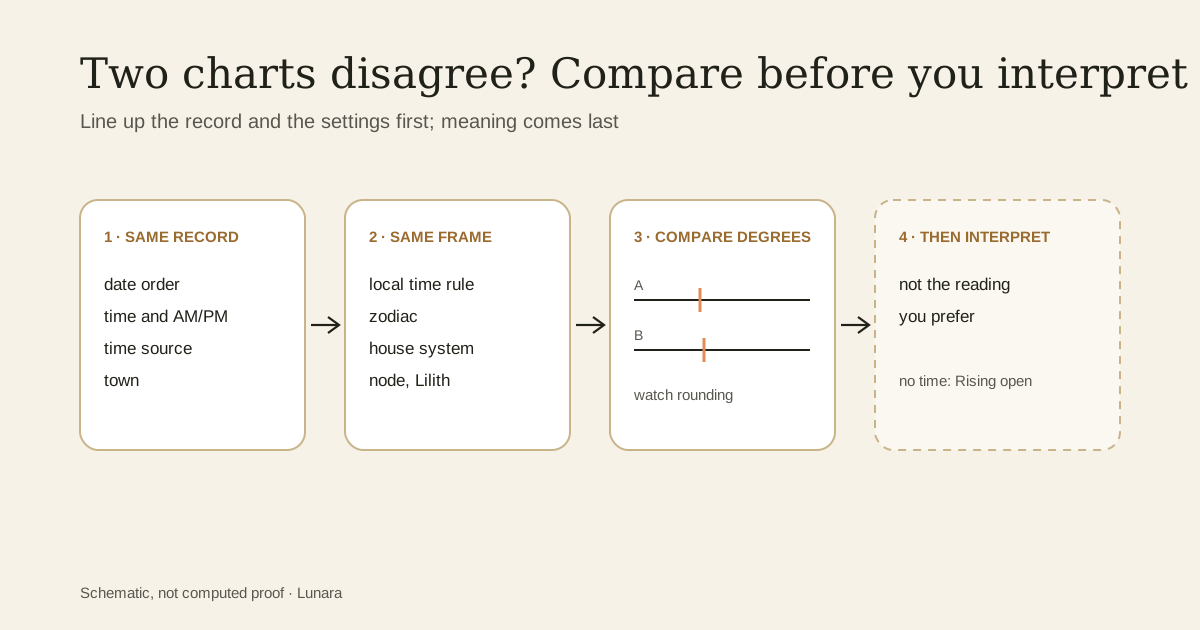
You calculated your chart on two sites and they don't agree. Maybe the Rising sign is different, or a planet sits in another house.
It's tempting to read both descriptions and keep the one that sounds more like you. Please don't. If the two charts were calculated from different inputs or settings, choosing the nicer interpretation doesn't fix that. It just hides the difference. The useful question isn't "which reading fits me?" It's "what's different about how these two charts were made?"
Most of the time, the answer is ordinary and findable.
Check in this order
Work through these with the two records side by side. Start at the top. Earlier items cause bigger differences and are easier to fix.
1. The date, and its order. Is 03/04 the 3rd of April or the 4th of March? Day-first and month-first formats are easy to swap, especially when one site is set up for a different country.
2. Noon, midnight and AM/PM. "12:00" can be entered meaning midnight when it should be noon, or the reverse. A 12-hour time can lose its AM or PM along the way. Check that both charts use the same time of day.
3. Where the time came from. Is it copied from a birth certificate or hospital record, or remembered, rounded or guessed? A guessed time can produce a chart that looks exact but isn't. If one chart uses a recorded time and the other a remembered one, that alone can explain a different Rising sign.
4. The place, and its coordinates. Did both sites pick the same town? Many places share a name. Some sites show the latitude and longitude they used; compare them if they do.
5. The local time rule. A calculator has to convert your local birth time into a universal time, using the clock rules that applied in that place on that date, including any daylight-saving time. If either chart shows the universal (UTC) time it used, compare those. If they differ while the local time is the same, the two sites applied different time rules.
6. Tropical or sidereal. Western astrology usually uses the tropical zodiac. Vedic and some other systems use a sidereal zodiac. The two label the same position in the sky with different signs, so the same horizon can be called one Rising sign in one system and another in the second.
7. The house system. Placidus, Whole Sign, Koch, Equal and others divide the chart differently. For the same moment, place and zodiac, a different house system can put a planet in a different house. On its own, it doesn't change the Ascendant degree.
8. Point definitions. The lunar node and Black Moon Lilith each have more than one definition (see below). Different definitions give different positions.
9. Rounding. One site may show degrees and minutes, another decimal degrees, another only whole degrees. A planet very close to a sign boundary can look as if it's in different signs when the real difference is just how the number was rounded.
If the birth time is missing
Without a reliable time, the Rising sign and houses can't be determined. That isn't a gap a better calculator can fill.
What not to do:
- Don't adjust a recorded time by an hour because you suspect daylight saving. The calculator's time rules handle that; changing the input usually creates the error you were trying to avoid.
- Don't apply today's time-zone offset to a historical birth. Clock rules change over the years.
- Don't decide your Rising sign by which description feels most familiar. That's a preference, not evidence.
It's fine to leave the Rising sign and houses open. The planets' signs, which usually don't depend on the exact time, are still there to explore.
Point definitions: nodes and Lilith
Two commonly listed points come in more than one version.
- The lunar node. The "true" node follows the Moon's actual, wobbling path; the "mean" node averages it out. They're usually close, but they aren't the same number, and occasionally they fall in different signs.
- Black Moon Lilith. "Mean" Lilith is the average far point of the Moon's orbit around Earth. "True" or osculating Lilith follows the orbit moment to moment. Neither is the asteroid also called Lilith.
These are conventions, not errors. Two charts using different ones aren't contradicting each other.
Lunara's settings, so you can compare like with like:
- tropical zodiac;
- Placidus houses;
- the true lunar node for the North Node shown on your chart;
- mean Black Moon Lilith (the mean lunar apogee) on our Lilith sign calculator.
A paper checklist you can copy
Write this out, or copy it into a note, and fill both columns from your two records:
- Date (day / month / year): Record A: ___ / Record B: ___
- Time and AM/PM: Record A: ___ / Record B: ___
- Source of the time (certificate, family, guess): Record A: ___ / Record B: ___
- Town chosen: Record A: ___ / Record B: ___
- Latitude and longitude shown: Record A: ___ / Record B: ___
- UTC time shown, if any: Record A: ___ / Record B: ___
- Zodiac (tropical or sidereal): Record A: ___ / Record B: ___
- House system: Record A: ___ / Record B: ___
- Node type (true or mean): Record A: ___ / Record B: ___
- Lilith type (mean or true), if shown: Record A: ___ / Record B: ___
- How degrees are displayed: Record A: ___ / Record B: ___
The first row that differs is usually your answer.
When everything matches and the charts still differ
Occasionally the inputs and settings line up and the results still don't agree. That can happen, and it's worth asking about. Contact the support team of the service you're questioning, describe which settings you checked, and let them look. Avoid concluding there's a bug from labels alone; two sites can use the same word for slightly different things.
Other astrology services publish help pages on the same question, for example CHANI's My sign or chart looks wrong page. Each service can only explain its own settings.
A note on privacy
Your full birth date, time and place identify you. Don't post your birth record, or screenshots showing your name and birth details, in public forums or comments. If you need help, share only the details that are necessary, privately, with the provider's support.
Explore further
Once you're confident in your inputs, you can calculate your free birth chart and compare it with your other record using the checklist above. Leave the time blank if you don't have a reliable one.
To see how a written reading uses a set of placements, read the sample natal reading, built from fictional birth details. There's also an optional paid personal birth chart reading, an automated reading of one person's natal chart. It can't repair a missing record or reconcile two different calculations, so sort those out first.
Text written with AI assistance. No charts were calculated for this article.