If you've ever wondered why you're drawn to certain things, why you handle emotions differently than your friends, or what your deepest strengths and challenges are, the answer lies in your birth chart.
Your birth chart is a cosmic snapshot—a map of where every planet in our solar system was positioned at the exact moment you were born. It's like an astrological fingerprint, unique to you, revealing the patterns that shape your personality, relationships, and life path.
Unlike your daily horoscope (which focuses on current planetary movements), your birth chart is fixed. It was created the moment you took your first breath and remains your personal cosmic blueprint for life.
In this guide, we'll explore what a birth chart is, what it reveals, how to get one, and how to begin interpreting this powerful tool for self-discovery and personal growth.
What Exactly Is a Birth Chart?
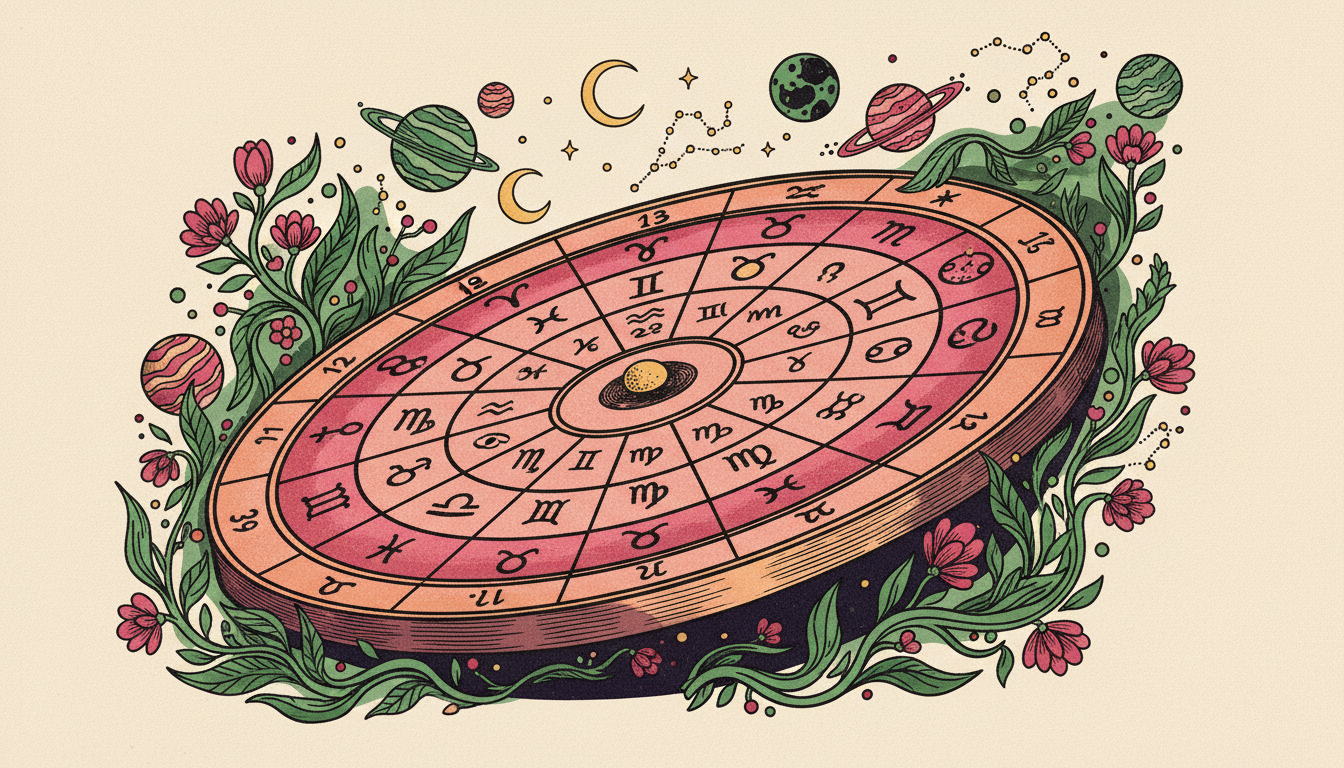
A birth chart, also called a natal chart, is a two-dimensional diagram of the sky as seen from your birthplace at the exact moment of your birth. It maps the positions of the sun, moon, planets, and other celestial points within the 12 zodiac signs and 12 houses.
Think of it this way: astrology is based on the observation that where the planets were at the moment you were born influences your personality and life themes. The birth chart is how we visualize and interpret that cosmic moment.
The chart itself is usually displayed as a wheel divided into 12 sections (houses), with zodiac signs, planetary symbols, and lines showing relationships between planets. It looks complex at first, but each component tells part of your story.
Why Your Birth Chart Matters More Than Your Sun Sign
Many people know only their sun sign—"I'm a Leo" or "I'm a Capricorn." Your sun sign is important, representing your core identity and ego. But it's only one piece of a much larger puzzle.
Your birth chart contains dozens of placements: your moon sign, rising sign, Venus sign, Mars sign, and the positions of all the outer planets. Each adds depth and nuance to your personality.
Someone might be a confident Leo sun but have a sensitive Pisces moon and a reserved Virgo rising. They'd appear more cautious and analytical than a typical Leo, even though their core identity is Leo fire. The birth chart explains these contradictions and makes sense of the complexity of being human.

The Key Components of Your Birth Chart
The Big Three: Sun, Moon, and Rising Sign
These three placements form the foundation of your personality:
Sun Sign (Your Core Identity) Your sun sign represents your essential self—your ego, willpower, and the energy you're meant to develop over your lifetime. It's the "you" that emerges as you mature and gain confidence. If astrology were a story, your sun sign is the hero's journey.
Moon Sign (Your Emotional World)
Your moon sign reveals how you process emotions, what you need to feel secure, and your subconscious patterns. While your sun sign is how you shine outward, your moon sign is your private emotional landscape. This is who you are when no one's watching.
Rising Sign / Ascendant (Your First Impression) Your rising sign is the mask you wear, your outward presentation, and the first impression you make on others. It's like the filter through which you experience the world. If people sometimes say, "You're not what I expected," it's often your rising sign surprising them after they got to know your sun sign.
The Planets
Each planet represents a different part of your psyche and areas of life:
-
Mercury: How you think, communicate, and learn. Your mental style and curiosity
-
Venus: How you love, what you value, your aesthetic preferences, and what attracts you
-
Mars: Your drive, ambition, anger, passion, and sexual energy
-
Jupiter: Expansion, luck, optimism, philosophy, and where life tends to flow easily
-
Saturn: Discipline, responsibility, limitations, and where you face your greatest challenges and eventual mastery
-
Uranus: Innovation, rebellion, sudden change, and where you break free from convention
-
Neptune: Dreams, spirituality, illusions, and transcendence
-
Pluto: Transformation, power, and deep psychological work
The 12 Houses
Your birth chart is divided into 12 houses, each representing a different area of life:
-
Self & Identity — Your appearance, personality, first impression
-
Money & Values — Resources, possessions, self-worth
-
Communication & Learning — Thinking style, short trips, siblings
-
Home & Family — Roots, parents, childhood, real estate
-
Creativity & Romance — Self-expression, love affairs, children, hobbies
-
Health & Work — Daily routine, health, service, pets
-
Partnerships & Marriage — One-on-one relationships, contracts, enemies
-
Transformation & Shared Resources — Inheritance, intimacy, psychology, death
-
Philosophy & Travel — Higher learning, long journeys, beliefs, spirituality
-
Career & Public Image — Reputation, authority, achievements, professional path
-
Friendships & Community — Groups, networks, hopes, wishes
-
Spirituality & Subconscious — Hidden things, spirituality, institutions, karmic patterns
Where your planets fall indicates where you'll experience those energies most intensely.
Aspects: How Planets Talk to Each Other
Aspects are the angles planets make to each other, showing how different parts of your personality interact. The main aspects are:
-
Conjunction (0°): Planets blend their energies—intensely focused
-
Sextile (60°): Harmonious, easy, natural opportunity
-
Square (90°): Tension and friction that drives growth
-
Trine (120°): Easy flow, natural talent, harmony
-
Opposition (180°): Polarity and balance, awareness through contrast
A chart full of trines and sextiles suggests ease and natural ability. A chart with many squares suggests you'll work hard but accomplish much. Neither is better—they just create different life experiences.

How to Get Your Birth Chart
Getting your birth chart is simple and free. You'll need three pieces of information:
What You Need
Birth Date (month, day, year) This determines your sun sign and the positions of slower-moving planets like Jupiter, Saturn, and the outer planets.
Birth Time (as exact as possible, with AM/PM)
This is crucial. Your rising sign changes approximately every two hours, and it determines your entire house system. Without accurate birth time, about 40% of your chart is incomplete or inaccurate. Even 15 minutes off can shift your rising sign.
Birth Location (city and country or coordinates) Astrology is geocentric—calculated from your specific point on Earth. The same moment looks different from New York versus Tokyo.
Where to Find Your Birth Time
If you don't know it:
-
Birth certificate — Usually the most reliable source
-
Hospital records — Contact the hospital directly
-
Baby book or family records — Parents sometimes write it down
-
Ask relatives — Someone might remember
-
Chart rectification — Advanced astrologers can estimate your time based on major life events
Getting Your Free Birth Chart
Once you have your information, visit any reputable free birth chart calculator online. Enter your data, click "Calculate," and within seconds you'll have your complete natal chart—a visual diagram with all your planetary placements, houses, and aspects.

Why Your Birth Chart Matters
Self-Understanding and Personal Growth
Your birth chart explains the parts of yourself that feel contradictory. It validates traits you might have been told to suppress. It shows why you're ambitious but also need security, why you're social but also need solitude.
Understanding your chart transforms self-judgment into self-compassion. The qualities that feel "wrong" or "difficult" are often your greatest strengths viewed from a different angle.
Relationship Insights
By understanding your moon sign and Venus sign, you learn how you give and receive love, what you need to feel safe in relationships, and what you're attracted to. Comparing your chart with a partner's chart can reveal compatibility patterns and areas where you complement each other or create friction.
Career and Purpose
Your 10th house (career), 6th house (daily work), and planets like Saturn and Midheaven point toward your natural strengths and the types of work that will feel meaningful. You might discover you're suited for careers you hadn't considered, or understand why certain work environments drain you.
Timing and Life Cycles
Once you know your birth chart, you can track current planetary transits against it. You'll see which life areas are being activated, when major decisions might be favorable, and when patience is called for. This isn't prediction—it's cosmic weather forecasting.
Compassion for Others
Understanding your own chart naturally extends to understanding others. That person who irritates you with their perfectionism? Virgo moon. The friend who's always late? Sagittarius rising. Astrology doesn't excuse difficult behavior, but it contextualizes it and builds empathy.

Beginning Your Interpretation
Looking at your birth chart for the first time can feel overwhelming. Here's where to start:
Step 1: Find Your Big Three
Locate your sun sign, moon sign, and rising sign. Read descriptions of each. These three alone will reveal profound insights into your personality.
Step 2: Explore Venus and Mars
Venus shows how you love and what you attract. Mars shows your drive and what you're passionate about. These two placements are especially important if you're curious about relationships and career.
Step 3: Look for Stelliums
A stellium is when you have three or more planets in the same sign or house. This indicates a major life focus. If you have a stellium, that area is important in your life story.
Step 4: Check Your Saturn
Saturn shows where you face challenges and do your deepest work. It's uncomfortable but ultimately where you gain mastery. Understanding your Saturn transforms struggles into growth opportunities.
Step 5: Read Your Houses
After understanding your planetary placements, read what each planet means in its house. A Venus in the 7th house is different from Venus in the 2nd house. The planet's energy meets the house's life area.
Step 6: Study Your Aspects
Look at the major aspects (conjunctions, squares, trines, oppositions) between your planets. These show how different parts of your personality interact. Do your sun and moon get along? Are your Venus and Mars in harmony? This shapes how you integrate your energies.
What a Birth Chart Doesn't Do
Important note: Your birth chart doesn't predict your future or determine your fate. It shows tendencies, strengths, challenges, and themes. You always have free will.
It's also not a personality test that puts you in a box. Every placements has shadow and light. Even "difficult" aspects (squares) drive tremendous growth.
A birth chart is a tool for self-understanding, not judgment. It's written to expand your awareness, not limit you.
Key Takeaways
-
Your birth chart is a map of planetary positions at the moment of your birth
-
It reveals your sun sign (core identity), moon sign (emotions), and rising sign (first impression)
-
You need your birth date, time, and location for an accurate chart—especially your birth time
-
Your chart shows planetary placements in houses and aspects between planets
-
Understanding your chart builds self-compassion, relationship insight, and clarity about your strengths
-
Start by exploring your Big Three, then expand to Venus, Mars, and Saturn
-
Your birth chart is a tool for self-discovery, not destiny
Frequently Asked Questions
Q: What if I don't know my birth time? A: You can still get valuable information about your sun and moon signs. But without your birth time, you'll miss your rising sign and house placements—about 40% of your chart. Try to find your birth certificate or hospital records.
Q: Can my birth chart change? A: No. Your natal chart is fixed. The planets were where they were when you were born, and that never changes. However, you evolve in how you express your chart, and current planetary transits continuously interact with your chart throughout your life.
Q: Are birth charts scientific? A: Astrology is not scientifically proven, but it's based on astronomy (the actual positions of planets) and thousands of years of observation. Whether you approach it as psychology, symbolism, or spiritual practice, a birth chart is a meaningful tool for self-reflection.
Q: Why do different websites give me different results? A: Most reputable calculators use the same astronomical data and give identical results. Differences usually come from:
- Different house systems (Placidus, Whole Sign, Equal House)
- Inclusion or exclusion of minor planets or asteroids
- Rounding variations
The core planetary placements should always be identical.
Q: How do I use my birth chart in daily life? A: Use it for self-awareness during challenging times, understanding relationship patterns, timing major decisions, and recognizing your natural strengths. Many people check transits (current planetary positions) against their natal chart regularly.
Ready to discover your cosmic blueprint?
Your birth chart holds the keys to deeper self-understanding. Stop wondering why you are the way you are, and start exploring the planetary patterns that shape your personality, relationships, and life path.
Generate your free birth chart now and begin your journey of astrological self-discovery.
Related Articles: