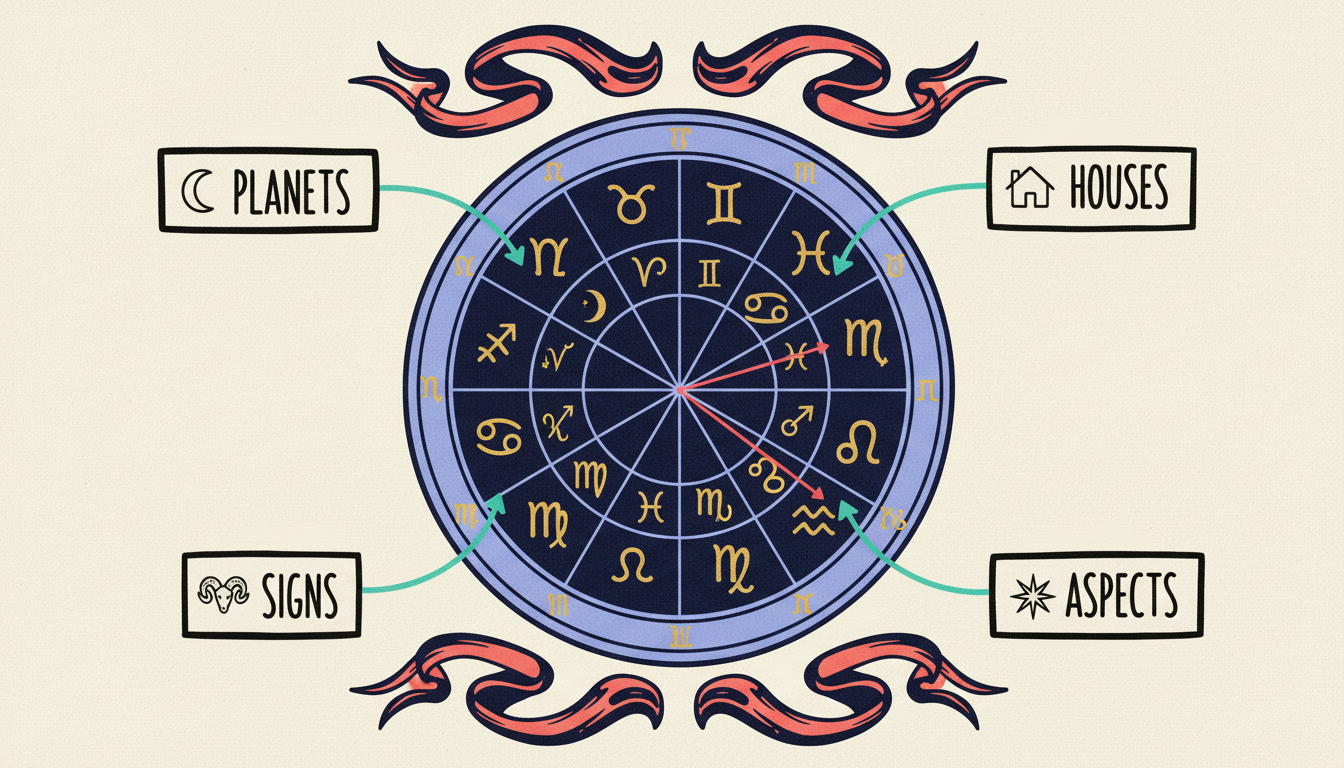
You've got your astrology chart in front of you—a wheel filled with symbols, numbers, and lines. It looks complex, maybe even intimidating. Where do you even start?
Learning how to read an astrology chart is simpler than it looks. Yes, there's depth you can explore for years, but you can gain meaningful insights from your chart today—even as a complete beginner.
An astrology chart (also called a birth chart or natal chart) is essentially a map of the sky at the moment you were born. Reading it means understanding what all those symbols represent and how they describe you—your personality, relationships, challenges, and life path.
In this guide, we'll break down exactly how to read an astrology chart step by step. By the end, you'll be able to look at any chart and extract real, practical insights.
What You're Looking at: The Basics
Before we dive into interpretation, let's identify what you're seeing when you look at an astrology chart.
The Chart Wheel
The circular diagram is divided into 12 sections, like slices of a pie. These are the houses, numbered 1 through 12, usually counterclockwise starting from the left.
Planetary Symbols
Scattered throughout the wheel are glyphs (symbols) representing the planets:
-
☉ Sun
-
☽ Moon
-
☿ Mercury
-
♀ Venus
-
♂ Mars
-
♃ Jupiter
-
♄ Saturn
-
♅ Uranus
-
♆ Neptune
-
♇ Pluto
Plus the Ascendant (AC or ASC) and Midheaven (MC), which are important points.
Zodiac Signs
Around the outer rim of the wheel, you'll see symbols for the 12 zodiac signs:
-
♈ Aries
-
♉ Taurus
-
♊ Gemini
-
♋ Cancer
-
♌ Leo
-
♍ Virgo
-
♎ Libra
-
♏ Scorpio
-
♐ Sagittarius
-
♑ Capricorn
-
♒ Aquarius
-
♓ Pisces
Aspect Lines
Lines crisscrossing the center of the chart connect planets to each other, showing their relationships (aspects). Different colors often indicate different types of aspects.
Degrees and Numbers
Small numbers next to planets show their exact position in degrees (0-29) within a sign.
Now that you know what you're looking at, let's learn how to read it.

The Four Core Components of Chart Reading
Every astrology chart reading involves understanding four key elements and how they interact:
1. Planets: The "What"
Planets represent different parts of your psyche and life experience. Each planet governs specific areas:
Personal Planets (fast-moving, unique to you):
-
Sun: Core identity, ego, vitality
-
Moon: Emotions, instincts, inner world
-
Mercury: Mind, communication, learning
-
Venus: Love, values, pleasure, beauty
-
Mars: Drive, action, sexuality, assertion
Social Planets:
- Jupiter: Growth, expansion, luck, philosophy
- Saturn: Structure, discipline, lessons, limitations
Outer Planets (slow-moving, generational):
- Uranus: Innovation, rebellion, sudden change
- Neptune: Dreams, spirituality, illusion, dissolution
- Pluto: Transformation, power, depth, regeneration
2. Signs: The "How"
The zodiac sign a planet is in describes how that planet expresses itself. Think of signs as the "flavor" or "style."
Fire Signs (Aries, Leo, Sagittarius): Bold, passionate, direct Earth Signs (Taurus, Virgo, Capricorn): Practical, grounded, material Air Signs (Gemini, Libra, Aquarius): Intellectual, social, communicative Water Signs (Cancer, Scorpio, Pisces): Emotional, intuitive, sensitive
Example: Mars in Aries is direct, aggressive, and quick to act. Mars in Pisces is indirect, intuitive, and moves with the flow.
3. Houses: The "Where"
The 12 houses represent different life areas where planetary energy operates:
-
1st House: Self, identity, appearance, how you approach life
-
2nd House: Money, possessions, values, self-worth
-
3rd House: Communication, siblings, early learning, short trips
-
4th House: Home, family, roots, emotional foundation
-
5th House: Creativity, romance, children, pleasure
-
6th House: Health, daily work, service, routines
-
7th House: Partnerships, marriage, committed relationships
-
8th House: Transformation, shared resources, intimacy, death/rebirth
-
9th House: Philosophy, higher education, long-distance travel, meaning
-
10th House: Career, public reputation, authority, life direction
-
11th House: Friendships, groups, aspirations, social causes
-
12th House: Spirituality, unconscious, secrets, solitude, endings
Example: Sun in the 10th house means your identity (Sun) is expressed through career and public life (10th house).
4. Aspects: The "Relationships"
Aspects are angles planets make to each other, creating dynamics between different parts of your personality.
Major Aspects:
-
Conjunction (0°): Planets merge, intensify each other
-
Sextile (60°): Harmonious, supportive, opportunity
-
Square (90°): Tension, conflict, growth through challenge
-
Trine (120°): Easy flow, natural talent, harmony
-
Opposition (180°): Polarity, balance, awareness through contrast
Harmonious aspects (sextiles, trines) show where life flows easily. Challenging aspects (squares, oppositions) show where you face friction—but also where growth happens.
Example: Venus square Saturn means tension between love/pleasure (Venus) and restriction/responsibility (Saturn). You might feel unworthy of love or experience relationship delays, but you also learn mature, lasting love through these challenges.
Type: Educational Infographic Dimensions: 1000x700
Alt Text: Four core components of astrology chart reading framework Description: Four-quadrant infographic. Top left: "PLANETS (What)" with planetary symbols and keywords. Top right: "SIGNS (How)" with zodiac symbols grouped by element. Bottom left: "HOUSES (Where)" with house numbers and life areas. Bottom right: "ASPECTS (Relationships)" with aspect symbols and degrees. Center: small chart showing how all four work together. Style: Clean, modern, educational. Color palette: White background, purple section dividers, gold symbols, teal accents, dark text for clarity. Priority: High File Name: how-to-read-astrology-chart-framework.jpg Priority: High

How to Read an Astrology Chart: Step-by-Step
Now let's put this into practice with a clear reading process.
Step 1: Identify the Big Three
Start with the three most important placements:
Sun Sign: Look for the ☉ symbol. What zodiac sign is it in? This is your core identity.
Moon Sign: Find the ☽ symbol. What sign is it in? This is your emotional nature.
Rising Sign (Ascendant): Look at the left horizontal line of the chart (often marked "AC" or "ASC"). What sign is there? This is your outward personality.
Example:
-
Sun in Leo: Confident, creative, seeks recognition
-
Moon in Virgo: Emotionally organized, needs order, serves others
-
Scorpio Rising: Appears intense, mysterious, powerful to others
This alone gives you a foundation for understanding the person.
Step 2: Find Mercury, Venus, and Mars
These personal planets shape daily life and relationships.
Mercury: Communication and thinking style
Venus: How you love and what you value Mars: How you take action and pursue desires
Example:
-
Mercury in Gemini: Quick thinker, versatile communicator, loves learning
-
Venus in Cancer: Nurturing in love, values emotional security
-
Mars in Capricorn: Disciplined action, ambitious, patient pursuit
Step 3: Note Which Houses These Planets Are In
Now look at where these planets sit—which house number.
Example:
- Sun in Leo in 3rd house: Identity expressed through communication, learning, siblings
- Moon in Virgo in 5th house: Emotional needs met through creativity, romance, children
- Venus in Cancer in 2nd house: Values emotional security, nurturing relates to self-worth
House placement localizes energy to specific life areas.
Step 4: Look at Jupiter and Saturn
Jupiter shows where you find luck, growth, and meaning. Saturn shows where you face challenges and build mastery.
Example:
-
Jupiter in Sagittarius in 9th house: Natural luck with travel, philosophy, higher education
-
Saturn in 7th house: Relationship challenges, but potential for committed, mature partnerships
Step 5: Identify Aspects
Look at the lines connecting planets.
Blue/green lines = harmonious (trines, sextiles) Red lines = challenging (squares, oppositions)
Example:
- Sun trine Moon: Inner harmony between identity and emotions
- Venus square Mars: Tension between love and desire; passionate but conflicted relationships
- Mercury conjunct Neptune: Imaginative thinking, possibly confusion or artistic communication
Aspects show how different parts of you interact—harmoniously or through friction.
Step 6: Look for Patterns
Now step back and notice:
-
Stelliums: 3+ planets in one sign or house = major life theme
-
Empty houses: Not a problem; they're still active
-
Element emphasis: Lots of fire? Action-oriented. Lots of water? Emotionally driven.
-
Chart ruler: The planet ruling your rising sign (extra important)
Example: If you have Sun, Mercury, and Venus all in Capricorn in the 10th house, career and public achievement are central themes in your life.

Example Chart Reading
Let's read a sample chart step by step:
Birth Data: March 15, 1990, 2:30 PM, New York, NY
Sun in Pisces (12th house): Core identity is spiritual, imaginative, compassionate. Operates behind the scenes.
Moon in Gemini (3rd house): Emotional needs met through communication, learning, variety. Restless feelings.
Virgo Rising: Appears practical, helpful, detail-oriented to the world.
Mercury in Pisces (12th house): Thinks intuitively, imaginatively. Communication may be poetic or unclear.
Venus in Aries (8th house): Loves boldly and independently. Attracted to intensity and transformation.
Mars in Aquarius (6th house): Takes action uniquely, innovatively. Energy goes toward work and service.
Key Aspect: Sun conjunct Mercury in Pisces—identity and communication are fused; thinks and speaks from intuition.
Pattern: Emphasis on 12th house (Sun, Mercury) = strong spiritual, imaginative, private nature. Virgo rising provides grounding and practicality to balance Pisces dreaminess.
Synthesis: This person is deeply spiritual and imaginative (Pisces Sun/Mercury in 12th) but appears practical and helpful (Virgo rising). They need mental stimulation and communication (Gemini Moon in 3rd) to feel emotionally safe. In relationships, they're bold and intense (Venus in Aries in 8th), and they work in innovative, service-oriented ways (Mars in Aquarius in 6th).
See how it comes together?

Common Mistakes When Reading Charts
1. Reading Only Sun Signs
Your sun sign is important, but it's maybe 20% of your chart. Moon, rising, and houses are equally critical.
2. Ignoring House Placements
A planet's sign tells you how it operates. The house tells you where. Both matter.
3. Reading Placements in Isolation
Don't just say "Venus in Scorpio = intense love." Look at what house Venus is in, what aspects it makes, and how it fits the whole chart.
4. Fearing "Bad" Placements
No placement is inherently bad. Challenging aspects (squares, oppositions) create growth. Saturn isn't punishment—it's mastery through effort.
5. Forgetting the Person's Free Will
Charts show potentials and tendencies, not fixed destinies. Two people with identical charts can live very different lives.
Tools to Help You Read Charts
Free Chart Calculators
- Our Free Natal Chart Calculator: Clean, modern, beginner-friendly
- Astro.com: Extensive, detailed options
- Cafe Astrology: Simple with helpful interpretations
Learning Resources
-
Books: The Inner Sky (Steven Forrest), The Twelve Houses (Howard Sasportas)
-
YouTube: Search "how to read birth chart" for visual tutorials
-
Apps: TimePassages, Co-Star, The Pattern (though interpretations vary)
Practice
The best way to learn? Read lots of charts:
-
Start with your own
-
Read charts of people you know well
-
Read celebrity charts
-
Take notes on patterns you notice
Chart reading is a skill built through repetition.
Key Takeaways
-
Astrology charts contain four core elements: planets (what), signs (how), houses (where), aspects (relationships)
-
Start by identifying your Big Three: Sun, Moon, Rising
-
Add personal planets: Mercury, Venus, Mars
-
Look at house placements to see where energy operates
-
Aspects show how different parts of you interact
-
Patterns and themes matter more than individual placements
-
Charts show potentials, not fixed destinies
Frequently Asked Questions
Q: How long does it take to learn to read astrology charts? A: You can start gaining insights within hours of learning the basics. Proficiency takes months. Mastery is a lifelong journey. Start simple and build gradually.
Q: Can I read my own chart accurately? A: Yes, though objectivity can be challenging. Combine self-study with occasional professional readings for blind spots.
Q: Do I need to know my exact birth time? A: For houses and rising sign—yes, exact time is critical. Without it, you can still read planetary signs and aspects, but you'll miss about 40% of the chart.
Q: Why do free calculators give different results? A: Planetary positions should match. Differences usually come from different house systems (Placidus vs. Whole Sign) or different aspects being emphasized. Core data is the same.
Q: What's the most important placement in a chart? A: There's no single "most important" placement. Sun, Moon, and Rising form your foundation, but the whole chart matters. Context and synthesis create meaning.
Start reading your astrology chart today
Stop wondering what your chart means. Calculate your free natal chart now and discover your sun, moon, rising, and complete planetary placements.
Related Articles: